Thank you for visiting SNEWPapers!
Sign up free
Editorial
September 1, 1841
Vermont Telegraph
Brandon, Rutland County, Vermont
What is this article about?
The Mercantile Journal's editor defends the practice of rejecting anonymous or inexpedient correspondent submissions, citing varied reasons, time constraints for explanations, and unwavering confidence in editorial decisions without regrets.
Clipping
OCR Quality
95%
Excellent
Full Text
To Correspondents.-
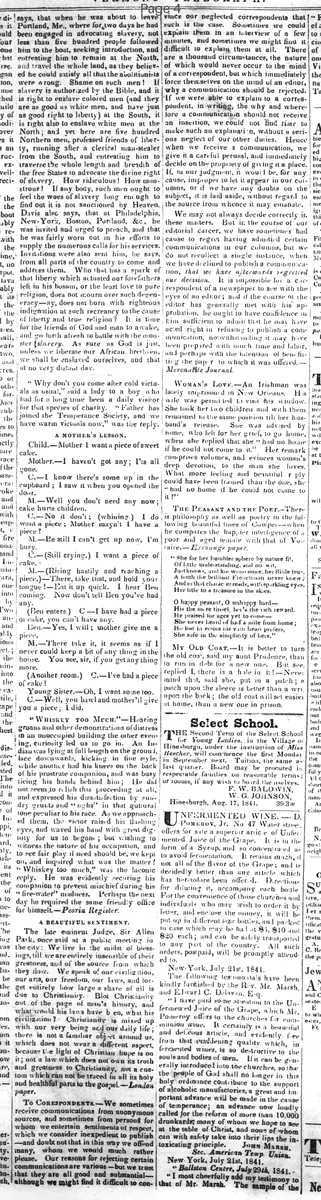
We sometimes receive communications from anonymous sources, and sometimes from persons for whom we entertain sentiments of respect, which we consider inexpedient to publish--and doubt not that in this way we offend many, whom we would much rather please. Our reasons for rejecting certain communications are various -but we trust that they are all good and substantial--although we might find it difficult to convince our neglected correspondents that such is the case. Sometimes we could explain them in an interview of a few minutes, and sometimes we might find it difficult to explain them at all. There are a thousand circumstances, the nature of which would never occur to the mind of a correspondent, but which immediately force themselves on the mind of an editor, why a communication should be rejected. If we were able to explain to a correspondent, in writing, the why and wherefore a communication should not receive an insertion, we could not find time to make such an explanation, without a serious neglect of our other duties. Hence when we receive a communication, we give it a careful perusal, and immediately decide on the propriety of giving it a place. If, in our judgment, it would be, for any cause, improper to let it appear in our columns, or if we have any doubts on the subject, it is laid aside, without regard to the source from whence it may emanate. We may not always decide correctly in these matters. But in the course of our editorial career, we have sometimes had cause to regret having admitted certain communications in our columns, but we do not recollect a single instance, when we have declined to publish a communication, that we have afterwards regretted our decision. It is impossible for a correspondent of a newspaper to see with the eyes of an editor; and if the course of the editor has generally met with his approbation, he ought to have confidence in him sufficient to admit that he may have acted right in refusing to publish a communication, notwithstanding it may have been prepared with much time and labor, and perhaps with the intention of benefiting the paper to which it was offered,--Mercantile Journal.
We sometimes receive communications from anonymous sources, and sometimes from persons for whom we entertain sentiments of respect, which we consider inexpedient to publish--and doubt not that in this way we offend many, whom we would much rather please. Our reasons for rejecting certain communications are various -but we trust that they are all good and substantial--although we might find it difficult to convince our neglected correspondents that such is the case. Sometimes we could explain them in an interview of a few minutes, and sometimes we might find it difficult to explain them at all. There are a thousand circumstances, the nature of which would never occur to the mind of a correspondent, but which immediately force themselves on the mind of an editor, why a communication should be rejected. If we were able to explain to a correspondent, in writing, the why and wherefore a communication should not receive an insertion, we could not find time to make such an explanation, without a serious neglect of our other duties. Hence when we receive a communication, we give it a careful perusal, and immediately decide on the propriety of giving it a place. If, in our judgment, it would be, for any cause, improper to let it appear in our columns, or if we have any doubts on the subject, it is laid aside, without regard to the source from whence it may emanate. We may not always decide correctly in these matters. But in the course of our editorial career, we have sometimes had cause to regret having admitted certain communications in our columns, but we do not recollect a single instance, when we have declined to publish a communication, that we have afterwards regretted our decision. It is impossible for a correspondent of a newspaper to see with the eyes of an editor; and if the course of the editor has generally met with his approbation, he ought to have confidence in him sufficient to admit that he may have acted right in refusing to publish a communication, notwithstanding it may have been prepared with much time and labor, and perhaps with the intention of benefiting the paper to which it was offered,--Mercantile Journal.
What sub-type of article is it?
Press Freedom
What keywords are associated?
Editorial Policy
Correspondents
Communications Rejection
Newspaper Editing
Press Discretion
What entities or persons were involved?
Correspondents
Editors
Mercantile Journal
Editorial Details
Primary Topic
Editorial Policy On Rejecting Communications
Stance / Tone
Defensive Justification Of Editorial Discretion
Key Figures
Correspondents
Editors
Mercantile Journal
Key Arguments
Reasons For Rejecting Communications Vary And Are Often Inexpedient To Publish
Editorial Decisions Consider Circumstances Unknown To Correspondents
Rejections Are Made Without Explanation Due To Time Constraints
Editors Have Never Regretted Declining To Publish
Correspondents Should Trust Editorial Judgment