Thank you for visiting SNEWPapers!
Sign up free
The Midland Journal
Rising Sun, Cecil County, Maryland
What is this article about?
The 20th Amendment, known as the Norris lame duck resolution, has been ratified by 12 states, shortening the presidential inauguration to January 20 and reforming congressional sessions to end lame duck periods and filibusters.
Clipping
OCR Quality
Full Text
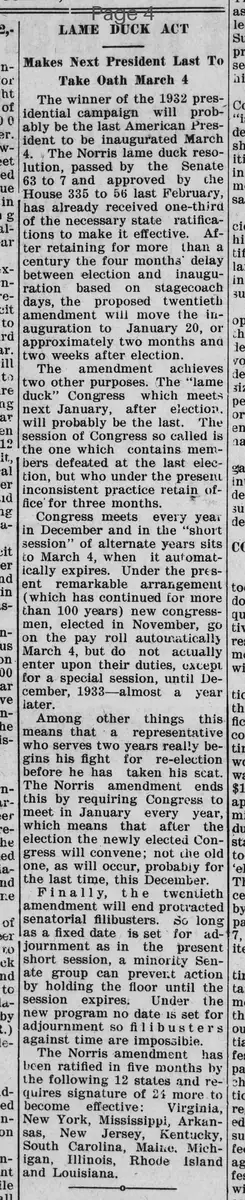
Makes Next President Last To Take Oath March 4
The winner of the 1932 presidential campaign will probably be the last American President to be inaugurated March 4. The Norris lame duck resolution, passed by the Senate 63 to 7 and approved by the House 335 to 56 last February, has already received one-third of the necessary state ratifications to make it effective. After retaining for more than a century the four months' delay between election and inauguration based on stagecoach days, the proposed twentieth amendment will move the inauguration to January 20, or approximately two months and two weeks after election.
The amendment achieves two other purposes. The "lame duck" Congress which meets next January, after election, will probably be the last. The session of Congress so called is the one which contains members defeated at the last election, but who under the present inconsistent practice retain office for three months.
Congress meets every year in December and in the "short session" of alternate years sits to March 4, when it automatically expires. Under the present remarkable arrangement (which has continued for more than 100 years) new congressmen, elected in November, go on the pay roll automatically March 4, but do not actually enter upon their duties, except for a special session, until December, 1933--almost a year later.
Among other things this means that a representative who serves two years really begins his fight for re-election before he has taken his seat.
The Norris amendment ends this by requiring Congress to meet in January every year, which means that after the election the newly elected Congress will convene; not the old one, as will occur, probably for the last time, this December.
Finally, the twentieth amendment will end protracted senatorial filibusters. So long as a fixed date is set for adjournment as in the present short session, a minority Senate group can prevent action by holding the floor until the session expires. Under the new program no date is set for adjournment so filibusters against time are impossible.
The Norris amendment has been ratified in five months by the following 12 states and requires signature of 24 more to become effective:
Virginia, New York, Mississippi, Arkansas, New Jersey, Kentucky, South Carolina, Maine, Michigan, Illinois, Rhode Island and Louisiana.
What sub-type of article is it?
What keywords are associated?
What entities or persons were involved?
Where did it happen?
Domestic News Details
Primary Location
United States
Event Date
Last February
Key Persons
Outcome
ratified by 12 states: virginia, new york, mississippi, arkansas, new jersey, kentucky, south carolina, maine, michigan, illinois, rhode island, louisiana. requires 24 more ratifications to become effective.
Event Details
The Norris lame duck resolution, passed by the Senate 63 to 7 and by the House 335 to 56 last February, has received one-third of necessary state ratifications. It proposes the twentieth amendment, moving presidential inauguration to January 20, shortening the delay between election and inauguration from four months to approximately two months and two weeks. It will likely make the winner of the 1932 presidential campaign the last to be inaugurated on March 4. The amendment also ends the 'lame duck' Congress by requiring Congress to meet in January every year, allowing newly elected members to convene after election instead of the defeated ones. Additionally, it prevents protracted senatorial filibusters by removing fixed adjournment dates.