Thank you for visiting SNEWPapers!
Sign up free
Literary
October 14, 1882
The Greenville Times
Greenville, Washington County, Mississippi
What is this article about?
Account of how Dan Emmet composed 'Dixie' in 1859 for Bryant's Minstrels in New York, its origins in circus slang, rapid popularity, publishing disputes, and adoption as a Confederate anthem during the Civil War, despite Emmet's Northern roots and poverty in later life.
Clipping
OCR Quality
95%
Excellent
Full Text
How "Dixie" Came to be Written.
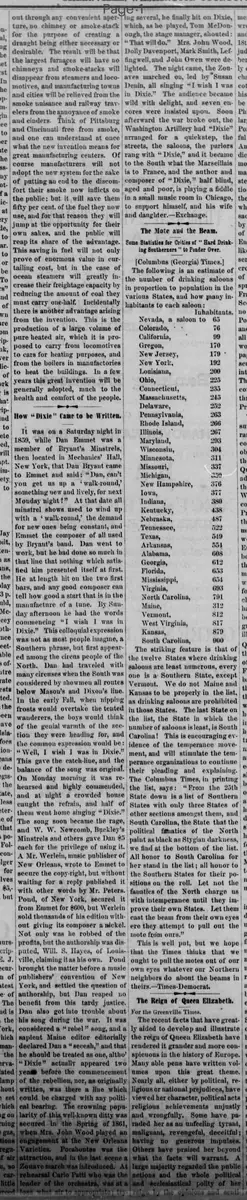
It was on a Saturday night in 1859, while Dan Emmet was a member of Bryant's Minstrels, then located in Mechanics' Hall, New York, that Dan Bryant came to Emmet and said: "Dan, can't you get us up a walk-round, something new and lively, for next Monday night?" At that date all minstrel shows used to wind up with a walk-round, the demand for new ones being constant, and Emmet the composer of all used by Bryant's band. Dan went to work, but he had done so much in that line that nothing which satisfied him presented itself at first. He at length hit on the two first bars, and any good composer can tell how good a start that is in the manufacture of a tune. By Sunday afternoon he had the words commencing "I wish I was in Dixie." This colloquial expression was not as most people imagine, a Southern phrase, but first appeared among the circus people of the North. Dan had traveled with many circuses when the South was considered by showmen all routes below Mason's and Dixon's line. In the early Fall, when nipping frosts would overtake the tented wanderers, the boys would think of the genial warmth of the section they were heading for, and the common expression would be: "Well, I wish I was in Dixie." This gave the catch-line, and the balance of the song was original. On Monday morning it was rehearsed and highly commended, and at night a crowded house caught the refrain, and half of them went home singing "Dixie." The song soon became the rage, and W. W. Newcomb, Buckley's Minstrels and others gave Dan $5 each for the privilege of using it. A Mr. Werlein, music publisher of New Orleans, wrote to Emmet to secure the copy-right, but without waiting for a reply published it with other words by Mr. Peters. Pond, of New York, secured it from Emmet for $600, but Werlein sold thousands of his edition without giving its composer a nickel. Not only was he robbed of the profits, but the authorship was disputed, Will. S. Hayes, of Louisville, claiming it as his own. Pond brought the matter before a music publishers' convention of New York, and settled the question of authorship, but Dan reaped no benefit from this tardy justice. Dan also got into trouble about his song during the war. It was considered a "rebel" song, and a sapient Maine editor editorially declared Dan a "secesh," and that he should be treated as one, altho' "Dixie" actually appeared two years before the commencement of the rebellion, nor, as originally written, was there a line which could be charged with any political bearing. The crowning popularity of this well-known ditty was secured in the Spring of 1861, when Mrs. John Wood played an engagement at the New Orleans Varieties, Pocahontas was the attraction, and in the last scene a Zouave march was introduced. At rehearsal Carlo Patti who was the leader of the orchestra, was at a loss for music, and after trying several, he finally hit on Dixie, which, as he played, Tom McDonough, the stage manager, shouted: "That will do." Mrs. John Wood, Dolly Davenport, Mark Smith, Leffingwell, and John Owen were delighted. The night came, the Zouaves marched on, led by Susan Denin, all singing "I wish I was in Dixie." The audience became wild with delight, and seven encores were insisted upon. Soon afterward the war broke out, the Washington Artillery had "Dixie" arranged for a quickstep, the streets, the saloons, the parlors rang with "Dixie," and it became to the South what the Marseillaise is to France, and the author and composer of "Dixie," half blind, aged and poor, is playing a fiddle in a small music room in Chicago, to support himself, and his wife and daughter.—Exchange.
It was on a Saturday night in 1859, while Dan Emmet was a member of Bryant's Minstrels, then located in Mechanics' Hall, New York, that Dan Bryant came to Emmet and said: "Dan, can't you get us up a walk-round, something new and lively, for next Monday night?" At that date all minstrel shows used to wind up with a walk-round, the demand for new ones being constant, and Emmet the composer of all used by Bryant's band. Dan went to work, but he had done so much in that line that nothing which satisfied him presented itself at first. He at length hit on the two first bars, and any good composer can tell how good a start that is in the manufacture of a tune. By Sunday afternoon he had the words commencing "I wish I was in Dixie." This colloquial expression was not as most people imagine, a Southern phrase, but first appeared among the circus people of the North. Dan had traveled with many circuses when the South was considered by showmen all routes below Mason's and Dixon's line. In the early Fall, when nipping frosts would overtake the tented wanderers, the boys would think of the genial warmth of the section they were heading for, and the common expression would be: "Well, I wish I was in Dixie." This gave the catch-line, and the balance of the song was original. On Monday morning it was rehearsed and highly commended, and at night a crowded house caught the refrain, and half of them went home singing "Dixie." The song soon became the rage, and W. W. Newcomb, Buckley's Minstrels and others gave Dan $5 each for the privilege of using it. A Mr. Werlein, music publisher of New Orleans, wrote to Emmet to secure the copy-right, but without waiting for a reply published it with other words by Mr. Peters. Pond, of New York, secured it from Emmet for $600, but Werlein sold thousands of his edition without giving its composer a nickel. Not only was he robbed of the profits, but the authorship was disputed, Will. S. Hayes, of Louisville, claiming it as his own. Pond brought the matter before a music publishers' convention of New York, and settled the question of authorship, but Dan reaped no benefit from this tardy justice. Dan also got into trouble about his song during the war. It was considered a "rebel" song, and a sapient Maine editor editorially declared Dan a "secesh," and that he should be treated as one, altho' "Dixie" actually appeared two years before the commencement of the rebellion, nor, as originally written, was there a line which could be charged with any political bearing. The crowning popularity of this well-known ditty was secured in the Spring of 1861, when Mrs. John Wood played an engagement at the New Orleans Varieties, Pocahontas was the attraction, and in the last scene a Zouave march was introduced. At rehearsal Carlo Patti who was the leader of the orchestra, was at a loss for music, and after trying several, he finally hit on Dixie, which, as he played, Tom McDonough, the stage manager, shouted: "That will do." Mrs. John Wood, Dolly Davenport, Mark Smith, Leffingwell, and John Owen were delighted. The night came, the Zouaves marched on, led by Susan Denin, all singing "I wish I was in Dixie." The audience became wild with delight, and seven encores were insisted upon. Soon afterward the war broke out, the Washington Artillery had "Dixie" arranged for a quickstep, the streets, the saloons, the parlors rang with "Dixie," and it became to the South what the Marseillaise is to France, and the author and composer of "Dixie," half blind, aged and poor, is playing a fiddle in a small music room in Chicago, to support himself, and his wife and daughter.—Exchange.
What sub-type of article is it?
Essay
What themes does it cover?
Political
War Peace
What keywords are associated?
Dixie Song
Dan Emmet
Bryan's Minstrels
Civil War Anthem
Minstrel Show
Song Composition
Publishing Dispute
What entities or persons were involved?
Exchange
Literary Details
Title
How "Dixie" Came To Be Written.
Author
Exchange
Form / Style
Historical Narrative
Key Lines
"Dan, Can't You Get Us Up A Walk Round, Something New And Lively, For Next Monday Night?"
"I Wish I Was In Dixie."
It Became To The South What The Marseillaise Is To France