Thank you for visiting SNEWPapers!
Sign up free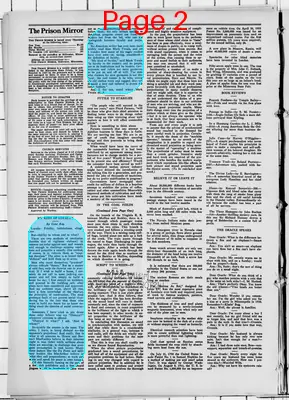
Editorial
October 24, 1935
The Prison Mirror
Stillwater, Washington County, Minnesota
What is this article about?
Editorial by Gene Kay defends true loyalty as fidelity to the country and its people, not institutions or leaders. Criticizes labeling critics as disloyal, ridicules theory opponents, and quotes Mark Twain on demanding better governance. Targets figures like Hearst, MacFadden, Du Ponts, and MacArthur.
Clipping
OCR Quality
98%
Excellent
Full Text
MY KIND OF LOYALTY
By Gene Kay
Loyalty: Fidelity, faithfulness, allegiance.
But--fidelity to whom and to what?
There are two methods of retaliation (besides that of vigilante violence) in common use today against men and women bold enough to challenge existing conditions and prescribe a remedy. One method, of course, is to ridicule them as "soap-box theorists." The other is to brand them "disloyal" and hold them up to scorn.
Men who count themselves "practical" always ridicule " theory." But as a matter of cold fact, only the theorist can be practical. If I wish to build a house, I certainly do not call in some jack-leg carpenter and tell him simply to build a house for me; I first consult an architect, and proceed to the building only after plans have been considered and approved.
And my architect must, above all else, have a firm knowledge of the theories, the principles, of construction. The most grotesque fault of our present social blundering lies in the fact that those who want to build our house for us know nothing about the theories of social construction.
Sometimes I have tried to pin down those noisy fellows who cry "Disloyal!" whenever criticism is offered.
"Disloyal to what?" I ask. "And to whom?"
Invariably the answer is the same. The critic, I learn, is being disloyal to--his opponent's prejudices! And really, that is what it all amounts to. Hearst and Bernarr MacFadden believe in their inherent right to wax richer while millions about them are starving; to challenge that arrogant presumption is rank heresy. Munitions makers like the Du Ponts and military leaders like MacArthur believe in what they call preparedness; to work and write and speak for peace is utter treason.
All this fantastic fuming on the part of a few rich publishers and a few stupid jingoes would be laughable if there were not so many unthinking people ready to follow them; the only serious menace to American progress comes not from the leaders but from the led, who can not distinguish between loyalty and prejudice.
No American writer has ever been more widely read than Mark Twain, and yet I wonder how many of his eager readers have ever seen--or, seeing, considered--his definition of loyalty.
"My kind of loyalty," said Mark Twain "is loyalty to the country and its people, not to its institutions and its leaders. Governments and rulers are mere garments, to be put on and off at will. The man who clamors for new garments is not disloyal; the real traitor is he who, seeing the old clothes worn and ragged, does not demand a new suit tailored to match the latest fashion."
And I, for one, stand where Mark Twain stood.
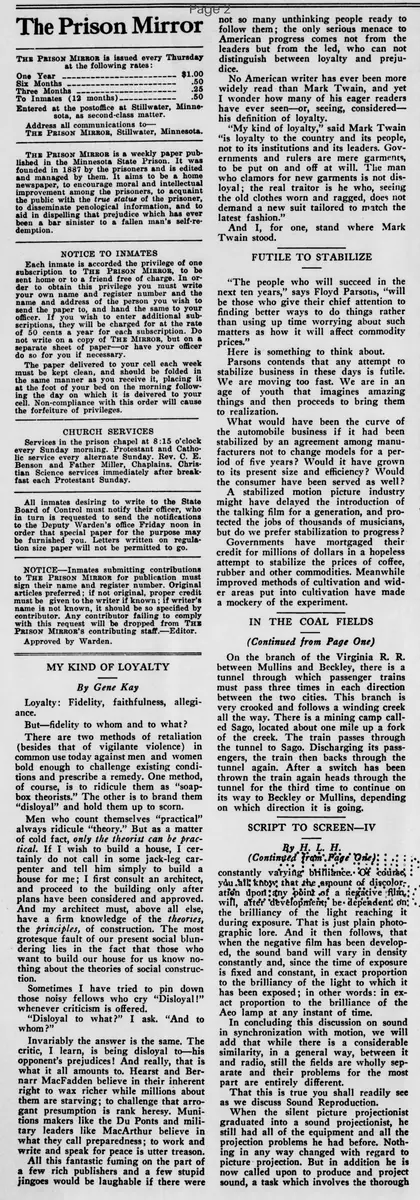
By Gene Kay
Loyalty: Fidelity, faithfulness, allegiance.
But--fidelity to whom and to what?
There are two methods of retaliation (besides that of vigilante violence) in common use today against men and women bold enough to challenge existing conditions and prescribe a remedy. One method, of course, is to ridicule them as "soap-box theorists." The other is to brand them "disloyal" and hold them up to scorn.
Men who count themselves "practical" always ridicule " theory." But as a matter of cold fact, only the theorist can be practical. If I wish to build a house, I certainly do not call in some jack-leg carpenter and tell him simply to build a house for me; I first consult an architect, and proceed to the building only after plans have been considered and approved.
And my architect must, above all else, have a firm knowledge of the theories, the principles, of construction. The most grotesque fault of our present social blundering lies in the fact that those who want to build our house for us know nothing about the theories of social construction.
Sometimes I have tried to pin down those noisy fellows who cry "Disloyal!" whenever criticism is offered.
"Disloyal to what?" I ask. "And to whom?"
Invariably the answer is the same. The critic, I learn, is being disloyal to--his opponent's prejudices! And really, that is what it all amounts to. Hearst and Bernarr MacFadden believe in their inherent right to wax richer while millions about them are starving; to challenge that arrogant presumption is rank heresy. Munitions makers like the Du Ponts and military leaders like MacArthur believe in what they call preparedness; to work and write and speak for peace is utter treason.
All this fantastic fuming on the part of a few rich publishers and a few stupid jingoes would be laughable if there were not so many unthinking people ready to follow them; the only serious menace to American progress comes not from the leaders but from the led, who can not distinguish between loyalty and prejudice.
No American writer has ever been more widely read than Mark Twain, and yet I wonder how many of his eager readers have ever seen--or, seeing, considered--his definition of loyalty.
"My kind of loyalty," said Mark Twain "is loyalty to the country and its people, not to its institutions and its leaders. Governments and rulers are mere garments, to be put on and off at will. The man who clamors for new garments is not disloyal; the real traitor is he who, seeing the old clothes worn and ragged, does not demand a new suit tailored to match the latest fashion."
And I, for one, stand where Mark Twain stood.
What sub-type of article is it?
Social Reform
War Or Peace
What keywords are associated?
Loyalty Definition
Social Criticism
Peace Advocacy
Mark Twain Quote
Institutional Critique
American Progress
What entities or persons were involved?
Gene Kay
Mark Twain
Hearst
Bernarr Macfadden
Du Ponts
Macarthur
Editorial Details
Primary Topic
Loyalty To Country And People Over Institutions And Leaders
Stance / Tone
Advocating Critical Loyalty And Peace Over Blind Allegiance
Key Figures
Gene Kay
Mark Twain
Hearst
Bernarr Macfadden
Du Ponts
Macarthur
Key Arguments
True Loyalty Is To The Country And Its People, Not Institutions Or Leaders.
Critics Of Existing Conditions Are Ridiculed As Theorists Or Branded Disloyal.
Only Theorists With Principles Can Build Practical Social Structures.
Accusations Of Disloyalty Protect Opponents' Prejudices, Like Wealth Inequality And Militarism.
Peace Advocacy Is Labeled Treason By Munitions Makers And Military Leaders.
The Real Threat Is Unthinking Followers Who Confuse Loyalty With Prejudice.
Mark Twain's View: Demand New Governance Like Changing Worn Clothes; Resistance Is True Treason.