Thank you for visiting SNEWPapers!
Sign up free
Story
November 25, 1960
The Gary American
Gary, Lake County, Indiana
What is this article about?
In 1960, federal hearings in Washington examined Louisiana's welfare laws that cut 22,500 mostly Black children from aid rolls to enforce segregation via 'suitable home' provisions. State officials revised plans to comply with federal requirements, averting potential loss of federal funds.
Clipping
OCR Quality
92%
Excellent
Full Text
NOVEMBER 25, 1960
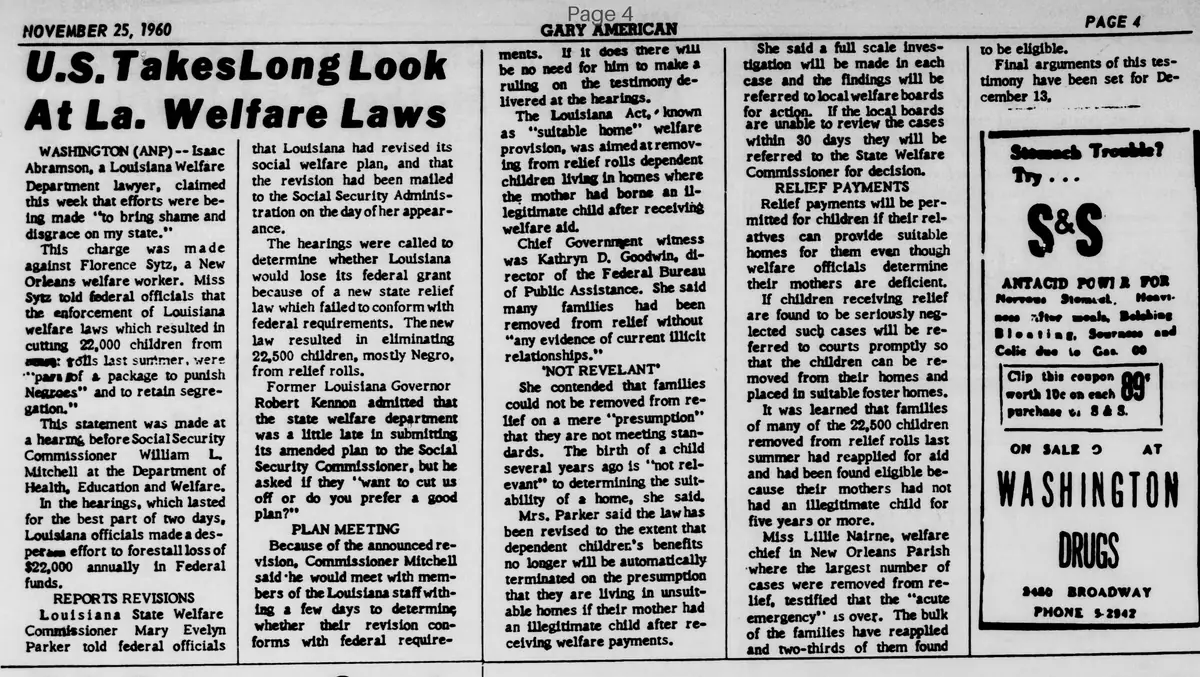
U.S. Takes Long Look At La. Welfare Laws
WASHINGTON (AP) -- Isaac Abramson, a Louisiana Welfare Department lawyer, claimed this week that efforts were being made to bring shame and disgrace on my state.
This charge was made against Florence Sytz, a New Orleans welfare worker. Miss Sytz told federal officials that the enforcement of Louisiana welfare laws which resulted in cutting 22,000 children from rolls last summer were part of a package to punish Negroes and to retain segregation.
This statement was made at a hearing before Social Security Commissioner William L. Mitchell at the Department of Health, Education and Welfare.
In the hearings, which lasted for the best part of two days, Louisiana officials made a desperate effort to forestall loss of $22,000 annually in Federal funds.
REPORTS REVISIONS
Louisiana State Welfare Commissioner Mary Evelyn Parker told federal officials that Louisiana had revised its social welfare plan, and that the revision had been mailed to the Social Security Administration on the day of her appearance.
The hearings were called to determine whether Louisiana would lose its federal grant because of a new state relief law which failed to conform with federal requirements. The new law resulted in eliminating 22,500 children, mostly Negro, from relief rolls.
Former Louisiana Governor Robert Kennon admitted that the state welfare department was a little late in submitting its amended plan to the Social Security Commissioner, but he asked if they 'want to cut us off or do you prefer a good plan?"
PLAN MEETING
Because of the announced revision, Commissioner Mitchell said he would meet with members of the Louisiana staff within a few days to determine whether their revision conforms with federal requirements.
If it does there will be no need for him to make a ruling on the testimony delivered at the hearings.
The Louisiana Act, known as "suitable home" welfare provision, was aimed at removing from relief rolls dependent children living in homes where the mother had borne an illegitimate child after receiving welfare aid.
Chief Government witness was Kathryn D. Goodwin, director of the Federal Bureau of Public Assistance. She said many families had been removed from relief without "any evidence of current illicit relationships."
'NOT RELEVANT'
She contended that families could not be removed from relief on a mere 'presumption" that they are not meeting standards. The birth of a child several years ago is "not relevant" to determining the suitability of a home, she said.
Mrs. Parker said the law has been revised to the extent that dependent children's benefits no longer will be automatically terminated on the presumption that they are living in unsuitable homes if their mother had an illegitimate child after receiving welfare payments.
She said a full scale investigation will be made in each case and the findings will be referred to local welfare boards for action. If the local boards are unable to review the cases within 30 days they will be referred to the State Welfare Commissioner for decision.
RELIEF PAYMENTS
Relief payments will be permitted for children if their relatives can provide suitable homes for them even though welfare officials determine their mothers are deficient.
If children receiving relief are found to be seriously neglected such cases will be referred to courts promptly so that the children can be removed from their homes and placed in suitable foster homes.
It was learned that families of many of the 22,500 children removed from relief rolls last summer had reapplied for aid and had been found eligible because their mothers had not had an illegitimate child for five years or more.
Miss Lillie Nairne, welfare chief in New Orleans Parish where the largest number of cases were removed from relief, testified that the "acute emergency" is over. The bulk of the families have reapplied and two-thirds of them found to be eligible.
Final arguments of this testimony have been set for December 13.
U.S. Takes Long Look At La. Welfare Laws
WASHINGTON (AP) -- Isaac Abramson, a Louisiana Welfare Department lawyer, claimed this week that efforts were being made to bring shame and disgrace on my state.
This charge was made against Florence Sytz, a New Orleans welfare worker. Miss Sytz told federal officials that the enforcement of Louisiana welfare laws which resulted in cutting 22,000 children from rolls last summer were part of a package to punish Negroes and to retain segregation.
This statement was made at a hearing before Social Security Commissioner William L. Mitchell at the Department of Health, Education and Welfare.
In the hearings, which lasted for the best part of two days, Louisiana officials made a desperate effort to forestall loss of $22,000 annually in Federal funds.
REPORTS REVISIONS
Louisiana State Welfare Commissioner Mary Evelyn Parker told federal officials that Louisiana had revised its social welfare plan, and that the revision had been mailed to the Social Security Administration on the day of her appearance.
The hearings were called to determine whether Louisiana would lose its federal grant because of a new state relief law which failed to conform with federal requirements. The new law resulted in eliminating 22,500 children, mostly Negro, from relief rolls.
Former Louisiana Governor Robert Kennon admitted that the state welfare department was a little late in submitting its amended plan to the Social Security Commissioner, but he asked if they 'want to cut us off or do you prefer a good plan?"
PLAN MEETING
Because of the announced revision, Commissioner Mitchell said he would meet with members of the Louisiana staff within a few days to determine whether their revision conforms with federal requirements.
If it does there will be no need for him to make a ruling on the testimony delivered at the hearings.
The Louisiana Act, known as "suitable home" welfare provision, was aimed at removing from relief rolls dependent children living in homes where the mother had borne an illegitimate child after receiving welfare aid.
Chief Government witness was Kathryn D. Goodwin, director of the Federal Bureau of Public Assistance. She said many families had been removed from relief without "any evidence of current illicit relationships."
'NOT RELEVANT'
She contended that families could not be removed from relief on a mere 'presumption" that they are not meeting standards. The birth of a child several years ago is "not relevant" to determining the suitability of a home, she said.
Mrs. Parker said the law has been revised to the extent that dependent children's benefits no longer will be automatically terminated on the presumption that they are living in unsuitable homes if their mother had an illegitimate child after receiving welfare payments.
She said a full scale investigation will be made in each case and the findings will be referred to local welfare boards for action. If the local boards are unable to review the cases within 30 days they will be referred to the State Welfare Commissioner for decision.
RELIEF PAYMENTS
Relief payments will be permitted for children if their relatives can provide suitable homes for them even though welfare officials determine their mothers are deficient.
If children receiving relief are found to be seriously neglected such cases will be referred to courts promptly so that the children can be removed from their homes and placed in suitable foster homes.
It was learned that families of many of the 22,500 children removed from relief rolls last summer had reapplied for aid and had been found eligible because their mothers had not had an illegitimate child for five years or more.
Miss Lillie Nairne, welfare chief in New Orleans Parish where the largest number of cases were removed from relief, testified that the "acute emergency" is over. The bulk of the families have reapplied and two-thirds of them found to be eligible.
Final arguments of this testimony have been set for December 13.
What sub-type of article is it?
Historical Event
Family Drama
What themes does it cover?
Justice
Social Manners
Misfortune
What keywords are associated?
Welfare Laws
Louisiana Segregation
Suitable Home Provision
Federal Hearings
Child Relief Cuts
Negro Families
Illegitimate Child Policy
What entities or persons were involved?
Isaac Abramson
Florence Sytz
William L. Mitchell
Mary Evelyn Parker
Robert Kennon
Kathryn D. Goodwin
Lillie Nairne
Where did it happen?
Washington, Louisiana, New Orleans
Story Details
Key Persons
Isaac Abramson
Florence Sytz
William L. Mitchell
Mary Evelyn Parker
Robert Kennon
Kathryn D. Goodwin
Lillie Nairne
Location
Washington, Louisiana, New Orleans
Event Date
November 1960
Story Details
Federal hearings investigated Louisiana's 'suitable home' welfare law that removed 22,500 mostly Black children from aid to punish for segregation. State revised plan to allow case-by-case reviews, averting federal fund loss; many families reinstated after reapplying.