Thank you for visiting SNEWPapers!
Sign up free
Letter to Editor
August 16, 1843
Morning Star
Limerick, York County, Maine
What is this article about?
A writer defends his skeptical views on Millerite prophecy interpretations, particularly the 2300 days and the little horn as Mohammedism, against critic Bro. Sanborn's accusations of sacrilege. He critiques the enthusiasm and logical fallacies in Millerism, referencing commentators like Faber and historical facts.
Clipping
OCR Quality
98%
Excellent
Full Text
MORNING STAR
For the Morning Star.
'Interpretation of Prophecy.'
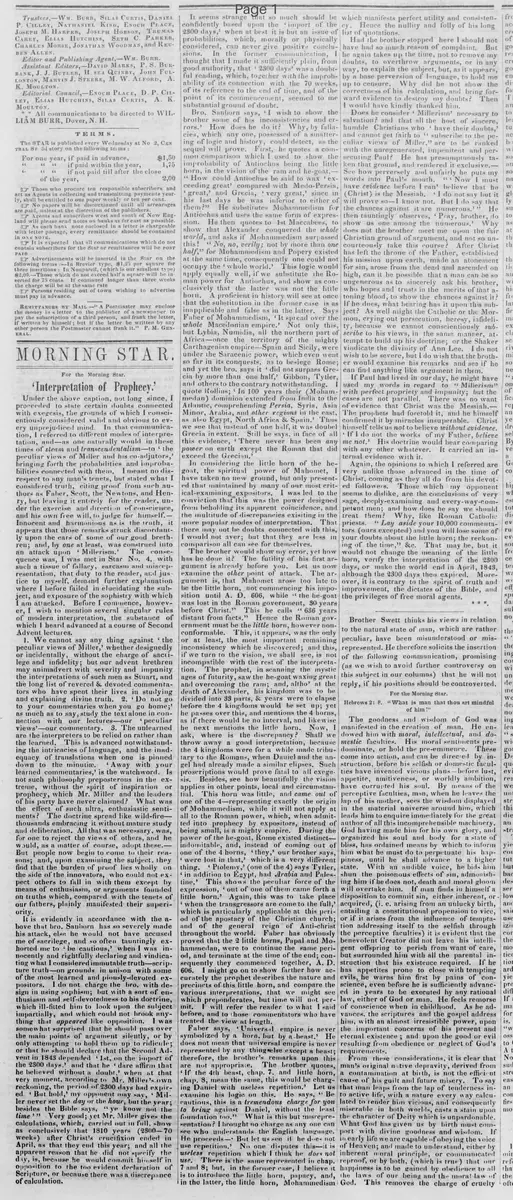
Under the above caption, not long since, I proceeded to state certain doubts connected with exegesis, the grounds of which I conscientiously considered valid and obvious to every unprejudiced mind. In that communication, I referred to different modes of interpretation, and—as one naturally would in these times of steam and transcendentalism—to 'the peculiar views of Miller and his co-adjutors, bringing forth the probabilities and improbabilities connected with them. I meant no disrespect to any man's tenets, but stated what I considered truth, citing proof from such authors as Faber, Scott, the Newtons, and Henry, but leaving it entirely for the reader, under the exercise and direction of conscience and his own free will, to judge for himself.
Innocent and harmonious as is the truth, it appears that those remarks struck discordantly upon the ears of some of our good brethren; and, by one at least, was construed into an attack upon Millerism.' The consequence was, I was met in Star No. 4, with such a tissue of fallacy, sarcasm and misrepresentation, that duty to the reader, and justice to myself, demand further explanation where I before failed in elucidating the subject. and exposure of the sophistry with which I am attacked. Before I commence, however, I wish to mention several singular rules of modern interpretation, the substance of which I heard advanced at a course of Second Advent lectures.
1. We cannot say any thing against 'the peculiar views of Miller,' whether designedly or incidentally, without the charge of sacrilege and infidelity; but our advent brethren may animadvert with severity and impunity the interpretations of such men as Stuart. and the long list of revered & devoted commentators who have spent their lives in studying and explaining divine truth. 2. Do not go to your commentaries when you go home; as much as to say, study the text alone in connection with our lectures—our 'peculiar views' our commentary. 3. The unlearned are the interpreters to be relied on rather than the learned." This is advanced notwithstanding the intricacies of language, and the inadequacy of translations when one is pinned down to the minutia. Away with your learned commentaries,' is the watchword. Is not such philosophy preposterous in the extreme, without the spirit of inspiration or prophecy, which Mr. Miller and the leaders of his party have never claimed? What was the effect of such ultra, enthusiastic sentiments? 'The doctrine spread like wild-fire—thousands embracing it without mature study and deliberation. All that was necessary, was, for one to reject the views of others, and he would, as a matter of course, adopt these.—
But people now begin to come to their reasons; and, upon examining the subject, they find that the burden of proof lies wholly on the side of the innovators, who could not expect others to fall in with them except by means of enthusiasm, or arguments founded on truths which, compared with the tenets of our fathers, plainly manifested their superiority.
It is evidently in accordance with the above that bro. Sanborn has so severely made his attack, else he would not have accused me of sacrilege, and so often tauntingly exhorted me to ' be cautious,' when I was innocently and rightfully declaring and vindicating what I considered immutable truth—scripture truth—on grounds in unison with some of the most learned and piously-devoted expositors. I do not charge the bro. with design in using sophism; but with a sort of enthusiasm and self-devotedness to his doctrine, which ill-fitted him to look upon the subject impartially, and which could not brook anything that appeared like opposition. I was somewhat surprised that he should pass over the main points of argument silently, or by only attempting to hold them up to ridicule; or that he should declare that the Second Advent in 1843 depended '1st, on the import of the 2300 days,' and that he 'dare affirm that he believed without a doubt,' when at that very moment, according to Mr. Miller's own reckoning, the period of 2300 days had expired. But hold, my opponent may say, Miller never set the day or the hour, but the year; besides the Bible says, "ye know not the time " Very good; yet Mr. Miller gives the calculations, which, carried out in full, show as conclusively that 1840 years (2300-70 weeks) after Christ's crucifixion ended in April, as that they end this year; and all the apparent reason that he did not specify the day, is, because he would commit himself in opposition to the too evident declaration of Scripture, or because there was a discrepancy of calculation.
It seems strange that so much should be confidently based upon the import of the 2300 days,' when at best it is but an issue of probabilities, which, morally or physically considered, can never give positive conclusions. In the former communication, I thought that I made it sufficiently plain, from good authority, that '2300 days' was a doubtful reading, which, together with the improbability of its connection with the 70 weeks, of its reference to the end of time, and of the point of its commencement, seemed to me substantial ground of doubt.
Bro. Sanborn says. I wish to show the brother some of his inconsistencies and errors.' How does he do it? Why, by fallacies, which any one, possessed of a smattering of logic and history, could detect, as the sequel will prove. First, he quotes a common comparison which I used to show the improbability of Antiochus being the little horn, in the vision of the ram and he-goat.— " How could Antiochus be said to wax exceeding great' compared with Medo-Persia, 'great,' and Grecia, 'very great,' since in his last days he was inferior to either of them?" He substitutes Mohammedism for Antiochus and uses the same form of expression. He then quotes to 1st Maccabees, to show that Alexander conquered the whole world, and asks if Mohammedism surpassed this! " No, no, verily; not by more than one half," for Mohammedism and Popery existed at the same time, consequently one could not occupy the 'whole world,' This logic would apply equally well, if we substitute the Roman power for Antiochus, and show as conclusively that the latter was not the little horn. A proficient in history will see at once that the substitution in the former case is as inapplicable and false as in the latter. Says Faber of Mohammedism, 'It spread over the whole Macedonian empire.' Not only this, but Lybia, Numidia, all the northern part of Africa—once the territory of the mighty Carthagenian empire—Spain and Sicily, were under the Saracenic power, which even went so far in its conquests, as to besiege Rome; and yet the bro. says it 'did not surpass Grecia by more than one half,' Gibbon, Tytler, and others to the contrary notwithstanding. I quote Rollins; 'In 100 years their (Mohammedan) dominion extended from India to the Atlantic, comprehending Persia, Syria, Asia Minor, Arabia, and other regions in the east, as also Egypt, North Africa & Spain.' Thus we see that instead of one half, it was double Grecia in extent. Still he says, in face of all this evidence, 'There never has been any power on earth except the Roman that did exceed the Grecian.'
In considering the little horn of the he-goat, the spiritual power of Mahomet, I have taken no new ground, but only presented that maintained by many of our most critical-examining expositors, I was led to the conviction that this was the power designed from beholding its apparent coincidence, and the multitude of discrepancies existing in the more popular modes of interpretation, That there may not be doubts connected with this, I would not aver; but that they are less in comparison all can see for themselves.
The brother would show my error, yet how has he done it? 'The futility of his first argument is already before you. Let us now examine the other point of attack. 'The argument is, that Mahomet arose too late to be the little horn, not commencing his imposture until A. D. 606, while the he-goat was lost in the Roman government, 30 years before Christ." This he calls " 636 years distant from facts." Hence the Roman gov. ernment must be the little horn, however non-conformable. 'This, it appears, was the only or at least, the most important remaining inconsistency which he discovered; and this, if we turn to the vision, we shall see, is not incompatible with the rest of the interpretation. The prophet, in scanning the mystic ages of futurity, saw the he-goat waxing great and overcoming the ram; and, altho' at the death of Alexander, his kingdom was to be divided into 4 parts, & years were to elapse before the 4 kingdoms would be set up; yet he passes over this, and mentions the 4 horns. as if there would be no interval, and likewise he next mentions the little horn. Now, I ask, where is the discrepancy? Shall we throw away a good interpretation, because the 4 kingdoms were for a while made tributary to the Romans, when Daniel and the angel had already made a similar ellipses. Such proscriptions would prove fatal to all exegesis. Besides, see how beautifully the vision applies in other points, local and circumstantial. 'This horn was little, and came out of one of the 4—representing exactly the origin of Mohammedism, while it will not apply at all to the Roman power, which, when admitted into prophecy by expositors, instead of being small, is a mighty empire. During the power of the he-goat, Rome existed distinct-indomitable, and, instead of coming out of one of the 4 horns, 'they,' our brother says, 'were lost in that, which is a very different thing. Ptolemy, (one of the 4) says Tytler, in addition to Egypt, had Arabia and Palestine.' This shows the peculiar force of the expression, 'out of one of them came forth a little horn.' Again, this was to take place when the transgressors are come to the full,' which is particularly applicable at this period of the apostasy of the Christian church; and of the general reign of Anti-christ throughout the world. Faber has obviously proved that the 2 little horns, Papal and Mohammedan, were to continue the same period, and terminate at the time of the end; consequently they commenced together, A. D. 606. I might go on to show farther how accurately the prophet describes the nature and precincts of this little horn, and compare the various interpretations, that we might see which preponderates, but time will not permit. I will refer the reader to what I said before, and to those commentators who have treated the view at length.
Faber says, 'Universal empire is never symbolized by a horn, but by a-beast.' He does not mean that universal empire is never represented by anything else except a beast; therefore, the brother's remarks upon this are not appropriate. The brother quotes, If the 4th beast, chap. 7. and little horn, chap. 8, mean the same, this would be charging Daniel with useless repetition.' Let us examine his logic on this. He says, " Be cautious, this is a tremendous charge for you to bring against Daniel, without the least foundation too." What is this but misrepresentation? I brought no charge as any one can see who understands the English language.
He proceeds-. But let us see if he does not use repetition.' No one disputes this—it is useless repetition which I think he does not use. There is the same represented in chap. 7 and 8; but, in the former case, I believe it is to introduce the little horn, papacy, and, in the latter, the little horn, Mohammedism which manifests perfect utility and consistency. Hence the nullity and folly of his long list of quotations.
Had the brother stopped here I should not have had so much reason of complaint. But he again takes up the time, not to remove my doubts, to overthrow arguments, or in any way, to explain the subject, but, as it appears, by a base perversion of language, to hold me up to censure. Why did he not show the correctness of his calculation, and bring forward evidence to destroy my doubts? Then I would have kindly thanked him.
Does he consider 'Millerism' necessary to salvation? and that all the host of sincere, humble Christians who have their doubts, and cannot get faith to " subscribe to the peculiar views of Miller," are to be ranked with the unregenerated, impenitent and persecuting Paul? He has presumptuously taken that ground, and rendered it exclusive.— See how perversely and unfairly he puts my words into Paul's mouth. "Now' I must have evidence before I can' believe that he (Christ is the Messiah. I do not say but it will prove so—I know not. But I do say that the chances against it are numerous.'" He then tauntingly observes, Pray, brother, do show us one among the numerous.' Why does not the brother meet me upon the fair Christian ground of argument, and not so uncourteously take this course? After Christ has left the throne of the Father. established his mission upon earth, made an atonement for sin, arose from the dead and ascended on high, can it be possible that a man can be so ungenerous as to sincerely ask his brother, who hopes and trusts in the merits of that atoning blood, to show the chances against it?
If he does, what bearing has it upon this subject? As well might the Catholic or the Mormon, crying out persecution, heresy, infidelity, because we cannot conscientiously subscribe to his views, in the same manner, attempt to build up his doctrine; or the Shaker vindicate the divinity of Ann Lee. I do not wish to be severe, but I do wish that the brother would examine his remarks and see if he can find anything like argument in them.
If Paul had lived in our day, he might have used my words in regard to " Millerism" with perfect propriety and impunity; but the cases are not parallel. There was no want of evidence that Christ was the Messiah.— The prophets had foretold it, and he himself confirmed it by miracles insuperable. Christ himself tells us not to believe without evidence. If I do not the works of my Father, believe me not.' His doctrine would bear comparing with any other whatever. It carried an internal evidence with it.
Again, the opinions to which I referred are very unlike those advanced in the time of Christ, coming as they all do from his devoted followers. Those which my opponent seems to dislike, are the conclusions of very sage, deeply-examining and every-way-competent men; and how does he say we should treat them? Why, like Roman Catholic priests. " Lay aside your 10,000 commentators (ours excepted) and you will lose some of your doubts about the little horn; the reckoning of the time," &c. That may be, but it would not change the meaning of the little horn. verify the interpretation of the 2300 days, or make the world end in April, 1843, although the 2300 days then expired. Moreover, it is contrary to the spirit of truth and improvement, the dictates of the Bible, and the privileges of free moral agents.
For the Morning Star.
'Interpretation of Prophecy.'
Under the above caption, not long since, I proceeded to state certain doubts connected with exegesis, the grounds of which I conscientiously considered valid and obvious to every unprejudiced mind. In that communication, I referred to different modes of interpretation, and—as one naturally would in these times of steam and transcendentalism—to 'the peculiar views of Miller and his co-adjutors, bringing forth the probabilities and improbabilities connected with them. I meant no disrespect to any man's tenets, but stated what I considered truth, citing proof from such authors as Faber, Scott, the Newtons, and Henry, but leaving it entirely for the reader, under the exercise and direction of conscience and his own free will, to judge for himself.
Innocent and harmonious as is the truth, it appears that those remarks struck discordantly upon the ears of some of our good brethren; and, by one at least, was construed into an attack upon Millerism.' The consequence was, I was met in Star No. 4, with such a tissue of fallacy, sarcasm and misrepresentation, that duty to the reader, and justice to myself, demand further explanation where I before failed in elucidating the subject. and exposure of the sophistry with which I am attacked. Before I commence, however, I wish to mention several singular rules of modern interpretation, the substance of which I heard advanced at a course of Second Advent lectures.
1. We cannot say any thing against 'the peculiar views of Miller,' whether designedly or incidentally, without the charge of sacrilege and infidelity; but our advent brethren may animadvert with severity and impunity the interpretations of such men as Stuart. and the long list of revered & devoted commentators who have spent their lives in studying and explaining divine truth. 2. Do not go to your commentaries when you go home; as much as to say, study the text alone in connection with our lectures—our 'peculiar views' our commentary. 3. The unlearned are the interpreters to be relied on rather than the learned." This is advanced notwithstanding the intricacies of language, and the inadequacy of translations when one is pinned down to the minutia. Away with your learned commentaries,' is the watchword. Is not such philosophy preposterous in the extreme, without the spirit of inspiration or prophecy, which Mr. Miller and the leaders of his party have never claimed? What was the effect of such ultra, enthusiastic sentiments? 'The doctrine spread like wild-fire—thousands embracing it without mature study and deliberation. All that was necessary, was, for one to reject the views of others, and he would, as a matter of course, adopt these.—
But people now begin to come to their reasons; and, upon examining the subject, they find that the burden of proof lies wholly on the side of the innovators, who could not expect others to fall in with them except by means of enthusiasm, or arguments founded on truths which, compared with the tenets of our fathers, plainly manifested their superiority.
It is evidently in accordance with the above that bro. Sanborn has so severely made his attack, else he would not have accused me of sacrilege, and so often tauntingly exhorted me to ' be cautious,' when I was innocently and rightfully declaring and vindicating what I considered immutable truth—scripture truth—on grounds in unison with some of the most learned and piously-devoted expositors. I do not charge the bro. with design in using sophism; but with a sort of enthusiasm and self-devotedness to his doctrine, which ill-fitted him to look upon the subject impartially, and which could not brook anything that appeared like opposition. I was somewhat surprised that he should pass over the main points of argument silently, or by only attempting to hold them up to ridicule; or that he should declare that the Second Advent in 1843 depended '1st, on the import of the 2300 days,' and that he 'dare affirm that he believed without a doubt,' when at that very moment, according to Mr. Miller's own reckoning, the period of 2300 days had expired. But hold, my opponent may say, Miller never set the day or the hour, but the year; besides the Bible says, "ye know not the time " Very good; yet Mr. Miller gives the calculations, which, carried out in full, show as conclusively that 1840 years (2300-70 weeks) after Christ's crucifixion ended in April, as that they end this year; and all the apparent reason that he did not specify the day, is, because he would commit himself in opposition to the too evident declaration of Scripture, or because there was a discrepancy of calculation.
It seems strange that so much should be confidently based upon the import of the 2300 days,' when at best it is but an issue of probabilities, which, morally or physically considered, can never give positive conclusions. In the former communication, I thought that I made it sufficiently plain, from good authority, that '2300 days' was a doubtful reading, which, together with the improbability of its connection with the 70 weeks, of its reference to the end of time, and of the point of its commencement, seemed to me substantial ground of doubt.
Bro. Sanborn says. I wish to show the brother some of his inconsistencies and errors.' How does he do it? Why, by fallacies, which any one, possessed of a smattering of logic and history, could detect, as the sequel will prove. First, he quotes a common comparison which I used to show the improbability of Antiochus being the little horn, in the vision of the ram and he-goat.— " How could Antiochus be said to wax exceeding great' compared with Medo-Persia, 'great,' and Grecia, 'very great,' since in his last days he was inferior to either of them?" He substitutes Mohammedism for Antiochus and uses the same form of expression. He then quotes to 1st Maccabees, to show that Alexander conquered the whole world, and asks if Mohammedism surpassed this! " No, no, verily; not by more than one half," for Mohammedism and Popery existed at the same time, consequently one could not occupy the 'whole world,' This logic would apply equally well, if we substitute the Roman power for Antiochus, and show as conclusively that the latter was not the little horn. A proficient in history will see at once that the substitution in the former case is as inapplicable and false as in the latter. Says Faber of Mohammedism, 'It spread over the whole Macedonian empire.' Not only this, but Lybia, Numidia, all the northern part of Africa—once the territory of the mighty Carthagenian empire—Spain and Sicily, were under the Saracenic power, which even went so far in its conquests, as to besiege Rome; and yet the bro. says it 'did not surpass Grecia by more than one half,' Gibbon, Tytler, and others to the contrary notwithstanding. I quote Rollins; 'In 100 years their (Mohammedan) dominion extended from India to the Atlantic, comprehending Persia, Syria, Asia Minor, Arabia, and other regions in the east, as also Egypt, North Africa & Spain.' Thus we see that instead of one half, it was double Grecia in extent. Still he says, in face of all this evidence, 'There never has been any power on earth except the Roman that did exceed the Grecian.'
In considering the little horn of the he-goat, the spiritual power of Mahomet, I have taken no new ground, but only presented that maintained by many of our most critical-examining expositors, I was led to the conviction that this was the power designed from beholding its apparent coincidence, and the multitude of discrepancies existing in the more popular modes of interpretation, That there may not be doubts connected with this, I would not aver; but that they are less in comparison all can see for themselves.
The brother would show my error, yet how has he done it? 'The futility of his first argument is already before you. Let us now examine the other point of attack. 'The argument is, that Mahomet arose too late to be the little horn, not commencing his imposture until A. D. 606, while the he-goat was lost in the Roman government, 30 years before Christ." This he calls " 636 years distant from facts." Hence the Roman gov. ernment must be the little horn, however non-conformable. 'This, it appears, was the only or at least, the most important remaining inconsistency which he discovered; and this, if we turn to the vision, we shall see, is not incompatible with the rest of the interpretation. The prophet, in scanning the mystic ages of futurity, saw the he-goat waxing great and overcoming the ram; and, altho' at the death of Alexander, his kingdom was to be divided into 4 parts, & years were to elapse before the 4 kingdoms would be set up; yet he passes over this, and mentions the 4 horns. as if there would be no interval, and likewise he next mentions the little horn. Now, I ask, where is the discrepancy? Shall we throw away a good interpretation, because the 4 kingdoms were for a while made tributary to the Romans, when Daniel and the angel had already made a similar ellipses. Such proscriptions would prove fatal to all exegesis. Besides, see how beautifully the vision applies in other points, local and circumstantial. 'This horn was little, and came out of one of the 4—representing exactly the origin of Mohammedism, while it will not apply at all to the Roman power, which, when admitted into prophecy by expositors, instead of being small, is a mighty empire. During the power of the he-goat, Rome existed distinct-indomitable, and, instead of coming out of one of the 4 horns, 'they,' our brother says, 'were lost in that, which is a very different thing. Ptolemy, (one of the 4) says Tytler, in addition to Egypt, had Arabia and Palestine.' This shows the peculiar force of the expression, 'out of one of them came forth a little horn.' Again, this was to take place when the transgressors are come to the full,' which is particularly applicable at this period of the apostasy of the Christian church; and of the general reign of Anti-christ throughout the world. Faber has obviously proved that the 2 little horns, Papal and Mohammedan, were to continue the same period, and terminate at the time of the end; consequently they commenced together, A. D. 606. I might go on to show farther how accurately the prophet describes the nature and precincts of this little horn, and compare the various interpretations, that we might see which preponderates, but time will not permit. I will refer the reader to what I said before, and to those commentators who have treated the view at length.
Faber says, 'Universal empire is never symbolized by a horn, but by a-beast.' He does not mean that universal empire is never represented by anything else except a beast; therefore, the brother's remarks upon this are not appropriate. The brother quotes, If the 4th beast, chap. 7. and little horn, chap. 8, mean the same, this would be charging Daniel with useless repetition.' Let us examine his logic on this. He says, " Be cautious, this is a tremendous charge for you to bring against Daniel, without the least foundation too." What is this but misrepresentation? I brought no charge as any one can see who understands the English language.
He proceeds-. But let us see if he does not use repetition.' No one disputes this—it is useless repetition which I think he does not use. There is the same represented in chap. 7 and 8; but, in the former case, I believe it is to introduce the little horn, papacy, and, in the latter, the little horn, Mohammedism which manifests perfect utility and consistency. Hence the nullity and folly of his long list of quotations.
Had the brother stopped here I should not have had so much reason of complaint. But he again takes up the time, not to remove my doubts, to overthrow arguments, or in any way, to explain the subject, but, as it appears, by a base perversion of language, to hold me up to censure. Why did he not show the correctness of his calculation, and bring forward evidence to destroy my doubts? Then I would have kindly thanked him.
Does he consider 'Millerism' necessary to salvation? and that all the host of sincere, humble Christians who have their doubts, and cannot get faith to " subscribe to the peculiar views of Miller," are to be ranked with the unregenerated, impenitent and persecuting Paul? He has presumptuously taken that ground, and rendered it exclusive.— See how perversely and unfairly he puts my words into Paul's mouth. "Now' I must have evidence before I can' believe that he (Christ is the Messiah. I do not say but it will prove so—I know not. But I do say that the chances against it are numerous.'" He then tauntingly observes, Pray, brother, do show us one among the numerous.' Why does not the brother meet me upon the fair Christian ground of argument, and not so uncourteously take this course? After Christ has left the throne of the Father. established his mission upon earth, made an atonement for sin, arose from the dead and ascended on high, can it be possible that a man can be so ungenerous as to sincerely ask his brother, who hopes and trusts in the merits of that atoning blood, to show the chances against it?
If he does, what bearing has it upon this subject? As well might the Catholic or the Mormon, crying out persecution, heresy, infidelity, because we cannot conscientiously subscribe to his views, in the same manner, attempt to build up his doctrine; or the Shaker vindicate the divinity of Ann Lee. I do not wish to be severe, but I do wish that the brother would examine his remarks and see if he can find anything like argument in them.
If Paul had lived in our day, he might have used my words in regard to " Millerism" with perfect propriety and impunity; but the cases are not parallel. There was no want of evidence that Christ was the Messiah.— The prophets had foretold it, and he himself confirmed it by miracles insuperable. Christ himself tells us not to believe without evidence. If I do not the works of my Father, believe me not.' His doctrine would bear comparing with any other whatever. It carried an internal evidence with it.
Again, the opinions to which I referred are very unlike those advanced in the time of Christ, coming as they all do from his devoted followers. Those which my opponent seems to dislike, are the conclusions of very sage, deeply-examining and every-way-competent men; and how does he say we should treat them? Why, like Roman Catholic priests. " Lay aside your 10,000 commentators (ours excepted) and you will lose some of your doubts about the little horn; the reckoning of the time," &c. That may be, but it would not change the meaning of the little horn. verify the interpretation of the 2300 days, or make the world end in April, 1843, although the 2300 days then expired. Moreover, it is contrary to the spirit of truth and improvement, the dictates of the Bible, and the privileges of free moral agents.
What sub-type of article is it?
Persuasive
Religious
Investigative
What themes does it cover?
Religion
What keywords are associated?
Millerism
Prophecy Interpretation
Second Advent
2300 Days
Little Horn
Mohammedism
Daniel Vision
What entities or persons were involved?
Morning Star
Letter to Editor Details
Recipient
Morning Star
Main Argument
the writer defends his doubts about millerite interpretations of biblical prophecies, such as the 2300 days and the little horn as mohammedism, against bro. sanborn's fallacious and sarcastic attacks, emphasizing reliance on learned commentators over unlearned enthusiasm.
Notable Details
References To Faber, Scott, The Newtons, Henry
Critique Of 2300 Days Calculation Ending In 1843
Little Horn As Mohammedism Starting A.D. 606
Comparison To Paul's Skepticism Before Evidence
Accusation Of Sophistry And Misrepresentation By Opponent