Thank you for visiting SNEWPapers!
Sign up free
The Delaware Gazette
Wilmington, New Castle County, Delaware
What is this article about?
Diplomatic correspondence from July 22, 1808, between Austrian Count Metternich and French Count Champagny in Paris, addressing the arrest of a Polish officer, trade complaints in Warsaw, Austrian military reforms via conscription and reserves, and rumors of war originating from French troop movements, while affirming commitment to peace.
Clipping
OCR Quality
Full Text
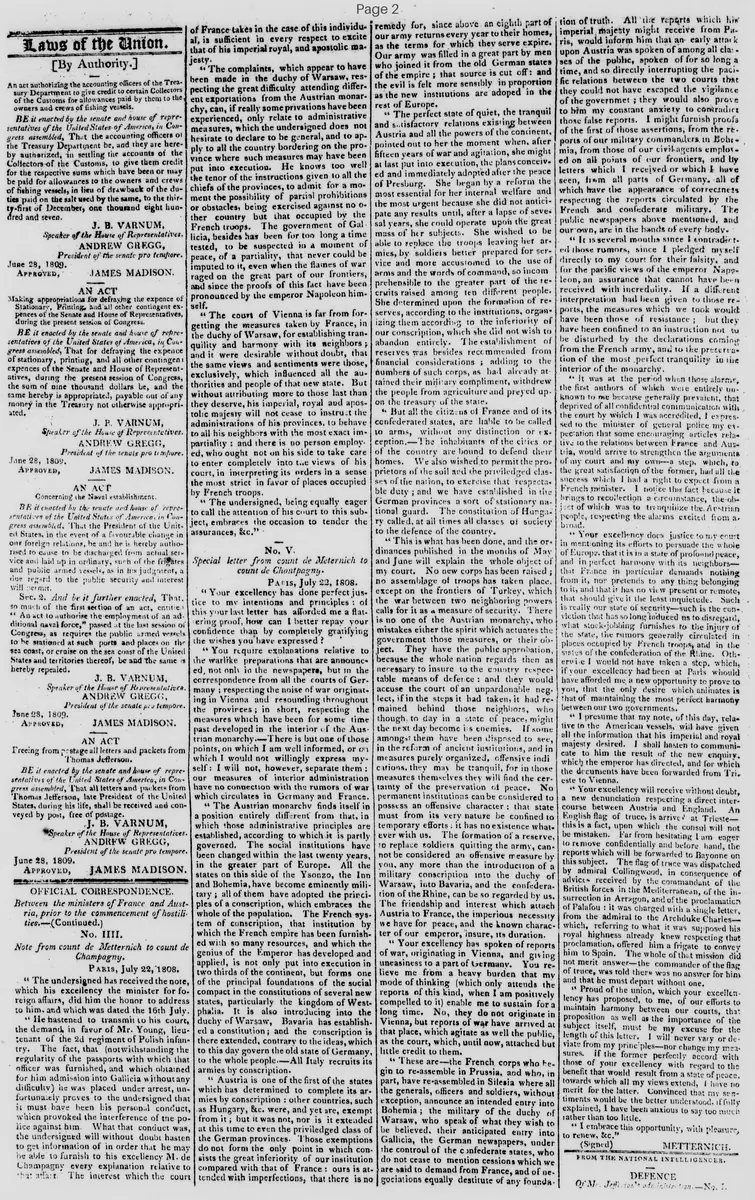
Between the ministers of France and Austria, prior to the commencement of hostilities.-(Continued.)
No. III.
Note from count de Metternich to count de Champagny
Paris, July 22, 1808.
"The undersigned has received the note, which his excellency the minister for foreign affairs, did him the honor to address to him, and which was dated the 16th July.
"He hastened to transmit to his court, the demand in favor of Mr. Young, lieutenant of the 2d regiment of Polish infantry. The fact, that (notwithstanding the regularity of the passports with which that officer was furnished, and which obtained for him admission into Gallicia without any difficulty) he was placed under arrest, unfortunately proves to the undersigned that it must have been his personal conduct, which provoked the interference of the police against him. What that conduct was, the undersigned will without doubt hasten to get information of in order that he may be able to furnish to his excellency M. de Champagny every explanation relative to his affair. The interest which the court of France takes in the case of this individual, is sufficient in every respect to excite that of his imperial royal, and apostolic majesty.
"The complaints, which appear to have been made in the duchy of Warsaw, respecting the great difficulty attending different exportations from the Austrian monarchy, can, if really some privations have been experienced, only relate to administrative measures, which the undersigned does not hesitate to declare to be general, and to apply to all the country bordering on the province where such measures may have been put into execution. He knows too well the tenor of the instructions given to all the chiefs of the provinces, to admit for a moment the possibility of partial prohibitions or obstacles, being exercised against no other country but that occupied by the French troops. The government of Gallicia, besides has been for too long a time tested, to be suspected in a moment of peace, of a partiality, that never could be imputed to it, even when the flames of war raged on the great part of our frontiers, and since the proofs of this fact have been pronounced by the emperor Napoleon himself.
"The court of Vienna is far from forgetting the measures taken by France, in the duchy of Warsaw, for establishing tranquility and harmony with its neighbors; and it were desirable without doubt, that the same views and sentiments were those, exclusively, which influenced all the authorities and people of that new state. But without attributing more to those last than they deserve, his imperial, royal and apostolic majesty will not cease to instruct the administrations of his provinces, to behave to all his neighbors with the most exact impartiality: and there is no person employed, who ought not on his side to take care to enter completely into the views of his court, in interpreting its orders in a sense the most strict in favor of places occupied by French troops.
"The undersigned, being equally eager to call the attention of his court to this subject, embraces the occasion to tender the assurances, &c."
No. V.
Special letter from count de Metternich to count de Champagny
Paris, July 22, 1808.
"Your excellency has done perfect justice to my intentions and principles: of this your last letter has afforded me a flattering proof, how can I better repay your confidence than by completely gratifying the wishes you have expressed?
"You require explanations relative to the warlike preparations that are announced, not only in the newspapers, but in the correspondence from all the courts of Germany; respecting the noise of war originating in Vienna and resounding throughout the provinces; in short, respecting the measures which have been for some time past developed in the interior of the Austrian monarchy.-There is but one of those points, on which I am well informed, or on which I would not willingly express myself: I will not, however, separate them: our measures of interior administration have no connection with the rumors of war which circulates in Germany and France.
"The Austrian monarchy finds itself in a position entirely different from that, in which those administrative principles are established, according to which it is partly governed. The social institutions have been changed within the last twenty years, in the greater part of Europe. All the states on this side of the Ysonzo, the Inn and Bohemia, have become eminently military: all of them have adopted the principles of a conscription, which embraces the whole of the population. The French system of conscription, that institution by which the French empire has been furnished with so many resources, and which the genius of the Emperor has developed and applied, is not only put into execution in two thirds of the continent, but forms one of the principal foundations of the social compact in the constitutions of several new states, particularly the kingdom of Westphalia. It is also introducing into the duchy of Warsaw, Bavaria has established a constitution; and the conscription is there extended, contrary to the ideas, which to this day govern the old state of Germany, to the whole people.--All Italy recruits its armies by conscription.
"Austria is one of the first of the states which has determined to complete its armies by conscription: other countries, such as Hungary, &c. were, and yet are, exempt from it; but it was not, nor is it extended at this time even to the privileged class of the German provinces. Those exemptions do not form the only point in which consists the great inferiority of our institution compared with that of France: ours is attended with imperfections, that there is no remedy or, since above an eighth part of our army returns every year to their homes, as the terms for which they serve expire. Our army was filled in a great part by men who joined it from the old German states of the empire: that source is cut off: and the evil is felt more sensibly in proportion as the new institutions are adopted in the rest of Europe.
"The perfect state of quiet, the tranquil and satisfactory relations existing between Austria and all the powers of the continent, pointed out to her the moment when, after fifteen years of war and agitation, she might at last put into execution, the plans conceived and immediately adopted after the peace of Presburg. She began by a reform the most essential for her internal welfare and the most urgent because she did not anticipate any results until, after a lapse of several years, she could operate upon the great mass of her subjects. She wished to be able to replace the troops leaving her armies, by soldiers better prepared for service and more accustomed to the use of arms and the words of command, so incomprehensible to the greater part of the recruits raised among ten different people. She determined upon the formation of reserves, according to the institutions, organizing them according to the inferiority of our conscription, which she did not wish to abandon entirely. The establishment of reserves was besides recommended from financial considerations; adding to the numbers of such corps, as had already attained their military complement, withdrew the people from agriculture and preyed upon the treasury of the state.
"But all the citizens of France and of its confederated states, are liable to be called to arms, without any distinction or exception.-The inhabitants of the cities or of the country are bound to defend their homes. We also wished to permit the proprietors of the soil and the privileged classes of the nation, to exercise that respectable duty: and we have established in the German provinces a sort of stationary national guard. The constitution of Hungary called, at all times all classes of society to the defence of the country.
"This is what has been done, and the ordinances published in the months of May and June will explain the whole object of my court. No new corps has been raised; no assemblage of troops has taken place, except on the frontiers of Turkey, which the war between two neighboring powers calls for it as a measure of security. There is no one of the Austrian monarchy, who mistakes either the spirit which actuates the government those measures, or their object. They have the public approbation, because the whole nation regards them as necessary to insure to the country respectable means of defence: and they would accuse the court of an unpardonable neglect, if in the steps it had taken, it had remained behind those neighbors, who though, to day in a state of peace, might the next day become its enemies. If some amongst them have been disposed to see, in the reform of ancient institutions, and in measures purely organized, offensive indications, they may be tranquil, for in those measures themselves they will find the certainty of the preservation of peace. No permanent institutions can be considered to possess an offensive character: that state must from its very nature be confined to temporary efforts: it has no existence whatever with us. The formation of a reserve, to replace soldiers quitting the army, cannot be considered an offensive measure by you, any more than the introduction of a military conscription into the duchy of Warsaw, into Bavaria, and the confederation of the Rhine, can be so regarded by us. The friendship and interest which attach Austria to France, the imperious necessity we have for peace, and the known character of our emperor, insure its duration.
"Your excellency has spoken of reports of war, originating in Vienna, and giving uneasiness to a part of Germany. You relieve me from a heavy burden that my mode of thinking (which only attends the reports of this kind, when I am positively compelled to it) enable me to sustain for a long time. No, they do not originate in Vienna, but reports of war have arrived at that place, which agitate as well the public, as the court, which, until now, attached but little credit to them.
"These are--the French corps who begin to re-assemble in Prussia, and who, in part, have re-assembled in Silesia where all the generals, officers and soldiers, without exception, announce an intended entry into Bohemia; the military of the duchy of Warsaw, who speak of what they wish to be believed, their anticipated entry into Gallicia, the German newspapers, under the controul of the confederate states, who do not cease to mention cessions which we are said to demand from France, and of negociations equally destitute of any foundation of truth. All the reports which his imperial majesty might receive from Paris, would inform him that an early attack upon Austria was spoken of among all classes of the public, spoken of for so long a time, and so directly interrupting the pacific relations between the two courts that they could not have escaped the vigilance of the government; they would also prove to him my constant anxiety to contradict those false reports. I might furnish proofs of the first of those assertions, from the reports of our military commanders in Bohemia, from those of our civil agents employed on all points of our frontiers, and by letters which I received or which I have seen, from all parts of Germany, all of which have the appearance of correctness respecting the reports circulated by the French and confederate military. The public newspapers above mentioned, and our own, are in the hands of every body.
"It is several months since I contradicted those rumors, since I pledged myself directly to my court for their falsity, and for the pacific views of the emperor Napoleon, an assurance that cannot have been received with incredulity. If a different interpretation had been given to those reports, the measures which we took would have been those of resistance; but they have been confined to an instruction not to be disturbed by the declarations coming from the French army, and to the preservation of the most perfect tranquility in the interior of the monarchy.
"It was at the period when those alarms, the first authors of which were entirely unknown to me because generally prevalent, that deprived of all confidential communication with the court by which I was accredited, I expressed to the minister of general police my expectation that some encouraging articles relative to the relations between France and Austria, would arrive to strengthen the arguments of my court and my own--a step, which, to the great satisfaction of the former, had all the success which I had a right to expect from a French minister. I notice this fact because it brings to recollection a circumstance, the object of which was to tranquilize the Austrian people, respecting the alarms excited from abroad.
"Your excellency does justice to my court in mentioning its efforts to persuade the whole of Europe, that it is in a state of profound peace, and in perfect harmony with its neighbors--that France in particular demands nothing from it, nor pretends to any thing belonging to it, and that it has no view present or remote, that should give it the least inquietude. Such is really our state of security-such is the conviction that has so long induced us to disregard, what stock-jobbing furnishes to the injury of the state, the rumors generally circulated in places occupied by French troops, and in the states of the confederation of the Rhine. Otherwise I would not have taken a step, which, if your excellency had been at Paris would have afforded me a new opportunity to prove to you, that the only desire which animates is that of maintaining the most perfect harmony between our two governments.
"I presume that my note, of this day, relative to the American vessels, will have given all the information that his imperial and royal majesty desired. I shall hasten to communicate to him the result of the new enquiry, which the emperor has directed, and for which the documents have been forwarded from Trieste to Vienna.
"Your excellency will receive without doubt, a new denunciation respecting a direct intercourse between Austria and England. An English flag of truce, is arrived at Trieste--this is a fact, upon which the consul will not be mistaken. Far from hesitating I am eager to remove confidentially and before hand, the reports which will be forwarded to Bayonne on this subject. The flag of truce was dispatched by admiral Collingwood, in consequence of advices received by the commandant of the British forces in the Mediterranean, of the insurrection in Arragon, and of the proclamation of Palafox: it was charged with a single letter, from the admiral to the Archduke Charles--which, referring to what it was supposed his royal highness already knew respecting that proclamation, offered him a frigate to convey him to Spain. The whole of that mission did not merit answer-the commander of the flag of truce, was told there was no answer for him and that he must depart without one.
"Proud of the union, which your excellency has proposed, to me, of our efforts to maintain harmony between our courts, that proposition as well as the importance of the subject itself, must be my excuse for the length of this letter. I will never vary or deviate from my principles-nor change my measures, if the former perfectly accord with those of your excellency with regard to the benefit that would result from a state of peace, towards which all my views extend, I have no merit for the latter. Convinced that my sentiments would be the better understood, if fully explained, I have been anxious to say too much rather than too little.
"I embrace this opportunity, with pleasure, to renew, &c."
(Signed)
METTERNICH.
What sub-type of article is it?
What keywords are associated?
What entities or persons were involved?
Where did it happen?
Foreign News Details
Primary Location
Paris
Event Date
July 22, 1808
Key Persons
Outcome
assurances of peace and harmony between france and austria; explanations of austrian military reforms as defensive and non-offensive; denial of war preparations; rejection of british overture via flag of truce.
Event Details
Count Metternich responds to Count Champagny's note regarding the arrest of Polish lieutenant Mr. Young in Galicia, attributing it to personal conduct, and promises explanations. He addresses trade complaints in the Duchy of Warsaw as general administrative measures, not targeted at French-occupied areas. In a special letter, Metternich explains Austrian internal military reforms, including conscription and reserves, as necessary for defense amid European changes, not preparations for war. He counters rumors of Austrian aggression by attributing them to French troop movements in Prussia, Silesia, and Warsaw, and French media reports. He affirms Austria's commitment to peace, notes efforts to contradict false alarms, and details a rejected British flag of truce offering transport to Archduke Charles amid Spanish insurrection.