Thank you for visiting SNEWPapers!
Sign up free
The Enquirer
Richmond, Henrico County, Virginia
What is this article about?
U.S. Congress proceedings on December 10, 1810: Senate handles resolutions on Pennsylvania approvals, West Florida, slave trade abuses, Bank of Potomac charter; appoints committees. House debates and adopts referrals of President's message to committees on foreign relations, West Florida, manufactures, slave trade, fortifications, navy, militia; proposes constitutional amendment barring members from civil appointments during term.
Merged-components note: Sequential coverage of congressional proceedings in the Senate and House on the same day.
Clipping
OCR Quality
Full Text
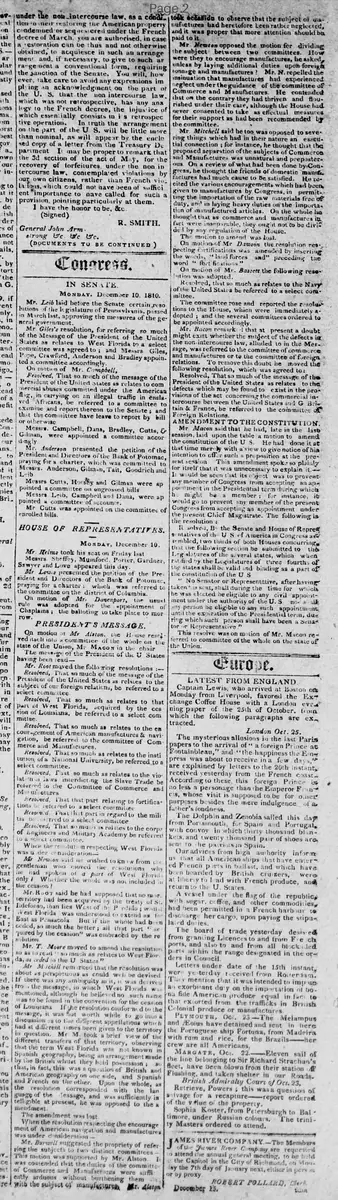
IN SENATE.
Monday, December 10, 1810.
Mr. Leib laid before the Senate certain resolutions of the legislature of Pennsylvania, passed in March last, approving the measures of the general government.
Mr Giles's resolution, for referring so much of the Message of the President of the United States as relates to West Florida to a select committee was agreed to; and Messrs Giles, Pope, Crawford, Anderson and Bradley appointed a committee accordingly.
On motion of Mr. Campbell,
Resolved, That so much of the message of the President of the United States as relates to commercial abuses committed under the American flag, in carrying on an illegal traffic in enslaved Africans, be referred to a committee to examine and report thereon to the Senate; and that the committee have leave to report by bill or otherwise
Messrs. Campbell, Dana, Bradley, Cutts, & Gilman, were appointed a committee accordingly
Mr. Anderson presented the petition of the President and Directors of the Bank of Potomac, praying for a charter, which was committed to Messrs. Anderson, Gilman, Tait, Goodrich and Leib
Messrs Cutts, Horsey and Gilman were appointed a committee on engrossed bills
Messrs Leib, Campbell and Dana, were appointed a committee of accounts.
Mr Cutts was appointed on the committee of enrolled bills.
HOUSE OF REPRESENTATIVES.
Monday, December 10.
Mr. Helms took his seat on Friday last
Messrs Sheffey, Mumford, Porter, Gardner, Sawyer and Love appeared this day.
Mr Lewis presented the petition of the President and Directors of the Bank of Potomac, praying for a charter: which was referred to the committee on the district of Columbia.
On motion of Mr. Davenport, the usual rule was adopted for the appointment of Chaplains; the balloting to take place to morrow.
PRESIDENT'S MESSAGE.
On motion of Mr Alston, the House resolved itself into a committee of the whole on the state of the Union, Mr Macon in the chair
The message of the President of the U States having been read--
Mr. Root moved the following resolutions :--
Resolved, That so much of the message of the President of the United States as relates to the subject of our foreign relations, be referred to a select committee
Resolved, That so much as relates to that part of West Florida, acquired by the cession of Louisiana, be referred to a select committee.
Resolved, That so much as relates to the encouragement of American manufactures & navigation, be referred to the committee of Commerce and Manufactures.
Resolved, That so much as relates to the institution of a National University, be referred to a select committee.
Resolved, That so much as relates to the violation of laws interdicting the Slave Trade be referred to the Committee of Commerce and Manufactures
Resolved, That that part relating to fortifications be referred to a select committee
Resolved, That that part in regard to the militia be referred to a select committee
Resolved, That so much as relates to the corps of Engineers and Military Academy be referred to a select committee.
When the resolution respecting West Florida was under consideration--
Mr Newton said he wished to know from the gentleman who moved the resolutions why he had spoken of a part of West Florida only ? Whether the whole was not included in the cession?
Mr. Root said he had supposed that no more territory had been acquired by the treaty of St. Ildefonso, than lies West of the Perdido ; whilst West Florida was understood to extend as far East as Pensacola But if the whole had been ceded, so much the better; all that part acquired by the cession" was embraced by the resolution
Mr. T. Moore moved to amend the resolution so as to read " so much as relates to West Florida, as ceded to the U States"
Mr Mitchell remarked that the resolution was about as perspicuous as could well be devised If there was any ambiguity in it, it was derived from the message, in which West Florida was mentioned, although he believed no such name was to be found in the convention for the cession of Louisiana If the resolution conformed to the message, it was not worth while to go into a discussion as to the different appellations which had at different times been given to the territory in question. Mr M. took a brief view of the different transfers of that territory, observing that the term West Florida was not known in Spanish geography, being an arrangement made by the British whilst they held possession; so that, in fact, this was a question of British and American geography on one side, and Spanish and French on the other. Upon the whole, as the resolution corresponded with the language of the message, and was sufficiently intelligible at present, he was opposed to the amendment.
The amendment was lost
When the resolution respecting the encouragement of American navigation and manufactures was under consideration--
Mr. Burwell suggested the propriety of referring the subjects to two distinct committees--
This motion was supported by Mr. Alston. It was contended that the duties of the committee of Commerce and Manufactures were sufficiently arduous without burthening them with the subject of manufactures
Mr Newton opposed the motion for dividing the subject between two committees. How were they to encourage manufactures, he asked, unless by laying additional duties upon foreign tonnage and manufactures? Mr. N. repelled the insinuation that manufactures had experienced neglect under the guidance of the committee of Commerce and Manufactures. He contended that on the contrary they had thriven and flourished under their care, although the House had never consented to take as effectual measures for their support as had been recommended by the committee.
Mr Mitchell said he too was opposed to severing things which had in their nature an essential connection ; for instance, he thought that the proposed separation of the subjects of Commerce and Manufactures was unnatural and preposterous. On a review of what had been done by Congress, he thought the friends of domestic manufactures had much cause to be satisfied. He recited the various encouragements which had been given to manufactures by Congress, in permitting the importation of the raw materials free of duty, and in laying heavy duties on the importation of manufactured articles. On the whole he thought that as commerce and manufactures in fact were inseparable, they ought not to be divided by any regulation of the House.
The motion to amend was lost.
On motion of Mr Dawson the resolution respecting fortifications was amended by inserting the words, "land forces and" preceding the word "fortifications."
On motion of Mr. Bassett the following resolution was adopted.
Resolved, that so much as relates to the Navy of the United States be referred to a select committee.
The committee rose and reported the resolutions to the House, which were immediately adopted; and the several committees ordered to be appointed accordingly.
Mr. Bacon remarked that at present a doubt might exist whether the subject of the defects in the non-intercourse law, alluded to in the Message, was referred to the committee of commerce and manufactures or to the committee of foreign relations. To remove this doubt he moved the following resolution, which was agreed to:
Resolved, That so much of the message of the President of the United States as relates to the defects which may be found to exist in the provisions of the act concerning the commercial intercourse between the United States and G Britain & France, be referred to the committee of Foreign Relations.
AMENDMENT TO THE CONSTITUTION.
Mr Macon said that he had, late in the last session, laid upon the table a motion to amend the constitution of the U S. He had done it at that time merely with a view to give notice of his intention to offer such a proposition at the present session This amendment spoke so plainly for itself that it was unnecessary to explain it. It would be seen that its object was to prevent any member of Congress from accepting an appointment in the Presidential term during which he might be a member; for instance, it would go to prevent any member of the present Congress from accepting an appointment under the present Chief Magistrate. The following is the resolution :
Resolved, By the Senate and House of Representatives of the U S of America in Congress assembled, two thirds of both Houses concurring that the following section be submitted to the Legislatures of the several states, which when ratified by the Legislatures of three fourths of the states shall be valid and binding as a part of the constitution of the U S
"No Senator or Representative, after having taken his seat, shall during the time for which he was elected be eligible to any civil appointment under the authority of the U. S no. shall any person be eligible to any such appointment until the expiration of the Presidential term, during which such person shall have been a senator or Representative"
What sub-type of article is it?
What keywords are associated?
What entities or persons were involved?
Domestic News Details
Event Date
Monday, December 10, 1810
Key Persons
Event Details
Senate proceedings include presenting Pennsylvania resolutions approving government measures, referring President's message sections on West Florida and slave trade abuses to committees, petition for Bank of Potomac charter, and committee appointments. House proceedings feature new members taking seats, Bank of Potomac petition referral, chaplain appointment rule, debates and adoptions of resolutions referring President's message to various committees on foreign relations, West Florida, manufactures and navigation, national university, slave trade, fortifications, militia, engineers, navy, and non-intercourse law defects; proposal for constitutional amendment barring congressional members from civil appointments during their term.