Thank you for visiting SNEWPapers!
Sign up free
Editorial
June 24, 1811
Portland Gazette, And Maine Advertiser
Portland, Cumberland County, Maine
What is this article about?
Editorial exhorts ministers to warn of national perils like sin and war, praises Dr. Parish's uncontroverted Fast Day sermon, notes Europe's conflicts approaching America, quotes Milton on threats, critiques unequal U.S. frigate President vs. British sloop engagement per Connecticut Mirror, questions strategy, suspects diversion from French affairs under Madison.
Clipping
OCR Quality
88%
Good
Full Text
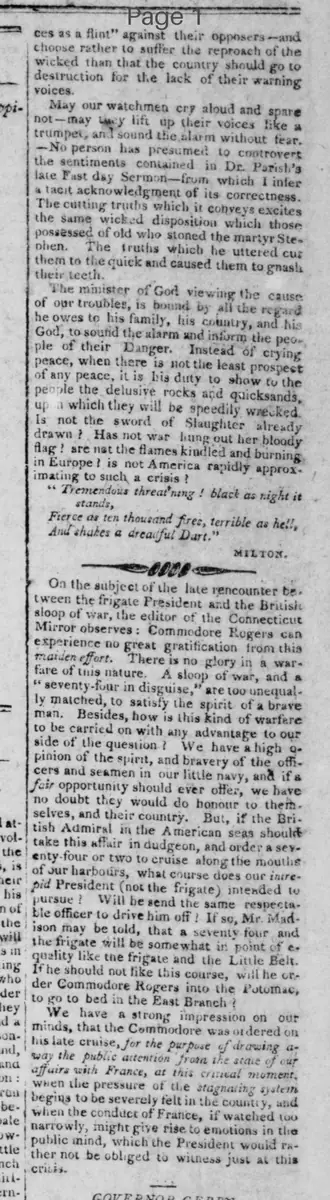
ces as a flint" against their opposers—and
choose rather to suffer the reproach of the
wicked than that the country should go to
destruction for the lack of their warning
voices.
May our watchmen cry aloud and spare
not—may they lift up their voices like a
trumpet, and sound the alarm without fear.
—No person has presumed to controvert
the sentiments contained in Dr. Parish's
late Fast day Sermon—from which I infer
a tacit acknowledgment of its correctness.
The cutting truths which it conveys excites
the same wicked disposition which those
possessed of old who stoned the martyr Ste-
ohen. The truths which he uttered cut
them to the quick and caused them to gnash
their teeth.
The minister of God viewing the cause
of our troubles, is bound by all the regard
he owes to his family, his country, and his
God, to sound the alarm and inform the peo-
ple of their Danger. Instead of crying
peace, when there is not the least prospect
of any peace, it is his duty to show to the
people the delusive rocks and quicksands.
upon which they will be speedily wrecked.
Is not the sword of Slaughter already
drawn? Has not war hung out her bloody
flag! are not the flames kindled and burning
in Europe? is not America rapidly approx-
imating to such a crisis?
"Tremendous threatening! black as night it
stands,
Fierce as ten thousand fires, terrible as hell,
And shakes a dreadful Dart."
MILTON.
On the subject of the late rencounter be-
tween the frigate President and the British
sloop of war, the editor of the Connecticut
Mirror observes: Commodore Rogers can
experience no great gratification from this
maiden effort. There is no glory in a war-
fare of this nature. A sloop of war, and a
"seventy-four in disguise," are too unequal-
ly matched, to satisfy the spirit of a brave
man. Besides, how is this kind of warfare
to be carried on with any advantage to our
side of the question? We have a high o-
pinion of the spirit, and bravery of the off-
cers and seamen in our little navy, and if a
fair opportunity should ever offer, we have
no doubt they would do honour to them-
selves, and their country. But, if the Bri-
tish Admiral in the American seas should
take this affair in dudgeon, and order a sev-
enty-four or two to cruise along the mouths
of our harbours, what course does our intre-
pid President (not the frigate) intend to
pursue? Will he send the same respecta-
ble officer to drive him off: If so. Mr. Mad-
ison may be told, that a seventy four and
the frigate will be somewhat in point of e-
quality like the frigate and the Little Belt.
If he should not like this course, will he or-
der Commodore Rogers into the Potomac,
to go to bed in the East Branch?
We have a strong impression on our
minds, that the Commodore was ordered on
his late cruise, for the purpose of drawing a-
way the public attention from the state of our
affairs with France, at this critical moment.
when the pressure of the stagnating system
begins to be severely felt in the country, and
when the conduct of France, if watched too
narrowly, might give rise to emotions in the
public mind, which the President would ra-
ther not be obliged to witness just at this
crisis.
choose rather to suffer the reproach of the
wicked than that the country should go to
destruction for the lack of their warning
voices.
May our watchmen cry aloud and spare
not—may they lift up their voices like a
trumpet, and sound the alarm without fear.
—No person has presumed to controvert
the sentiments contained in Dr. Parish's
late Fast day Sermon—from which I infer
a tacit acknowledgment of its correctness.
The cutting truths which it conveys excites
the same wicked disposition which those
possessed of old who stoned the martyr Ste-
ohen. The truths which he uttered cut
them to the quick and caused them to gnash
their teeth.
The minister of God viewing the cause
of our troubles, is bound by all the regard
he owes to his family, his country, and his
God, to sound the alarm and inform the peo-
ple of their Danger. Instead of crying
peace, when there is not the least prospect
of any peace, it is his duty to show to the
people the delusive rocks and quicksands.
upon which they will be speedily wrecked.
Is not the sword of Slaughter already
drawn? Has not war hung out her bloody
flag! are not the flames kindled and burning
in Europe? is not America rapidly approx-
imating to such a crisis?
"Tremendous threatening! black as night it
stands,
Fierce as ten thousand fires, terrible as hell,
And shakes a dreadful Dart."
MILTON.
On the subject of the late rencounter be-
tween the frigate President and the British
sloop of war, the editor of the Connecticut
Mirror observes: Commodore Rogers can
experience no great gratification from this
maiden effort. There is no glory in a war-
fare of this nature. A sloop of war, and a
"seventy-four in disguise," are too unequal-
ly matched, to satisfy the spirit of a brave
man. Besides, how is this kind of warfare
to be carried on with any advantage to our
side of the question? We have a high o-
pinion of the spirit, and bravery of the off-
cers and seamen in our little navy, and if a
fair opportunity should ever offer, we have
no doubt they would do honour to them-
selves, and their country. But, if the Bri-
tish Admiral in the American seas should
take this affair in dudgeon, and order a sev-
enty-four or two to cruise along the mouths
of our harbours, what course does our intre-
pid President (not the frigate) intend to
pursue? Will he send the same respecta-
ble officer to drive him off: If so. Mr. Mad-
ison may be told, that a seventy four and
the frigate will be somewhat in point of e-
quality like the frigate and the Little Belt.
If he should not like this course, will he or-
der Commodore Rogers into the Potomac,
to go to bed in the East Branch?
We have a strong impression on our
minds, that the Commodore was ordered on
his late cruise, for the purpose of drawing a-
way the public attention from the state of our
affairs with France, at this critical moment.
when the pressure of the stagnating system
begins to be severely felt in the country, and
when the conduct of France, if watched too
narrowly, might give rise to emotions in the
public mind, which the President would ra-
ther not be obliged to witness just at this
crisis.
What sub-type of article is it?
Moral Or Religious
War Or Peace
Foreign Affairs
What keywords are associated?
Watchmen Warning
Fast Day Sermon
Naval Rencounter
Comodore Rogers
British Sloop
French Affairs
War Crisis
What entities or persons were involved?
Dr. Parish
Commodore Rogers
Frigate President
British Sloop Of War
Connecticut Mirror
President Madison
France
Editorial Details
Primary Topic
Ministers' Duty To Warn Of National Dangers And Critique Of Naval Engagement With Britain
Stance / Tone
Urgent Exhortation To Warn And Critical Of Unequal Warfare And Political Diversion
Key Figures
Dr. Parish
Commodore Rogers
Frigate President
British Sloop Of War
Connecticut Mirror
President Madison
France
Key Arguments
Ministers Must Sound Alarm Against National Troubles And Dangers Without Fear
Dr. Parish's Fast Day Sermon Truths Are Tacitly Acknowledged And Provoke Opposition
War Flames Burn In Europe And America Approaches Crisis
Unequal Match Between Frigate President And Sloop Yields No Glory
Such Warfare Disadvantages U.S. Navy Against British Response
Cruise Likely Diverts Attention From Critical French Affairs