Thank you for visiting SNEWPapers!
Sign up free
The Mahnomen Pioneer
Mahnomen, Mahnomen County, Minnesota
What is this article about?
Doctors Morris and William Fishbein warn that low-quality milk poses health risks to children, highlighting the need for uniform US standards. Only 40% of milk in small communities is pasteurized; they explain grading (A, B, C) and bacteria limits, emphasizing pasteurization's role in preventing tuberculosis and undulant fever.
Clipping
OCR Quality
Full Text
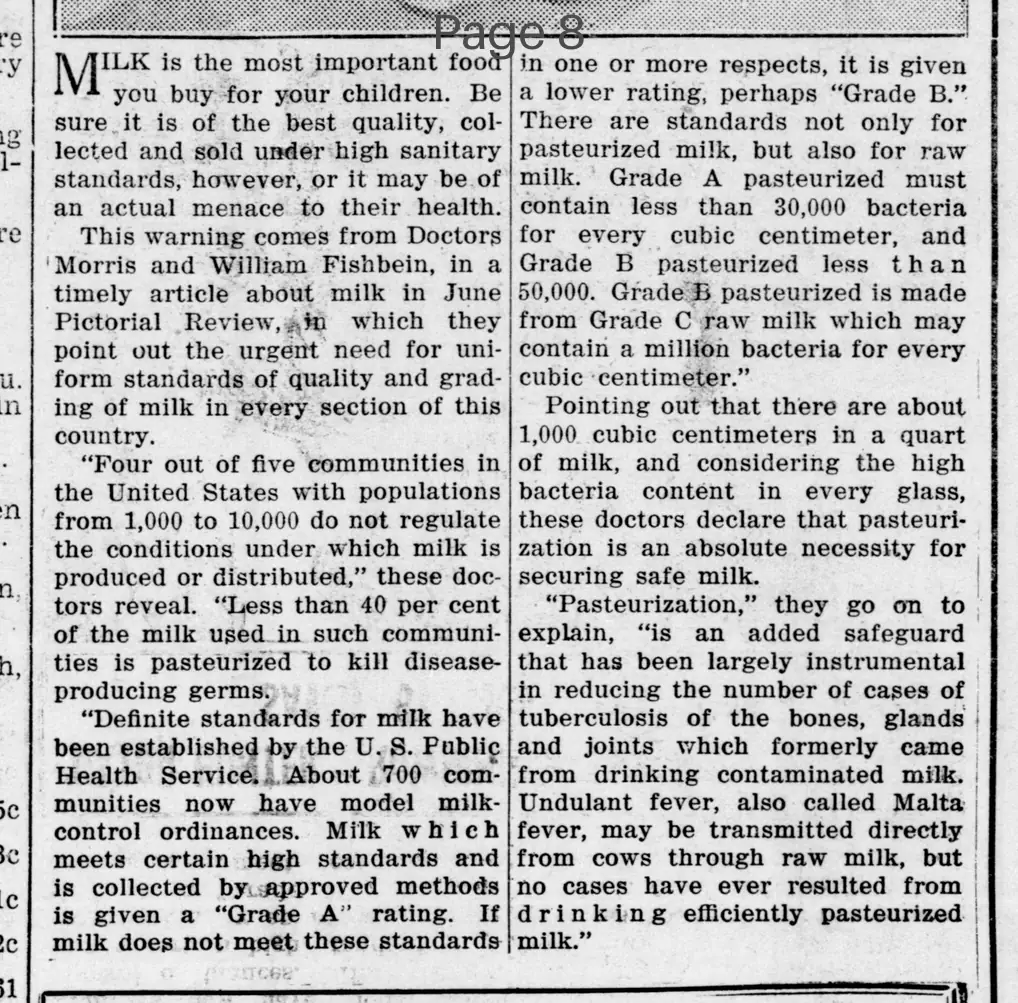
"Four out of five communities in the United States with populations from 1,000 to 10,000 do not regulate the conditions under which milk is produced or distributed," these doctors reveal. "Less than 40 per cent of the milk used in such communities is pasteurized to kill disease-producing germs."
Definite standards for milk have been established by the U. S. Public Health Service. About 700 communities now have model milk-control ordinances. Milk which meets certain high standards and is collected by approved methods is given a "Grade A" rating. If milk does not meet these standards in one or more respects, it is given a lower rating, perhaps "Grade B." There are standards not only for pasteurized milk, but also for raw milk. 'Grade A pasteurized must contain less than 30,000 bacteria for every cubic centimeter, and Grade B pasteurized less than 50,000. Grade B pasteurized is made from Grade C raw milk which may contain a million bacteria for every cubic centimeter.'
Pointing out that there are about 1,000 cubic centimeters in a quart of milk, and considering the high bacteria content in every glass, these doctors declare that pasteurization is an absolute necessity for securing safe milk. "Pasteurization," they go on to explain, "is an added safeguard that has been largely instrumental in reducing the number of cases of tuberculosis of the bones, glands and joints which formerly came from drinking contaminated milk. Undulant fever, also called Malta fever, may be transmitted directly from cows through raw milk, but no cases have ever resulted from drinking efficiently pasteurized milk."
What sub-type of article is it?
What themes does it cover?
What keywords are associated?
What entities or persons were involved?
Where did it happen?
Story Details
Key Persons
Location
United States
Story Details
Doctors warn of milk's health risks to children due to poor sanitation in most small US communities, where little milk is pasteurized. They detail U.S. Public Health Service standards for grading milk (A, B, C) based on bacteria counts and stress pasteurization's necessity to prevent diseases like tuberculosis and undulant fever.