Thank you for visiting SNEWPapers!
Sign up free
Editorial
April 7, 1809
Norfolk Gazette And Publick Ledger
Norfolk, Virginia
What is this article about?
An editorial from the Spirit of Seventy-Six defends the Union by criticizing Mr. Nicholas's claim that British intrigues caused much dissatisfaction with the Embargo Act. It argues the policy's severe economic effects on commerce, seamen, and property naturally provoked opposition, without foreign influence, and warns against divisive accusations that weaken national unity.
Clipping
OCR Quality
98%
Excellent
Full Text
From the Spirit of Seventy Six.
UNION.
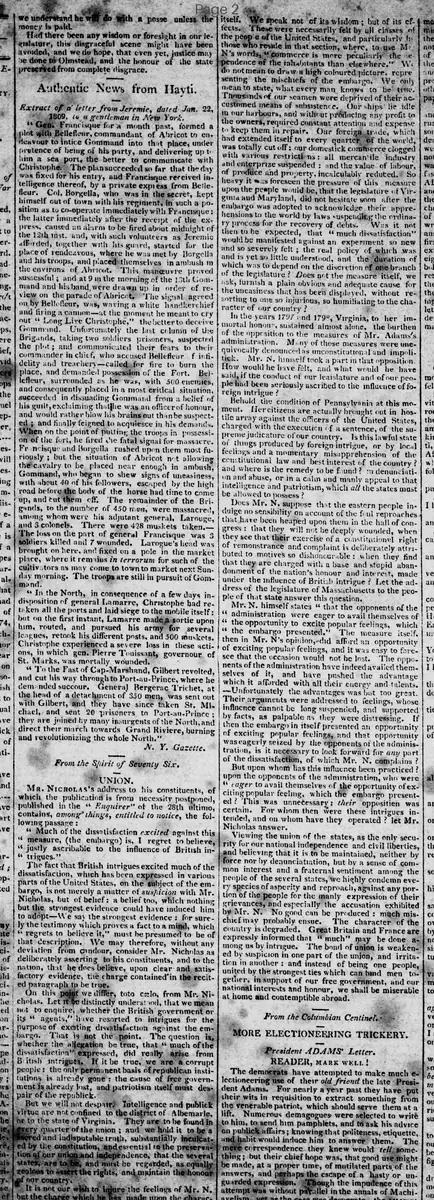
Mr. Nicholas's address to his constituents, of which the publication is from necessity postponed, published in the "Enquirer" of the 28th ultimo, contains, among other things, entitled to notice, the following passage:
"Much of the dissatisfaction excited against this measure, (the embargo) is, I regret to believe, justly ascribable to the influence of British intrigues."
The fact that British intrigues excited much of the dissatisfaction, which has been expressed in various parts of the United States, on the subject of the embargo, is not merely a matter of suspicion with Mr. Nicholas, but of belief: a belief too, which nothing but the strongest evidence could have induced him to adopt--We say the strongest evidence: for surely the testimony which proves a fact to a mind, which "regrets to believe it," must be presumed to be of that description. We may therefore, without any deviation from candour, consider Mr. Nicholas as deliberately asserting to his constituents, and to the nation, that he does believe, upon clear and satisfactory evidence, the charge contained in the recited paragraph to be true.
On this point we differ, toto coelo, from Mr. Nicholas. Let it be distinctly understood, that we mean not to enquire, whether the British government or its "agents," have resorted to intrigues for the purpose of exciting dissatisfaction against the embargo. That is not the point. The question is, whether the allegation be true, that "much of the dissatisfaction" expressed, did really arise from British intrigues. If it be true, we are a corrupt people: the only permanent basis of republican institutions is already gone: the cause of free government is already lost, and patriotism itself must despair of the republic.
But we will not despair. Intelligence and publick virtue are not confined to the district of Albemarle, or to the state of Virginia. They are to be found in every quarter of the union; and we hold it to be a sacred and indisputable truth, substantially inculcated by the constitution, and essential to the preservation of our union and independence, that the several states, are to be, and must be regarded, as equally zealous to assert the rights, and maintain the honour of our country.
It is not our wish to injure the feelings of Mr. N. but the charge which he has made upon the character of our country, is so well calculated to degrade us abroad, to divide us at home, and to invite foreign intrigue; that Mr. N. ought to lay before the publick the evidence on which the accusation is made, or, magnanimously to retract it.
Before he decides upon the course to be pursued, we take leave to submit to his consideration, what we conceive to have been the real cause of the dissatisfaction, which he so pathetically deplores. If these causes shall upon examination appear adequate to the production of the effect under consideration, Mr. N. who "regrets to believe" any thing to the discredit of his countrymen, should unite with us in saying that in condemning the embargo, tho' they may have been mistaken, they could not have been corrupt.
To ascertain the cause of "dissatisfaction" with the Embargo, we have only to recur to the measure itself. We speak not of its wisdom; but of its effects. These were necessarily felt by all classes of the people of the United States, and particularly in those who reside in that section, where, to use Mr. N's words, "commerce is more peculiarly the dependence of the inhabitants than elsewhere." We do not mean to draw a high coloured picture, representing the mischiefs of the embargo. We only mean to state, what every man knows to be true. Thousands of our seamen were deprived of their accustomed means of subsistence. Our ships lie idle in our harbours, and without producing any profit to the owners, required constant attention and expense to keep them in repair. Our foreign trade, which had extended itself to every quarter of the world, was totally cut off: our domestick commerce clogged with various restrictions: all mercantile industry and enterprize suspended: and the value of labour, of produce and property, incalculably reduced. So heavy was foreseen the pressure of this measure upon the people would be, that the legislature of Virginia and Maryland, did not hesitate soon after the embargo was adopted to acknowledge their apprehensions to the world by laws suspending the ordinary process for the recovery of debts. Was it not then to be expected, that "much dissatisfaction" would be manifested against an experiment so new and so severely felt; the real policy of which was and is yet so little understood, and the duration of which was to depend on the discretion of one branch of the legislature? Does not the measure itself, we ask, furnish a plain obvious and adequate cause for the uneasiness that has been displayed, without resorting to one so injurious, so humiliating to the character of our country?
In the years 1798 and 1799, Virginia, to her immortal honour, sustained almost alone, the burthen of the opposition to the measures of Mr. Adams's administration. Many of those measures were unequivocally denounced as unconstitutional and impolitic. Mr. N. himself took a part in that opposition. How would he have felt, and what would he have said, if the conduct of our legislature and of our people had been seriously ascribed to the influence of foreign intrigue?
Behold the condition of Pennsylvania at this moment. Her citizens are actually brought out in hostile array against the officers of the United States, charged with the execution of a sentence, of the supreme judicature of our country. Is this unlawful state of things produced by foreign intrigue, or by local feelings and a momentary misapprehension of the constitutional law and best interest of the country? and where is the remedy to be found? in denunciation and abuse, or in a calm and manly appeal to that intelligence and patriotism, which all the states must be allowed to possess?
Does Mr. N. suppose that the eastern people indulge no sensibility on account of the foul reproaches that have been heaped upon them in the hall of congress: that they will not be deeply wounded, when they see that their exercise of a constitutional right of remonstrance and complaint is deliberately attributed to motives so dishonourable: when they find that they are charged with a base and stupid abandonment of the nation's honour and interest, made under the influence of British intrigue? Let the address of the legislature of Massachusetts to the people of that state answer this question.
Mr. N. himself states "that the opponents of the administration were eager to avail themselves of the opportunity to excite popular feelings, which the embargo presented." The measure itself, then in Mr. N's opinion, did afford an opportunity of exciting popular feelings, and it was easy to foresee that the occasion would not be lost. The opponents of the administration have indeed availed themselves of it, and have pushed the advantage which it afforded with all their energy and talents. Unfortunately the advantage was but too great. Their arguments were addressed to feelings, whose influence cannot be long suspended, and supported by facts, as palpable as they were distressing. If then the embargo in itself presented an opportunity of exciting popular feelings, and that opportunity was eagerly seized by the opponents of the administration, is it necessary to look abroad for any part of the dissatisfaction, of which Mr. N. complains?
But upon whom has this influence been practiced? upon the opponents of the administration, who were "eager to avail themselves of the opportunity of exciting popular feeling, which the embargo presented?" This was unnecessary: their opposition was certain. For whom then were these intrigues intended, and on whom have they operated? let Mr. Nicholas answer.
Viewing the union of the states, as the only security for our national independence and civil liberties, and believing that it is to be maintained, neither by force nor by denunciation, but by a sense of common interest and a fraternal sentiment among the people of the several states, we highly condemn every species of asperity and reproach, against any portion of the people for the manly expression of their grievances, and especially the accusation exhibited by Mr. N. No good can be produced: much mischief may probably ensue. The character of the country is degraded. Great Britain and France are expressly informed that "much" may be done among us by intrigue. The bond of union is weakened by suspicion in one part of the union, and irritation in another: and instead of being one people, united by the strongest ties which can bind men together, in support of our free government, and our national interests and honour, we shall be miserable at home and contemptible abroad.
UNION.
Mr. Nicholas's address to his constituents, of which the publication is from necessity postponed, published in the "Enquirer" of the 28th ultimo, contains, among other things, entitled to notice, the following passage:
"Much of the dissatisfaction excited against this measure, (the embargo) is, I regret to believe, justly ascribable to the influence of British intrigues."
The fact that British intrigues excited much of the dissatisfaction, which has been expressed in various parts of the United States, on the subject of the embargo, is not merely a matter of suspicion with Mr. Nicholas, but of belief: a belief too, which nothing but the strongest evidence could have induced him to adopt--We say the strongest evidence: for surely the testimony which proves a fact to a mind, which "regrets to believe it," must be presumed to be of that description. We may therefore, without any deviation from candour, consider Mr. Nicholas as deliberately asserting to his constituents, and to the nation, that he does believe, upon clear and satisfactory evidence, the charge contained in the recited paragraph to be true.
On this point we differ, toto coelo, from Mr. Nicholas. Let it be distinctly understood, that we mean not to enquire, whether the British government or its "agents," have resorted to intrigues for the purpose of exciting dissatisfaction against the embargo. That is not the point. The question is, whether the allegation be true, that "much of the dissatisfaction" expressed, did really arise from British intrigues. If it be true, we are a corrupt people: the only permanent basis of republican institutions is already gone: the cause of free government is already lost, and patriotism itself must despair of the republic.
But we will not despair. Intelligence and publick virtue are not confined to the district of Albemarle, or to the state of Virginia. They are to be found in every quarter of the union; and we hold it to be a sacred and indisputable truth, substantially inculcated by the constitution, and essential to the preservation of our union and independence, that the several states, are to be, and must be regarded, as equally zealous to assert the rights, and maintain the honour of our country.
It is not our wish to injure the feelings of Mr. N. but the charge which he has made upon the character of our country, is so well calculated to degrade us abroad, to divide us at home, and to invite foreign intrigue; that Mr. N. ought to lay before the publick the evidence on which the accusation is made, or, magnanimously to retract it.
Before he decides upon the course to be pursued, we take leave to submit to his consideration, what we conceive to have been the real cause of the dissatisfaction, which he so pathetically deplores. If these causes shall upon examination appear adequate to the production of the effect under consideration, Mr. N. who "regrets to believe" any thing to the discredit of his countrymen, should unite with us in saying that in condemning the embargo, tho' they may have been mistaken, they could not have been corrupt.
To ascertain the cause of "dissatisfaction" with the Embargo, we have only to recur to the measure itself. We speak not of its wisdom; but of its effects. These were necessarily felt by all classes of the people of the United States, and particularly in those who reside in that section, where, to use Mr. N's words, "commerce is more peculiarly the dependence of the inhabitants than elsewhere." We do not mean to draw a high coloured picture, representing the mischiefs of the embargo. We only mean to state, what every man knows to be true. Thousands of our seamen were deprived of their accustomed means of subsistence. Our ships lie idle in our harbours, and without producing any profit to the owners, required constant attention and expense to keep them in repair. Our foreign trade, which had extended itself to every quarter of the world, was totally cut off: our domestick commerce clogged with various restrictions: all mercantile industry and enterprize suspended: and the value of labour, of produce and property, incalculably reduced. So heavy was foreseen the pressure of this measure upon the people would be, that the legislature of Virginia and Maryland, did not hesitate soon after the embargo was adopted to acknowledge their apprehensions to the world by laws suspending the ordinary process for the recovery of debts. Was it not then to be expected, that "much dissatisfaction" would be manifested against an experiment so new and so severely felt; the real policy of which was and is yet so little understood, and the duration of which was to depend on the discretion of one branch of the legislature? Does not the measure itself, we ask, furnish a plain obvious and adequate cause for the uneasiness that has been displayed, without resorting to one so injurious, so humiliating to the character of our country?
In the years 1798 and 1799, Virginia, to her immortal honour, sustained almost alone, the burthen of the opposition to the measures of Mr. Adams's administration. Many of those measures were unequivocally denounced as unconstitutional and impolitic. Mr. N. himself took a part in that opposition. How would he have felt, and what would he have said, if the conduct of our legislature and of our people had been seriously ascribed to the influence of foreign intrigue?
Behold the condition of Pennsylvania at this moment. Her citizens are actually brought out in hostile array against the officers of the United States, charged with the execution of a sentence, of the supreme judicature of our country. Is this unlawful state of things produced by foreign intrigue, or by local feelings and a momentary misapprehension of the constitutional law and best interest of the country? and where is the remedy to be found? in denunciation and abuse, or in a calm and manly appeal to that intelligence and patriotism, which all the states must be allowed to possess?
Does Mr. N. suppose that the eastern people indulge no sensibility on account of the foul reproaches that have been heaped upon them in the hall of congress: that they will not be deeply wounded, when they see that their exercise of a constitutional right of remonstrance and complaint is deliberately attributed to motives so dishonourable: when they find that they are charged with a base and stupid abandonment of the nation's honour and interest, made under the influence of British intrigue? Let the address of the legislature of Massachusetts to the people of that state answer this question.
Mr. N. himself states "that the opponents of the administration were eager to avail themselves of the opportunity to excite popular feelings, which the embargo presented." The measure itself, then in Mr. N's opinion, did afford an opportunity of exciting popular feelings, and it was easy to foresee that the occasion would not be lost. The opponents of the administration have indeed availed themselves of it, and have pushed the advantage which it afforded with all their energy and talents. Unfortunately the advantage was but too great. Their arguments were addressed to feelings, whose influence cannot be long suspended, and supported by facts, as palpable as they were distressing. If then the embargo in itself presented an opportunity of exciting popular feelings, and that opportunity was eagerly seized by the opponents of the administration, is it necessary to look abroad for any part of the dissatisfaction, of which Mr. N. complains?
But upon whom has this influence been practiced? upon the opponents of the administration, who were "eager to avail themselves of the opportunity of exciting popular feeling, which the embargo presented?" This was unnecessary: their opposition was certain. For whom then were these intrigues intended, and on whom have they operated? let Mr. Nicholas answer.
Viewing the union of the states, as the only security for our national independence and civil liberties, and believing that it is to be maintained, neither by force nor by denunciation, but by a sense of common interest and a fraternal sentiment among the people of the several states, we highly condemn every species of asperity and reproach, against any portion of the people for the manly expression of their grievances, and especially the accusation exhibited by Mr. N. No good can be produced: much mischief may probably ensue. The character of the country is degraded. Great Britain and France are expressly informed that "much" may be done among us by intrigue. The bond of union is weakened by suspicion in one part of the union, and irritation in another: and instead of being one people, united by the strongest ties which can bind men together, in support of our free government, and our national interests and honour, we shall be miserable at home and contemptible abroad.
What sub-type of article is it?
Economic Policy
Foreign Affairs
Partisan Politics
What keywords are associated?
Embargo
British Intrigues
National Union
Economic Hardship
Partisan Opposition
Mr Nicholas
Dissatisfaction
Commerce
What entities or persons were involved?
Mr. Nicholas
British Government
Virginia Legislature
Maryland Legislature
Massachusetts Legislature
Mr. Adams
Pennsylvania Citizens
Editorial Details
Primary Topic
Critique Of Blaming British Intrigues For Anti Embargo Dissatisfaction
Stance / Tone
Strong Defense Of National Union Against Divisive Accusations
Key Figures
Mr. Nicholas
British Government
Virginia Legislature
Maryland Legislature
Massachusetts Legislature
Mr. Adams
Pennsylvania Citizens
Key Arguments
Dissatisfaction With The Embargo Stems From Its Severe Economic Effects, Not British Intrigues.
Accusing Americans Of Foreign Influenced Corruption Undermines Republican Institutions.
Embargo Deprived Seamen Of Livelihood, Idled Ships, Cut Off Foreign Trade, And Reduced Property Values.
Virginia And Maryland Legislatures Suspended Debt Recovery Due To Foreseen Economic Pressure.
Historical Opposition In 1798 1799 Was Not Blamed On Foreign Intrigue.
Opponents Of The Administration Naturally Exploited The Embargo's Unpopularity.
Divisive Charges Weaken The Union And Invite Further Foreign Interference.
All States Share Equal Intelligence And Patriotism Per The Constitution.
Remedy Lies In Calm Appeals To Common Interest, Not Denunciation.
Eastern States' Remonstrances Are Constitutional Rights, Not Dishonorable Motives.