Thank you for visiting SNEWPapers!
Sign up free
Editorial
November 19, 1894
Weekly Courier Journal
Louisville, Jefferson County, Kentucky
What is this article about?
The editorial critiques the Strike Commission's report on the Pullman strike, arguing it promotes excessive government intervention in labor matters, leaning toward socialist ideas of state control over industries, potentially revolutionizing the economic system.
Clipping
OCR Quality
98%
Excellent
Full Text
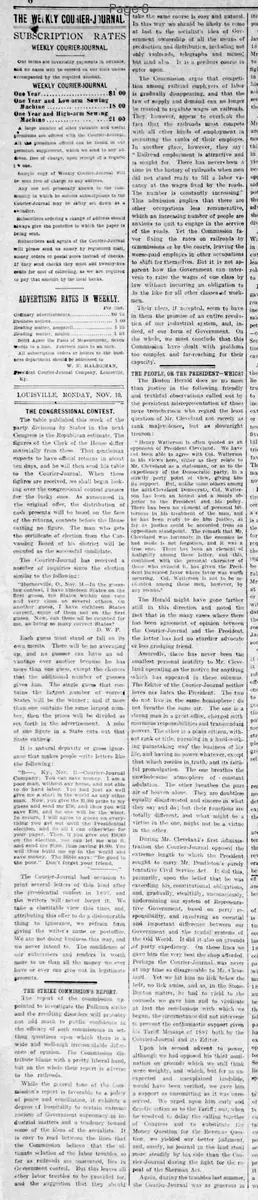
THE STRIKE COMMISSION'S REPORT.
The report of the commission appointed to investigate the Pullman strike and the resulting disorders will probably not add much to public confidence in the efficacy of such commissions in settling questions upon which there is a wide and well-nigh irreconcilable difference of opinion. The Commission distributes blame with a pretty liberal hand, but on the whole their report is a reverse to the railroads.
While the general tone of the Commission's report is favorable to a policy of peace and conciliation, it exhibits a degree of hospitality to certain extreme notions of Government supremacy in industrial matters and a tendency toward some of the ideas of the socialists. It is easy to read between the lines that the Commission believe that the ultimate solution of the labor troubles, so far as railroads are concerned, lies in Government control. But this leaves all other labor troubles to be provided for, and the suggestion that they should take the same course is easy and natural. In this way we should be likely to come at last to the socialist's idea of Government ownership of all the means of production and distribution, including not only railroads, telegraphs and mines, but land also. It is a perilous course to enter upon.
The Commission argue that competition among railroad employers of labor is gradually disappearing, and that the law of supply and demand can no longer be trusted to regulate wages on railroads. They, however, appear to overlook the fact that the railroads must compete with all other kinds of employment in recruiting the ranks of their employes. In another place, however, they say:
"Railroad employment is attractive and is sought for. There has never been a time in the history of railroads when men did not stand ready to fill a labor vacancy at the wages fixed by the roads. The number is constantly increasing."
This admission implies that there are other occupations less remunerative, which an increasing number of people are anxious to quit to engage in the service of the roads. Yet the Commission favor fixing the rates on railroads by commissions or by the courts, leaving the worse-paid employes in other occupations to shift for themselves. But it is not apparent how the Government can intervene to raise the wages of one class by law without incurring an obligation to do the like for all other classes of workmen.
Their ideas, if accepted, seem to have in them the promise of an entire revolution of our industrial system, and, indeed, of our form of Government. On the whole, we must conclude that this Commission have dealt with problems too complex and far-reaching for their capacity.
The report of the commission appointed to investigate the Pullman strike and the resulting disorders will probably not add much to public confidence in the efficacy of such commissions in settling questions upon which there is a wide and well-nigh irreconcilable difference of opinion. The Commission distributes blame with a pretty liberal hand, but on the whole their report is a reverse to the railroads.
While the general tone of the Commission's report is favorable to a policy of peace and conciliation, it exhibits a degree of hospitality to certain extreme notions of Government supremacy in industrial matters and a tendency toward some of the ideas of the socialists. It is easy to read between the lines that the Commission believe that the ultimate solution of the labor troubles, so far as railroads are concerned, lies in Government control. But this leaves all other labor troubles to be provided for, and the suggestion that they should take the same course is easy and natural. In this way we should be likely to come at last to the socialist's idea of Government ownership of all the means of production and distribution, including not only railroads, telegraphs and mines, but land also. It is a perilous course to enter upon.
The Commission argue that competition among railroad employers of labor is gradually disappearing, and that the law of supply and demand can no longer be trusted to regulate wages on railroads. They, however, appear to overlook the fact that the railroads must compete with all other kinds of employment in recruiting the ranks of their employes. In another place, however, they say:
"Railroad employment is attractive and is sought for. There has never been a time in the history of railroads when men did not stand ready to fill a labor vacancy at the wages fixed by the roads. The number is constantly increasing."
This admission implies that there are other occupations less remunerative, which an increasing number of people are anxious to quit to engage in the service of the roads. Yet the Commission favor fixing the rates on railroads by commissions or by the courts, leaving the worse-paid employes in other occupations to shift for themselves. But it is not apparent how the Government can intervene to raise the wages of one class by law without incurring an obligation to do the like for all other classes of workmen.
Their ideas, if accepted, seem to have in them the promise of an entire revolution of our industrial system, and, indeed, of our form of Government. On the whole, we must conclude that this Commission have dealt with problems too complex and far-reaching for their capacity.
What sub-type of article is it?
Labor
Economic Policy
Constitutional
What keywords are associated?
Pullman Strike
Strike Commission
Government Control
Labor Troubles
Socialism
Railroad Wages
Industrial Revolution
What entities or persons were involved?
Strike Commission
Pullman Strike
Railroads
Socialists
Editorial Details
Primary Topic
Critique Of The Strike Commission's Report On The Pullman Strike
Stance / Tone
Critical Of Government Intervention And Socialist Tendencies
Key Figures
Strike Commission
Pullman Strike
Railroads
Socialists
Key Arguments
The Commission's Report Distributes Blame But Favors Railroads Overall
The Report Shows Hospitality To Government Supremacy In Industrial Matters And Socialist Ideas
Ultimate Solution Suggested Is Government Control Of Railroads, Potentially Leading To Ownership Of All Production Means
Competition Among Railroads Is Disappearing, But Railroads Compete With Other Employments
Admission That Railroad Jobs Are Attractive And Sought After
Favoring Fixed Rates For Railroads Ignores Worse Paid Other Occupations
Government Intervention For One Class Implies Obligation For All
Ideas Promise Revolution Of Industrial System And Government Form
Commission Lacked Capacity For Such Complex Problems