Thank you for visiting SNEWPapers!
Sign up free
Richmond Enquirer
Richmond, Richmond County, Virginia
What is this article about?
Mr. Blackburn's speech in the Virginia House of Delegates on January 6 opposes a bill for new banks, decrying the system as ruinous based on European history, morally corrupt, and politically dangerous, urging rejection to protect the state.
Merged-components note: Mr. Blackburn's speech on the bill to establish new banks in Virginia, continued across multiple components.
Clippings
1 of 2
OCR Quality
Full Text
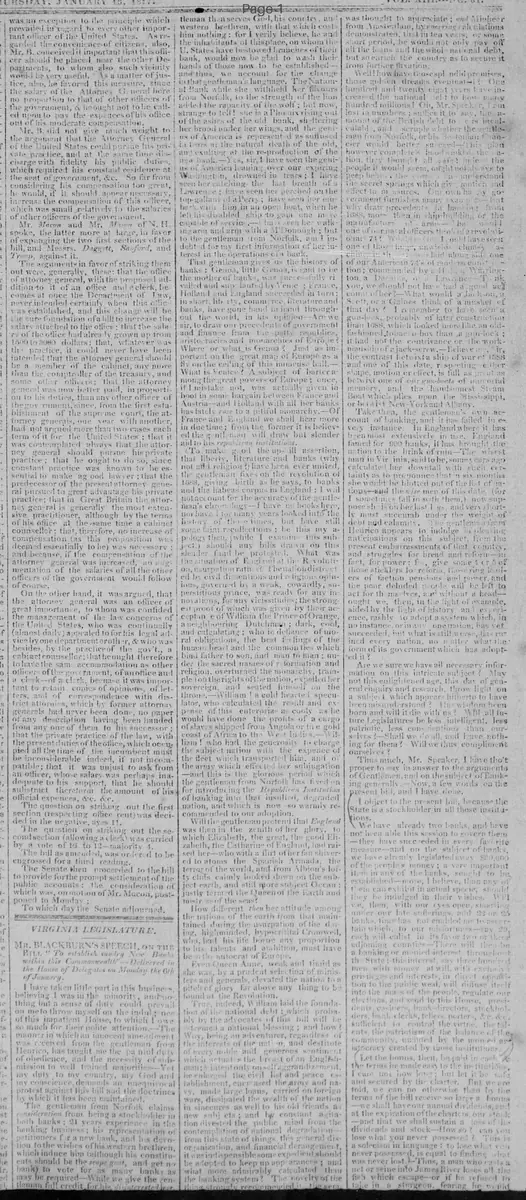
I have taken little part in this business, believing I was in the minority, and nothing but a sense of duty could prevail on me to throw myself on the indulgence of this impatient House, to which I owe so much for their polite attention.—The manner in which an innocent amendment was received from the gentleman from Henrico, has taught me the painful duty of obedience, and the necessity of submission to well trained majorities—Yet my duty to my country, my God and my conscience, demands an unequivocal protest against this bill and the doctrines by which it has been maintained.
The gentleman from Norfolk claims consideration from being a stockholder in both banks: 21 years experience in the banking business; his representation of petitioners for a new bank, and his devotion to the wishes of his western brethren, which induce him (although his constituents should be the scape goat, and get no bank) to vote for as many banks as may be required—While we give the gentleman full credit for his tleman then serves God, his country, and western brethren, with that which costs him nothing: for I verily believe, he and the inhabitants of this place, on whom the U. States have bestowed branches of their bank, would now be glad to wash their hands of those now to be established— and thus, we account for the change in that gentleman's language.
The National Bank while she withheld her favors from Norfolk, to the strength of the lion added the rapacity of the wolf; but now, strange to tell! she is a Phoenix rising out of the ashes of the old bank, sheltering her brood under her wings, and the genius of America is represented as suffused in tears at the natural death of the old, and exulting at the re-production of the new bank.—Yes, sir, I have seen the genius of America leaning over our expiring Washington, drowned in tears: I have seen her catching the last breath of a Lawrence: have seen her perched on the top-gallant of a Perry; have seen her embarking with him in an open boat, when he left his disabled ship to gain one more capable of service —I have seen her walking arm and arm with a M'Donough: but to the gentleman from Norfolk, am I indebted for my first information of her interest in the operations of a bank.
That gentleman gives us the history of banks: Genoa, little Genoa, is said to be the mother of banks, was successfully rivalled and supplanted by Venice; France, Holland and England succeeded in turn: in short, liberty, commerce, literature and banks, have gone hand in hand throughout the world, in his opinion—Are we sir, to draw our precedents of government and finance from the petty republics, aristocracies and monarchies of Europe? Where or what is Genoa? Just as important on the great map of Europe as a Av on the ceiling of this immense hall.— What is Venice? A subject of barter among the great powers of Europe; once, if I mistake not, was actually given in boot in some bargain between France and Austria—and Holland with all her banks has but badly raised to a pitiful monarchy.—Of France and England we shall hear more in due time: from the former it is believed the gentleman will draw but slender aid to his republican institutions.
(To make good the unhallowed assertion, that liberty, literature and banks (why not add religion?) have been ever united, the gentleman fixes on the revolution of 1688, giving birth as he says, to banks and the habeas corpus in England: I will not account for the accuracy of the gentleman's chronology—I have no books here, nor have I for many years looked into the history of those times, but have still some faint recollections; be this my apology then, (while I examine this subject) should any bills drawn on this slender fund be protested.
What was the situation of England at the Revolution, usurpation rather? The nation distracted by civil dissensions and religious opinions, governed by a weak, cowardly, superstitious prince, was ready for any innovations, for any vicissitudes; the strongest proof of which was given by their acceptance of William the Prince of Orange, a neighbouring Dutchman; dark, cool, and calculating; who in defiance of moral obligations, the best feelings of the human heart and the common ties which bind father to son, and man to man; under the sacred names of reformation and religion, overturned the monarchy, trampled on the rights of the nation, expelled her sovereign, and seated himself on the throne.—William! a cold hearted speculator, who calculated the result and expense of this enterprize— as coolly as he would have done the profits of a cargo of slaves shipped from Angola or the gold coast of Africa to the West Indies.—William! who had the generosity to charge the subject nation with the expense of the fleet which transported him, and of the army which effected her subjugation —and this is the glorious period which the gentleman from Norfolk has fixed on for introducing the Republican Institution of banking into that insulted, degraded nation, and which is now so warmly recommended to our adoption.
Will the gentleman pretend that England was then in the zenith of her glory, to which Elizabeth, the great, the good Elizabeth, the Catherine of England, had raised her—who with a flirt of her fan shivered to atoms the Spanish Armada, the terror of the world, and from Albion's lofty cliffs calmly looked down on the subject earth, and still more subject Ocean: justly termed the Queen of the Earth and mistress of the seas?
How different then her attitude among the nations of the earth from that maintained during the usurpation of the dying, high minded, hypocritical Cromwell, who, had his life borne any proportion to his talents and ambition, must have become the autocrat of Europe.
Even Queen Anne, weak and timid as she was, by a prudent selection of ministers and generals, elevated the nation to a pitch of glory far above any thing to be found at the Revolution.
True, indeed, William laid the foundation of the national debt: which probably as the advocates of this bill will hold it a national blessing; and how? Now, being an adventurer, regardless of the interests of the nation, and destitute of every noble and generous sentiment which actuates the breast of an Englishman; intent only on self-aggrandizement, he enlarged the civil list and peace establishment, increased the army and navy, made large loans, carried on foreign wars, dissipated the wealth of the nation in sinecures as well to his old friends as new subjects: and by constant agitation divested the public mind from the contemplation of national degradation from this state of things, this general disorganization, and financial derangement, it was indispensable some expedient should be adopted to keep up appearances; and what more admirably calculated than the banking system?
"The novelty of the was thought to appreciate; and Mynheer from Amsterdam, by unerring calculations demonstrated, that in ten years, or some short period, he would not only pay off all the loans and the whole national debt, but enrich the country as to secure it from further taxation.
Well! how have these splendid premises, those golden dreams eventuated? One hundred and twenty eight years have increased the national debt to eight hundred millions! Oh, Mr. Speaker, I'm lost in numbers; suffice it to say, the amount of the British debt is incalculable, and scruple whether the gentleman from Norfolk, or his Batavian financier would better succeed—This plan however complete hoodwinked the nation, they thought all safe: indeed the people it would seem, ought not to have to peep behind the curtain to understand the secret springs which give motion and effect to measures.
On our government furnishes many examples—But why draw precedents in banking from England, more than in ship-building or the manufacture of arms—I was in a small one of our naval officers the other day? Would he have seen one of those British 74's? Would you have seen one of those banks, unyielding clumsy as chained in, they poured a broadside along side one of our American 74's of modern Construction; commanded by a young Warren, a Decatur, or a Lawrence? No, you would not have had a good account of her?—What would a Jackson, a Scott, or a Gaines think of a musket of that day? I remember to have seen a gun-lock, probably of later construction than 1688, which looked more like an old-fashioned tobacco-box than a gun-lock; it had not the contrivance or the workmanship of a jack-screw.—Believe me, sir, the contrast between a ship of war of 1688 and one of this date, respecting either shape, motion or effect, is full as great as between one of our gun-boats of mythical memory, and the handsomest Steam Boat which plies upon the Mississippi, or between New-York and Albany.
Take then, the gentleman's own account of banking, and it has failed in every instance. In England where it has been most extensively in use, England famed for good banks, it has brought the nation to the brink of ruin—The wisest man in Virginia, said to be, some years ago, calculated her downfall with such certainty as to pronounce that in six months she would be blotted out of the list of nations—and the wise men of this day, (God sometimes falls in with them,) now suppose she is on her last legs, and very shortly must succumb under the weight of debt and calamity.
The gentleman from Henrico appears to indulge in pleasing anticipations on this subject, from the present embarrassments of that country, and struggles for bread and reform—In fact, for power: for, give some of those sticklers to reform, those ring leaders of faction pensions and power, and the poor deluded rabble will be left to act for themselves, a head without a body ought we, then, in the light of example, aided by the light of history and experience, rashly to adopt a system which, in no instance, ordinarily one nation, has yet succeeded, but what is still worse, has ruined every nation, no matter what the form of its government which has adopted it?
Are we sure we have all necessary information on this intricate subject? May not this enlightened age, this day of general enquiry and research, throw light on a subject which appears hitherto to have been misunderstood? Has wisdom been born and will it die with us? Will all future Legislatures be less intelligent, less patriotic, less conscientious than ourselves?—Shall we do all, and leave nothing for them? Will we thus compliment ourselves?
Thus much, Mr. Speaker, I have thought proper to say in answer to the arguments of Gentlemen, and on the subject of Banking generally—Now, a few words on the present bill, and I have done.
I object to the present bill, because the State is a stockholder in all those institutions. We have already two Banks, and have not been able this session to govern them —they have succeeded in every favorite measure—and on the subject of banks, we have already legislated away $300,000 of the people's money; a very important item in any of the banks sought to be established—more, I believe, than any of them can exhibit in actual specie, should they be indulged in their wishes.
If ye, then, with our eyes open, smarting under our late sufferings, add 2 or 25 banks, time has not enabled me to guess which, to our misfortunes—say go, each will enlist in its favor two or three adjoining counties—There will then be a banking or monied interest throughout the State: this interest say three hundred men, with money at will, with cashless privileges and interests, in direct opposition to the public weal, will diffuse itself into the mass of the people, regulate our elections, and send to this House, precedents covered with bank-directors, stockholders, bank clerks, tellers, porters, &c. &c sufficient to control the virtue, the talent the patriotism of the balance of the, community, awed by the moneyed aristocracy created by those institutions.
Let the bonus, then, be paid in cash & the terms be made easy to the institutions. I care not how long; but let it be safe and secured by the charter. But we are told, we can no otherwise than by the terms of the bill receive so large a bonus —we shall have our annual dividends, and at the expiration of the charters our stock —and that we shall sustain a loss of h dividends and stock—how so? can you lose what you never possessed? This is a solecism in language: to lose what we never possessed, is equal to finding what was never lost.—Thus, a man who casts a net or seine into James River loses all the fish which escape—or if he refused to take in asturgeou fonsineJoauld
so are we, to accept of those banks on the terms proposed.
Shall we, then, go hand in hand with them, embark the interests of the State, and introduce them to the world, and be accountable for their future conduct? Is not every gentleman accountable for the honor and good conduct of the man he introduces into society? To show we are bound for those banks, and that they are dependent on the state for their credit and importance, sell the State shares in the Virginia and Farmers' Bank, and I pronounce the stock will fall in one day: fall 50 per cent. and for this good reason, the State would not be bound by its Representatives to protect them.
Must the State, then, give the breast to this litter, this farrow of banks: which, like the vultures of Prometheus, are incessantly preying on her vitals, which are continually increased or renewed, that they might have the pleasure of fasting, and he the torture of laceration?
We have now two twins (cancers, if you please) deforming the fair face of the body politic, and more pustules have appeared on the body, which, although not in an equal state of putrescence with the originals, are yet well known to be of the same species, and are considerably inflamed. Will you, then, add 20 more, and produce the most frightful deformity?
Did you discover a cancer fixing on the wife of your bosom, or the child of your hopes, would you give it two, three or five years to mature: that its roots might sink deep into the system, and possess themselves of the sources of life and motion, or at once apply the knife and caustic?
If this would be your course with your wife or child, I conjure you by the God that made you, to be equally faithful to your country.
I object to the bill, because the most salutary measures have been rejected, and that with contempt, as from a source unfriendly to the bill. I had always thought the maxim sound--qui facit per alium facit per se--that is, he who acts by another, acts for himself. The amendment, then, offered by the gentleman from Buckingham, (Mr. Austin,) subjecting the stockholders to individual responsibility, in proportion to their interest, ought to have been received--the directors are only the agents intrusted by the stockholders to manage their concerns, and no truth is less deniable than that the principal is liable for the acts of his deputy. Great, Sir, has been my regret and mortification to find a strong current in this House to protect the banks and debtors, in defiance of the just claims of honest dealers and creditors.
The Literary Fund and of Internal Improvement ought not to be identified with those banks. Oh! save them, our country's last, best hope, from this unhallowed embrace, this sacrilegious touch, this incestuous intercourse!--The issue must be monstrous, beyond poetical imagination. Will you embark in the same boat, and trust to the same winds, the honest earnings of industry, and the ungodly gains of the usurious, gambling speculators, lying in wait for, and preying on the necessities of man? Can you serve God and Mammon? Can you draw sweet water from a bitter fountain, or of brambles gather figs?
The country will be inundated with paper, without calculation, on which I have little reliance, on practical subjects--say 15 millions--how to be employed? What to be given for it? And how did we get along before the institution of banking capital?
But people have petitioned--Who? Where is the petition from the great counties of Shenandoah, Rockingham, Augusta, Botetourt, Rockbridge, Greenbrier, Monroe, Montgomery, &c. &c.? 16 or 18 counties, out of 100, or thereabout, have petitioned, after every method has been adopted to lash them into the measure! Are gentlemen in earnest? do they expect to be believed, when they talk of this being the wish of the people? No, Sir, it is untrue: a few little aristocratical communities, wishing to aggrandize themselves, at the expense of the many, have brought forward this business; and in contempt of truth and decency, arrogate to themselves the privileges and prerogatives of the people, when in fact there is not three-tenths of the people who have petitioned, or taken an interest in the measure.
But we are told the people are diseased: their remedy is banks.--A man in a burning fever calls for water, more water! Does his physician indulge him? Not unless he wishes to kill him.
We want capital: cannot contend with other States, who are our importers!--Will banks alter the case? No. Subject real estate to the payment of debts; wipe off the stain of shutting your courts against the recovery of British debts, and my hand for it, my sort, if you please, and our merchants will import on equal terms with those of other States. But still you will not be able to send the productions of the Shenandoah, Appomattox, and their adjoining rivers and counties, to Richmond, while those rivers, the roads and the distance, point out a different direction.--True, indeed, Mr. Jefferson, when Secretary of State, justified by most elaborate reasoning, in his correspondence with the then British Minister, the justice of Virginia's policy, in the occlusion of her Courts: but it is equally true, at a subsequent treaty, this cobweb system was abandoned: our courts thrown open: the debts recovered: and this baseless fabric, with the whims of gun-boats, dry-docks and pendulums, sunk into oblivion.
The gentlemen endeavor to prove that the profits of Banking are not drawn from the pockets of the people--money gets money, say they--let us see--Put any sum into a box, shake it, turn it as you please, count it, or keep it till it rusts, like the Gentleman's gold in Holland banks: it will come out exactly the same sum. Money has, they say, no creative powers, and increases no otherwise than by use; and the borrower, as in all other cases the consumer, pays the interest, the impost, the duty, excise, or whatever name you may please to give it.
Mr. B. asked, from whence the specie capital, (for they were to be specie paying banks?) It was acknowledged not to be in the country, except in the vaults of the present banks--and where was the justice or policy of draining them? Were the means at hand? But a few days since, we had locked them up against their honest creditors; what superior claims had the new banks on them or us? By the 1st of June, near a million would be required in actual specie: for the bill has been so
rate effort made against that amendment: when adopted, terror & dismay appeared in every face, momentary disorder pervaded the ranks; a hollow groan resounded from every quarter of the House--it was, indeed, a fearful struggle; the last convulsive throes of expiring nature. It wrung from the advocates of this bill all but tears of blood--To him, it was a perfect feast: strains so dulcet had never struck his ravished ear: he heard, or thought he heard, the departing knell of bank influence in Virginia; then, he thought, he clearly saw the cloven foot: and that it had, however carefully concealed, been designed to receive a deposit other than the lawful coin of the U. S.
He asked, how that important object had at last been secured by the bill--why, the Executive was to send an agent to overhaul each bank before it went into operation, who was to see and report 'all is well.'--He asked whether the agent would be cash proof: if he were not, it was a matter of little moment whether the vaults were fire proof. Who was to be this agent? He could be no common man, to whom so important a trust was committed: he must be some exalted personage, the roads ought to be turnpiked before he set out, his sacred person ought not to be exposed to rivers and mountains in the uncultivated country thro' which he had to pass: he should at all events be furnished with our new-fangled chart, lest he should not find his way home, the report be never made, and all the purposes of the law defeated.
Great credit is claimed for limiting the charters of the new banks to the year 1834, when that of the Farmers' bank shall also expire; intimating a design at that period of getting rid of the whole system: 'credat Judaeus Appella.' This is a hopeful way of redressing the evil by increasing it ten fold, nourishing and even insuring its existence for 17 years, by which time it shall have taken deep root, interwoven itself with the laws and general policy of the country, corrupted the fountains of legislation, demoralized the people, and, like the Upas of Java, tainted the atmosphere itself, rendering it unfit for respiration.
Nor, can I discover, said Mr. B. any thing more substantial in the clause extending to future Legislatures the right to sell out the State shares--they want no such grant: we have no such authority to bestow: the right will vest in them, as it has in us--we might, and they will, when it shall be deemed necessary, exercise that power.
Frederick of Prussia has been pressed into this service. Why not the Czar of Muscovy--he, too, was a great man!---Frederick civilized the Silesians, after, in the seven years' war, he had conquered them, and added that territory to the Marquisate of Brandenburg, built schools, &c. To make any thing of the argument, the gentleman from L. should show Frederick was indebted to banks for his means of improvement. No--he owed them to economy: the expenses of his table were limited to a per diem allowance of £5.--Why, it would not furnish wine and fruits for a republican dinner among the Dons of Richmond. Blessed fruits of Banking!
Frederick had no banks--The doctrine that the rich are made richer, and the poor poorer, is denied by our opponents--and we are told by the gentleman from Norfolk, that the man who launched a fine carriage, paid the poor--the smith, the upholsterer, the painter, the driver, &c. &c.
How is this? I am a practical man--would not give a grain of fact for a pound of theory. Now, look at the petitions on your table from the master mechanics of Richmond and the neighboring towns, stating they have built houses and done work for the inhabitants, often at their own expense, and are still unpaid, and praying a lien may be given on their works--If this is done in the 'green tree, what shall be done in the dry?' If our mechanics of capital are in this distress from want of punctuality in their employers, what is to become of our taylors, shoemakers, chandlers, &c? Those people must sacrifice their implements of trade--the taylor his goose, the shoemaker his last--the chandler his moulds: and all inferior tradesmen stand farther on in the back ground.
China has, by the gentleman from Henrico, been brought into review. We are told, a Mandarin would there carry off a bank without asking questions, as Bonaparte did, when he went to Russia, those of Holland and France.--I know little about China--cannot tell how the gentleman knows more; but had thought, the rights of persons and property were pretty well understood, and the government well administered. If, however, there was any thing amiss, it must be owing to the want of banks, a republican institution.
We are told specie can be imported at two per cent. What is to be given for it? We have not cotton; that belongs to our southern brethren--we have not sugar: our soil and sun deny it--our flour 'will not do, the harvests in England preclude us. My belief is that of the first merchant in this city (a friend to banks) that it cannot be imported under 15 or 16 per cent. But if our banks go into operation, it must be had, and the immense demand made by this bill will increase the demand without adding to the means of acquisition.
The gentleman from Jefferson, (in which the gentleman from Loudoun concurs), has discovered a new plan of defence to the Commonwealth. Our fathers thought of cannon, muskets, bayonets, and all this ferocious trumpery; but they will now defend us with a Cordon of Banks! Maryland has fortified her shore in that way, and the gent. from J. fortifies Virginia, by the Banks of Morgantown, Clarksburg, Wheeling, Kanawha and Abingdon, against Foreign invasion!--for those of Loudoun and Jefferson, I presume, are to defend us against internal insurrection! This is the day of discovery, Mr. Speaker. France, under the direction of the great Vauban, lavished millions in erecting her iron frontier against her enemies--but we, better taught, more learned in the science of defence, can protect ourselves and the nation, by paper! Why then deny this specific to any section of the state? Poor little Brooke--we must lose her, at all events. Insulated betwixt two hostile states, Ohio and Pennsylvania, a small force thrown into the isthmus, must cut her off, and we lose her forever!--for here you know, Mr. Speaker, all things must be carried by the weight of metal, by the weight of rags--Dumfries has claims; I am told she has an excellent harbour; is she a port of entry, Mr. Speaker?--Can vessels of
or three mills? I was once at Dumfries; saw nothing like a sea-port, a dock, or a navy-yard; a few boats, some in dry dock, the balance deep in the mud--nor was there shipping of any kind, to transport the produce of a wealthy planter. Port Royal too, wants a bank, in which every thing has the appearance of age, desolation and decay: Old Sarum, at once.--There must, Mr. Speaker, be something magic in the word Bank! Is the season dry? they must have a bank to buy plaster: plaster produces moisture: is the season rainy? we must have a bank, to buy stock to eat our surplus forage;--does the frost kill our corn? we must have a bank, at all events, to restore the losses of the season! I, for one, have no faith in Banks.
The gentleman from Loudoun, has been in London! that we have often heard--and there saw 6000 males or females. I know not which, in one grand dome, and the ceiling of that building rending with the shouts of those innocents (which had been collected from the streets, & lanes, & stews of that country), in hymns of praise to their Maker, and of gratitude to their benefactors!--I enter into all the gentleman's feelings: it was a sight would have made any human being--a God, more happy!--But what is this to the question? Did that institution grow out of a Bank? Did the Magdalene, the Foundling, the Invalid, the Marine Hospitals, and other national institutions, which neither time nor information, at this moment, enable me to enumerate, and which, perhaps, have kept that nation afloat: for charity, we are told, covers a multitude of sins--originate, or were they founded on banks? Far from it: the opulent, the great, the benevolent, the good, founded those institutions: and if the superstitious loaned their aid, it injures not my argument.
But the gentleman from Loudoun appears to have forgotten, that there is no such class of people in Virginia or America as he has seen and described--We acknowledge not the Lazzaroni of Naples, or the off-scourings of London or Paris--It will be long, very long, before this country can exhibit a sight, so much enjoyed by the gentleman, or so disgraceful to our country--Poor-schools! Where is the Virginian, who would brook the idea of sending his child to be brought up on charity?
But what becomes of those children at last? Are they in any manner better off than ours? Male and female, after taking this course, are distributed among the manufactories of the neighbourhood: and of the balance, the boys are put to trades, and the girls to service, where they have still to struggle with the hardships of poverty, the seductions of the devil, and the innumerable misfortunes incident to humanity. I shall not be understood as hostile to those institutions, but deny they originated from, or are allied to banks.
We have some in our own country, on a small scale, to be sure--I have examined them with a critical eye, & a heart overflowing with gratitude, that it had pleased God I should be an American--a Virginian. There is in Russia too, a country not famed for republicanism and alien to banks, an institution of this kind, founded and patronized, I think, by the dowager of Paul, more amply endowed and diffusive in its blessings than any of those above-mentioned, or on the globe--But be it remembered, and I beg the gentleman from Loudoun always to recollect, when he indulges himself and enchants the House with his visions, his pleasing reveries, that none of those institutions in Europe or America owe their foundation, support, or existence, to his favorite system--Banks are out of the question.
If (said Mr. B.) I thought with the advocates of the bill, was a firm believer in the justice and efficacy of the banking system, I would esteem it criminal to leave this House without asking leave to bring in a bill, establishing a bank for the propagation of the Gospel; that the 'Sun of Righteousness might arise, with healing under his wings, upon the darkest corner of the earth; that the knowledge of God should cover the earth as the waters do the seas; that one should not say to his neighbour, Know the Lord: but that all should know him from the greatest to the least'--that the diffusion of the word of life should be co-extensive with the habitation of man. Yet, would not the proposition shock this House? Would not I be hissed for making it? I shuddered, when the idea this moment struck me!--Believe me, Sir, with my present feelings and sentiments, I would just as soon steal the consecrated vessels from the holy altar, as make it--I intreat gentlemen of honor, of religion, (for of those descriptions I know my opponents consist,) to test by this rule the propriety of their tenets--I conjure them to look forward to that hour which awaits us all, that sober hour, when all the vanities, the wealth, and splendors of this world will appear like a meteor which just attracted the eye and vanished forever--when this world shall have nothing to charm, and when the only consolation will be, the retrospect of a life well spent--Under those impressions, let this vote be taken, and I cannot doubt the success of this opposition.
Are gentlemen prepared to incorporate gambling-houses in the cities, towns and hamlets of this country, and invite those birds of night, who have been (by the joint efforts of our Judiciary, the Legislature, and all good men;) confined to the garrets and to the cellars, to appear in open day and (like the pestilence) walk at noon-day! Are they prepared to incorporate houses of ill-fame, and invite the resort of our youth, our men of middle age, our fathers, to dissipate their fame, their fortunes, their souls, in those haunts of iniquity--and all this, because we shall reserve to the State a bonus, a gift of 15 per cent. and the dividends of this unholy traffic? My blood turns cold at the proposition--I am not made for those times--And the bonus is to be applied to the education of our children! 'Will you receive the earnings of a harlot, to raise temples to your God, that your children may praise him? Will you impress into the service the 'unhallowed means to accomplish the most holy end?' I cannot.
I have now, Mr. Speaker, discharged what I believe was my duty to my country--Here let the bill rest--Would to God it might have eternal sleep--But, if the wisdom, the patriotism, the error of my Country say it shall go into operation, I yield to a majority--I must and will support it, and give my feeble aid to carry it into execution.--My last and most pleas
What sub-type of article is it?
What themes does it cover?
What keywords are associated?
What entities or persons were involved?
Where did it happen?
Story Details
Key Persons
Location
House Of Delegates, Virginia
Event Date
Monday The 6th Of January
Story Details
Mr. Blackburn delivers a speech opposing the bill to establish new banks in Virginia, criticizing the banking system through historical examples from Europe, arguing it leads to national debt and moral corruption, and warning of its potential to control politics and harm the public.