Thank you for visiting SNEWPapers!
Sign up free
Gazette Of The United States
New York, New York County, New York
What is this article about?
In late 1789, Dr. Price and the Earl of Stanhope sent addresses from England's Revolution Society to France's Duke of Rochefoucauld and National Assembly, celebrating the English Revolution and supporting French liberty. The Assembly responded positively, promoting unity between the nations and extinguishing ancient jealousies.
Clipping
OCR Quality
Full Text
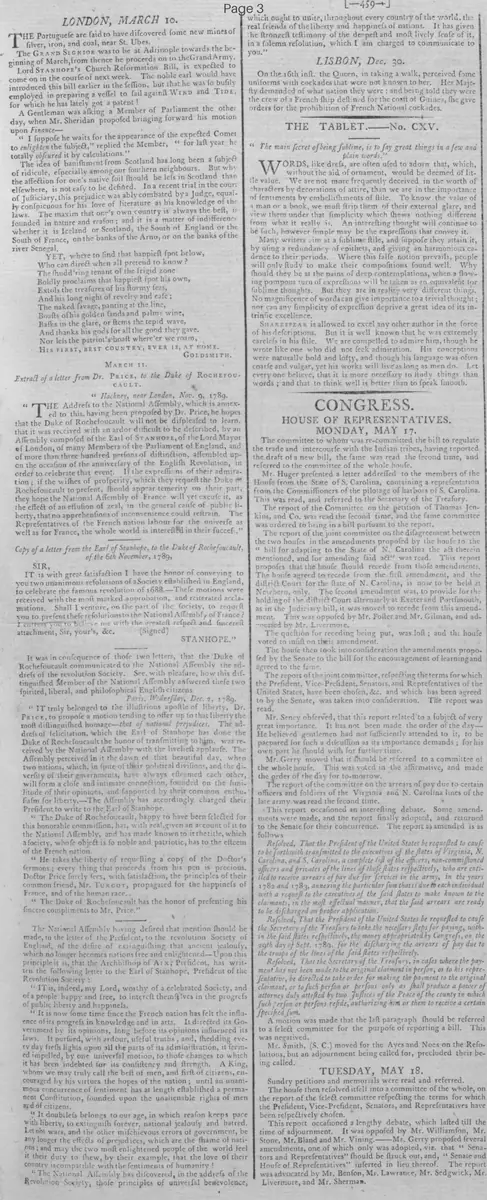
Extract of a letter from Dr. Price, to the Duke of Rochefoucauld.
"Hackney, near London, Nov. 9, 1789
The Address to the National Assembly, which is annexed to this, having been proposed by Dr. Price, he hopes that the Duke of Rochefoucauld will not be displeased to learn that it was received with an ardor difficult to be described, by an Assembly composed of the Earl of Stramore, of the Lord Mayor of London, of many Members of the Parliament of England, and of more than three hundred persons of distinction, assembled upon the occasion of the anniversary of the English Revolution, in order to celebrate that event. If the expressions of their admiration; if the wishes of prosperity, which they request the Duke of Rochefoucauld to present, should appear temerity on their part, they hope the National Assembly of France will yet excuse it, as the effect of an effusion of zeal, in the general cause of public liberty, that no apprehensions of inconvenience could restrain. The Representatives of the French nation labour for the universe as well as for France, the whole world is interested in their success."
Copy of a letter from the Earl of Stanhope, to the Duke of Rochefoucauld, of the 6th November, 1789,
SIR,
IT is with great satisfaction I have the honor of conveying to you two unanimous resolutions of a Society established in England, to celebrate the famous revolution of 1688.—These motions were received with the most marked approbation, and reiterated acclamations. Shall I venture, on the part of the society, to request you to present these resolutions to the National Assembly of France? I entreat you to believe me with the greatest respect and sincere attachment, Sir, yours, &c.
(Signed) STANHOPE.
It was in consequence of these two letters, that the Duke of Rochefoucauld communicated to the National Assembly the address of the revolution Society. See, with pleasure, how this distinguished Member of the National Assembly answered these two spirited, liberal, and philosophical English citizens
Paris, Wednesday, Dec. 2, 1789.
"IT truly belonged to the illustrious apostle of liberty, Dr. Price, to propose a motion tending to offer up to that liberty the most distinguished homage—that of national prejudices. The address of felicitation, which the Earl of Stanhope has done the Duke of Rochefoucauld the honor of transmitting to him, was received by the National Assembly with the liveliest applause. The Assembly perceived in it the dawn of that beautiful day, when two nations, which, in spite of their political divisions, and the diversity of their governments, have always esteemed each other, will form a close and intimate connection, founded on the similitude of their opinions, and supported by their common enthusiasm for liberty.—The Assembly has accordingly charged their President to write to the Earl of Stanhope.
"The Duke of Rochefoucauld, happy to have been elected for this honorable commission, has, with zeal, given an account of it to the National Assembly, and has made known to it the title, which a society, whose object is so noble and patriotic, has to the esteem of the French nation
"He takes the liberty of requesting a copy of the Doctor's sermons; every thing that proceeds from his pen is precious. Doctor Price surely sees, with satisfaction, the principles of their common friend, Mr. Turgot, propagated for the happiness of France, and of the human race.
"The Duke of Rochefoucauld has the honor of presenting his sincere compliments to Mr. Price."
The National Assembly having desired that mention should be made, in the letter of the President, to the revolution Society of England, of the desire of extinguishing that ancient jealousy, which no longer becomes nations free and enlightened—Upon this principle it is, that the Archbishop of Aix, President, has written the following letter to the Earl of Stanhope, President of the Revolution Society :
"IT is, indeed, my Lord, worthy of a celebrated Society, and of a people happy and free, to interest themselves in the progress of public liberty and happiness.
"It is now some time since the French nation has felt the influence of its progress in knowledge and in arts. It directed its Government by its opinions, long before its opinions influenced its laws. It pursued, with ardour, useful truths; and, shedding every day fresh lights upon all the parts of its administration, it seemed impelled, by one universal motion, to those changes to which it has been indebted for its consistency and strength. A King whom we may truly call the best of men, and first of citizens, encouraged by his virtues the hopes of the nation; until an unanimous concurrence of sentiment has at length established a permanent Constitution, founded upon the unalienable rights of man and of citizens.
"It doubtless belongs to our age, in which reason keeps pace with liberty, to extinguish forever, national jealousy and hatred. Let not wars, and the other mischievous errors of government, be any longer the effects of prejudices, which are the shame of nations; and may the two most enlightened people of the world feel it their duty to show, by their example, that the love of their country is compatible with the sentiments of humanity!
"The National Assembly has discovered, in the address of the Revolution Society, those principles of universal benevolence, which ought to unite, throughout every country of the world, the real friends of the liberty and happiness of nations. It has given the strongest testimony of the deepest and most lively sense of it, in a solemn resolution, which I am charged to communicate to you."
What sub-type of article is it?
What keywords are associated?
What entities or persons were involved?
Where did it happen?
Foreign News Details
Primary Location
Paris
Event Date
November December 1789
Key Persons
Outcome
the addresses were received with applause and acclamations by the national assembly, leading to reciprocal letters promoting a close connection between england and france based on shared enthusiasm for liberty and the extinguishing of national jealousies.
Event Details
Dr. Price and the Earl of Stanhope sent letters and addresses from the English Revolution Society to the Duke of Rochefoucauld for presentation to the French National Assembly, expressing admiration for French efforts in liberty on the anniversary of the English Revolution of 1688. The Duke communicated them, and the Assembly responded positively through the Duke and the President (Archbishop of Aix), emphasizing unity, shared principles, and the end of prejudices between the two nations.