Thank you for visiting SNEWPapers!
Sign up free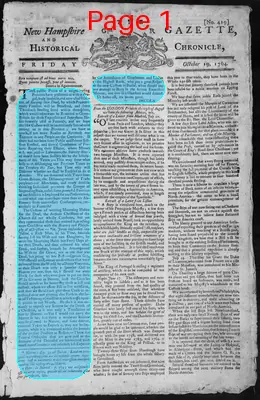
Editorial
October 19, 1764
The New Hampshire Gazette And Historical Chronicle
Portsmouth, Greenland, Rockingham County, New Hampshire
What is this article about?
An editorial advocates adopting frugal burial customs from a neighboring province to save money amid economic pressures like taxes and trade discouragement in the colony. It cites early Christian views from St. Hierom and Cyprian to support moderate mourning, noting Boston's shift to less expensive funerals attended by elites.
Clipping
OCR Quality
95%
Excellent
Full Text
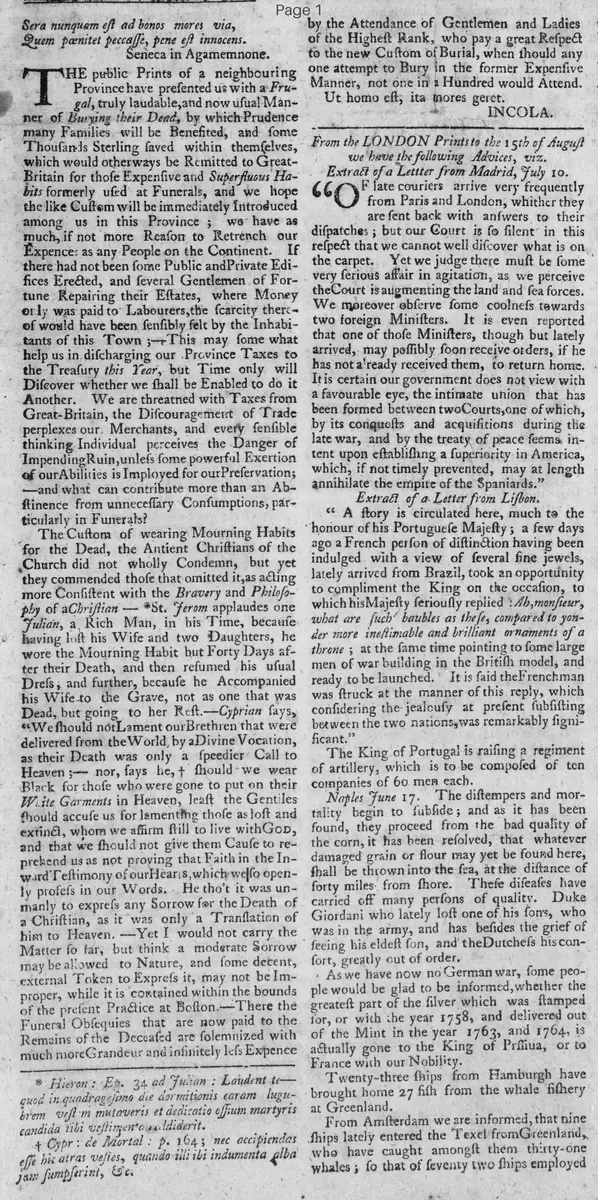
The public Prints of a neighbouring Province have presented us with a Frugal, truly laudable, and now usual Manner of Burying their Dead. by which Prudence many Families will be Benefited, and some Thousands Sterling saved within themselves, which would otherwise be Remitted to Great-Britain for those Expensive and Superfluous Habits formerly used at Funerals. and we hope the like Custom will be immediately Introduced among us in this Province ; we have as much, if not more Reason to Retrénch our Expences as any People on the Continent. If there had not been some Public and Private Edifices Erected. and several Gentlemen of Fortune, Repairing their Estates, where Money only was paid to Labourers. the scarcity thereof would have been sensibly felt by the Inhabitants of this Town ;-. This may some what help us in discharging our Province Taxes to the Treasury this Year. but Time only will Discover whether we shall be Enabled to do it Another. We are threatned with Taxes from Great-Britain, the Discouragement of Trade perplexes our Merchants, and every sensible thinking Individual perceives the Danger of Impending Ruin, unless some powerful Exertion of our Abilities is Employed for our Preservation; -and what can contribute more than an Abstinence from unnecessary Consumptions, particularly in Funerals?
The Custom of wearing Mourning Habits for the Dead, the Antient Christians of the Church did not wholly Condemn, but yet they commended those that omitted it, as Acting more Consistent with the Bravery and Philosophy of a Christian - *St. Hierom applauds one Julian, a Rich Man, in his Time, because having lost his Wife and two Daughters, he wore the Mourning Habit but Forty Days after their Death, and then resumed his usual Dress; and further, because he Accompanied his Wife to the Grave, not as one that was Dead, but going to her Rest.--Cyprian says, We should not Lament our Brethren that were delivered from the World by a Divine Vocation, as their Death was only a speedier Call to Heaven ;-- nor, says he, + should we wear Black for those who were gone to put on their White Garments in Heaven, lest the Gentiles should accuse us for lamenting those as lost and extinct, whom we affirm still to live with God, and that we should not give them Cause to reprehend us as not proving that Faith in the Inward Testimony of our Hearts, which we so openly profess in our Words. He tho't it was unmanly to express any Sorrow for the Death of a Christian, as it was only a Translation of him to Heaven. --Yet I would not carry the Matter so far, but think a moderate Sorrow may be allowed to Nature, and some decent, external Token to Express it, may not be Improper, while it is contained within the bounds of the present Practice at Boston.--There the Funeral Obsequies that are now paid to the Remains of the Deceased are solemnized with much more Grandeur and infinitely less Expence by the Attendance of Gentlemen and Ladies of the Highest Rank, who pay a great Respect to the new Custom of Burial, when should any one attempt to Bury in the former Expensive Manner, not one in a Hundred would Attend.
Ut homo est, ita mores geret.
INCOLA.
* Hieron. Ep. 34 ad Julian. Laudent te-- quod in quadragesimo die dormitionis earum lugubrem vestem mutaveris et dedicatio officium martyris candida tibi vestimenta succederit.
+ Cypr. de Mortal. p. 164; nec accipiendas esse hic atras vestes, quando illi ibi indumenta alba jam sumperint, &c.
The Custom of wearing Mourning Habits for the Dead, the Antient Christians of the Church did not wholly Condemn, but yet they commended those that omitted it, as Acting more Consistent with the Bravery and Philosophy of a Christian - *St. Hierom applauds one Julian, a Rich Man, in his Time, because having lost his Wife and two Daughters, he wore the Mourning Habit but Forty Days after their Death, and then resumed his usual Dress; and further, because he Accompanied his Wife to the Grave, not as one that was Dead, but going to her Rest.--Cyprian says, We should not Lament our Brethren that were delivered from the World by a Divine Vocation, as their Death was only a speedier Call to Heaven ;-- nor, says he, + should we wear Black for those who were gone to put on their White Garments in Heaven, lest the Gentiles should accuse us for lamenting those as lost and extinct, whom we affirm still to live with God, and that we should not give them Cause to reprehend us as not proving that Faith in the Inward Testimony of our Hearts, which we so openly profess in our Words. He tho't it was unmanly to express any Sorrow for the Death of a Christian, as it was only a Translation of him to Heaven. --Yet I would not carry the Matter so far, but think a moderate Sorrow may be allowed to Nature, and some decent, external Token to Express it, may not be Improper, while it is contained within the bounds of the present Practice at Boston.--There the Funeral Obsequies that are now paid to the Remains of the Deceased are solemnized with much more Grandeur and infinitely less Expence by the Attendance of Gentlemen and Ladies of the Highest Rank, who pay a great Respect to the new Custom of Burial, when should any one attempt to Bury in the former Expensive Manner, not one in a Hundred would Attend.
Ut homo est, ita mores geret.
INCOLA.
* Hieron. Ep. 34 ad Julian. Laudent te-- quod in quadragesimo die dormitionis earum lugubrem vestem mutaveris et dedicatio officium martyris candida tibi vestimenta succederit.
+ Cypr. de Mortal. p. 164; nec accipiendas esse hic atras vestes, quando illi ibi indumenta alba jam sumperint, &c.
What sub-type of article is it?
Economic Policy
Moral Or Religious
Social Reform
What keywords are associated?
Frugal Burials
Mourning Habits
Economic Retrenchment
Colonial Taxes
Christian Philosophy
Funeral Customs
Boston Practice
What entities or persons were involved?
St. Hierom
Julian
Cyprian
Great Britain
Neighbouring Province
This Province
Boston
Editorial Details
Primary Topic
Promoting Frugal Burial Customs To Save Money
Stance / Tone
Supportive Of Frugality And Moderate Mourning
Key Figures
St. Hierom
Julian
Cyprian
Great Britain
Neighbouring Province
This Province
Boston
Key Arguments
Frugal Burials Save Thousands Sterling Otherwise Remitted To Great Britain
Colony Faces Economic Pressures From Taxes And Trade Discouragement
Abstinence From Unnecessary Consumption Aids Preservation From Ruin
Early Christians Commended Omitting Mourning Habits As More Philosophical
St. Hierom Praised Julian For Short Mourning Period
Cyprian Advised Against Black Mourning For Those In Heaven
Moderate Sorrow And Decent Tokens Are Allowable
Boston's New Custom Reduces Expense While Maintaining Grandeur Through Elite Attendance