Thank you for visiting SNEWPapers!
Sign up free
Editorial
June 27, 1789
Gazette Of The United States
New York, New York County, New York
What is this article about?
This continued editorial argues for the union of all American states, countering the refusal of two states to join. It highlights natural advantages from diverse climates and political imperatives like majority rule, shared independence pledges, and risks of disunion leading to civil war, aiming for a united nation free from tyranny.
Clipping
OCR Quality
98%
Excellent
Full Text
SKETCH OF THE POLITICAL STATE OF AMERICA.
[Continued from No. XX.]
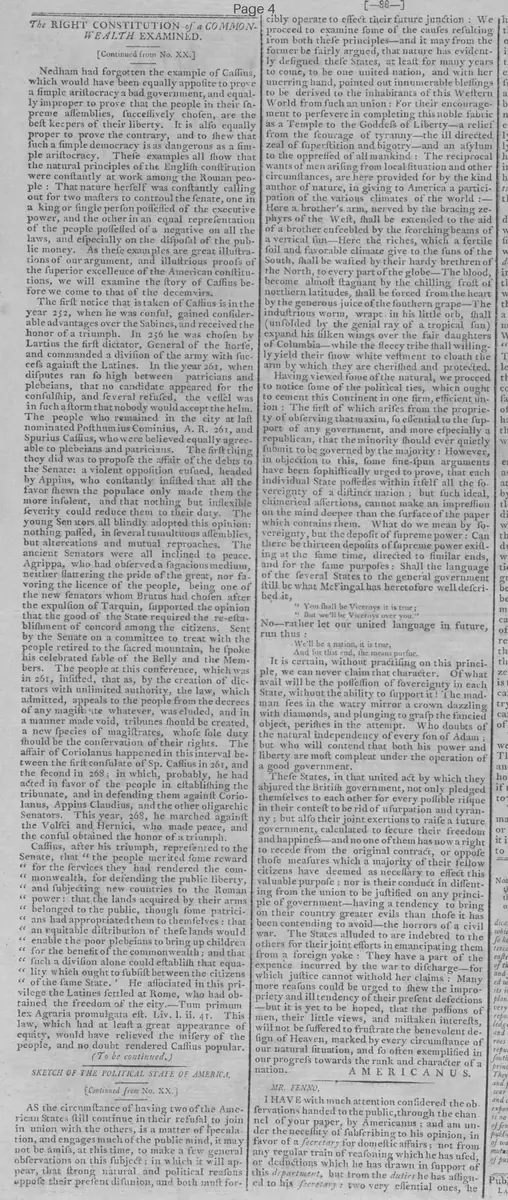
AS the circumstance of having two of the American States still continue in their refusal to join in union with the others, is a matter of speculation, and engages much of the public mind, it may not be amiss, at this time, to make a few general observations on this subject; in which it will appear, that strong natural and political reasons oppose their present disunion, and both must forcibly operate to effect their future junction: We proceed to examine some of the causes resulting from both these principles—and it may from the former be fairly argued, that nature has evidently designed these States, at least for many years to come, to be one united nation, and with her unerring hand, pointed out innumerable blessings to be derived to the inhabitants of this Western World from such an union: For their encouragement to persevere in completing this noble fabric as a Temple to the Goddess of Liberty—a relief from the scourge of tyranny—the ill directed zeal of superstition and bigotry—and an asylum to the oppressed of all mankind: The reciprocal wants of men arising from local situation and other circumstances, are here provided for by the kind author of nature, in giving to America a participation of the various climates of the world:—Here a brother's arm, nerved by the bracing zephyrs of the West, shall be extended to the aid of a brother enfeebled by the scorching beams of a vertical sun—Here the riches, which a fertile soil and favorable climate give to the sons of the South, shall be wafted by their hardy brethren of the North, to every part of the globe—The blood, become almost stagnant by the chilling frost of northern latitudes, shall be forced from the heart by the generous juice of the southern grape—The industrious worm, wrapt in his little orb, shall (unfolded by the genial ray of a tropical sun) expand his silken wings over the fair daughters of Columbia—while the fleecy tribe shall willingly yield their snow white vestment to clothe the arm by which they are cherished and protected.
Having viewed some of the natural, we proceed to notice some of the political ties, which ought to cement this Continent in one firm, efficient union: The first of which arises from the propriety of observing that maxim, so essential to the support of any government, and more especially a republican, that the minority should ever quietly submit to be governed by the majority: However, in objection to this, some fine-spun arguments have been sophistically urged to prove, that each individual State possesses within itself all the sovereignty of a distinct nation; but such ideal, chimerical assertions, cannot make an impression on the mind deeper than the surface of the paper which contains them. What do we mean by sovereignty, but the deposit of supreme power: Can there be thirteen deposits of supreme power existing at the same time, directed to similar ends, and for the same purposes: Shall the language of the several States to the general government still be what McFingal has heretofore well described it,
"You shall be Viceroys it is true;
But we'll be Viceroys over you."
No—rather let our united language in future, run thus:
We'll be a nation, it is true,
And for that end, the means pursue.
It is certain, without practicing on this principle, we can never claim that character. Of what avail will be the possession of sovereignty in each State, without the ability to support it! The madman sees in the watery mirror a crown dazzling with diamonds, and plunging to grasp the fancied object, perishes in the attempt. Who doubts of the natural independency of every son of Adam; but who will contend that both his power and liberty are most complete under the operation of a good government.
These States, in that united act by which they abjured the British government, not only pledged themselves to each other for every possible risque in their contest to be rid of usurpation and tyranny; but also their joint exertions to raise a future government, calculated to secure their freedom and happiness—and no one of them has now a right to recede from the original contract, or oppose those measures which a majority of their fellow citizens have deemed as necessary to effect this valuable purpose; nor is their conduct in dissenting from the union to be justified on any principle of government—having a tendency to bring on their country greater evils than those it has been contending to avoid—the horrors of a civil war.
The States alluded to are indebted to the others for their joint efforts in emancipating them from a foreign yoke: They have a part of the expense incurred by the war to discharge—for which justice cannot withhold her claims: Many more reasons could be urged to show the impropriety and ill tendency of their present defections—but it is yet to be hoped, that the passions of men, their little views, and mistaken interests, will not be suffered to frustrate the benevolent design of Heaven, marked by every circumstance of our natural situation, and so often exemplified in our progress towards the rank and character of a nation.
AMERICANUS.
[Continued from No. XX.]
AS the circumstance of having two of the American States still continue in their refusal to join in union with the others, is a matter of speculation, and engages much of the public mind, it may not be amiss, at this time, to make a few general observations on this subject; in which it will appear, that strong natural and political reasons oppose their present disunion, and both must forcibly operate to effect their future junction: We proceed to examine some of the causes resulting from both these principles—and it may from the former be fairly argued, that nature has evidently designed these States, at least for many years to come, to be one united nation, and with her unerring hand, pointed out innumerable blessings to be derived to the inhabitants of this Western World from such an union: For their encouragement to persevere in completing this noble fabric as a Temple to the Goddess of Liberty—a relief from the scourge of tyranny—the ill directed zeal of superstition and bigotry—and an asylum to the oppressed of all mankind: The reciprocal wants of men arising from local situation and other circumstances, are here provided for by the kind author of nature, in giving to America a participation of the various climates of the world:—Here a brother's arm, nerved by the bracing zephyrs of the West, shall be extended to the aid of a brother enfeebled by the scorching beams of a vertical sun—Here the riches, which a fertile soil and favorable climate give to the sons of the South, shall be wafted by their hardy brethren of the North, to every part of the globe—The blood, become almost stagnant by the chilling frost of northern latitudes, shall be forced from the heart by the generous juice of the southern grape—The industrious worm, wrapt in his little orb, shall (unfolded by the genial ray of a tropical sun) expand his silken wings over the fair daughters of Columbia—while the fleecy tribe shall willingly yield their snow white vestment to clothe the arm by which they are cherished and protected.
Having viewed some of the natural, we proceed to notice some of the political ties, which ought to cement this Continent in one firm, efficient union: The first of which arises from the propriety of observing that maxim, so essential to the support of any government, and more especially a republican, that the minority should ever quietly submit to be governed by the majority: However, in objection to this, some fine-spun arguments have been sophistically urged to prove, that each individual State possesses within itself all the sovereignty of a distinct nation; but such ideal, chimerical assertions, cannot make an impression on the mind deeper than the surface of the paper which contains them. What do we mean by sovereignty, but the deposit of supreme power: Can there be thirteen deposits of supreme power existing at the same time, directed to similar ends, and for the same purposes: Shall the language of the several States to the general government still be what McFingal has heretofore well described it,
"You shall be Viceroys it is true;
But we'll be Viceroys over you."
No—rather let our united language in future, run thus:
We'll be a nation, it is true,
And for that end, the means pursue.
It is certain, without practicing on this principle, we can never claim that character. Of what avail will be the possession of sovereignty in each State, without the ability to support it! The madman sees in the watery mirror a crown dazzling with diamonds, and plunging to grasp the fancied object, perishes in the attempt. Who doubts of the natural independency of every son of Adam; but who will contend that both his power and liberty are most complete under the operation of a good government.
These States, in that united act by which they abjured the British government, not only pledged themselves to each other for every possible risque in their contest to be rid of usurpation and tyranny; but also their joint exertions to raise a future government, calculated to secure their freedom and happiness—and no one of them has now a right to recede from the original contract, or oppose those measures which a majority of their fellow citizens have deemed as necessary to effect this valuable purpose; nor is their conduct in dissenting from the union to be justified on any principle of government—having a tendency to bring on their country greater evils than those it has been contending to avoid—the horrors of a civil war.
The States alluded to are indebted to the others for their joint efforts in emancipating them from a foreign yoke: They have a part of the expense incurred by the war to discharge—for which justice cannot withhold her claims: Many more reasons could be urged to show the impropriety and ill tendency of their present defections—but it is yet to be hoped, that the passions of men, their little views, and mistaken interests, will not be suffered to frustrate the benevolent design of Heaven, marked by every circumstance of our natural situation, and so often exemplified in our progress towards the rank and character of a nation.
AMERICANUS.
What sub-type of article is it?
Constitutional
Partisan Politics
What keywords are associated?
American Union
State Disunion
Republican Government
Sovereignty
Majority Rule
Civil War Risks
Independence Pledge
What entities or persons were involved?
American States
British Government
Mcfingal
Editorial Details
Primary Topic
Advocacy For Union Of American States Against Disunion
Stance / Tone
Strongly Pro Union And Anti Disunion
Key Figures
American States
British Government
Mcfingal
Key Arguments
Nature Designs The States For Union Through Diverse Climates Providing Mutual Benefits
Political Maxim Requires Minority Submission To Majority In Republican Government
State Sovereignty Claims Are Chimerical Without Ability To Support Independence
States Pledged Mutual Support In Independence And Cannot Recede From Union Contract
Disunion Risks Civil War And Greater Evils Than British Tyranny
Holdout States Owe Debt For Shared War Efforts And Emancipation