Thank you for visiting SNEWPapers!
Sign up free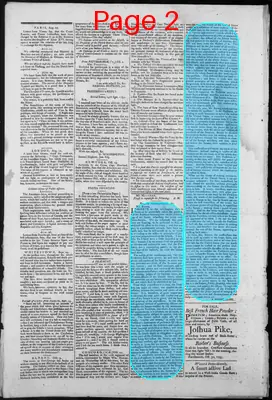
Editorial
November 3, 1795
The New Hampshire Gazette
Portsmouth, Rockingham County, New Hampshire
What is this article about?
An editorial letter argues that the U.S. President lacks veto power over the Senate's consent to treaties, interpreting the Constitution to grant the Senate final authority in ratification, using the British treaty as context. It emphasizes checks against executive overreach.
Clipping
OCR Quality
98%
Excellent
Full Text
From the Philadelphia Gazette.
Mr. Brown,
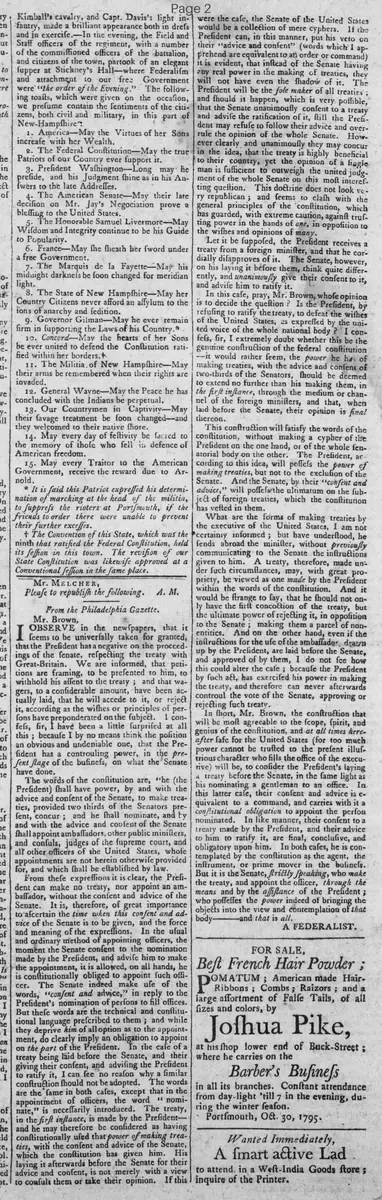
OBSERVE in the newspapers, that it seems to be universally taken for granted, that the President has a negative on the proceedings of the Senate, respecting the treaty with Great-Britain. We are informed, that petitions are framing, to be presented to him, to withhold his assent to the treaty; and that wagers, to a considerable amount, have been actually laid, that he will accede to it, or reject it, according as the wishes or principles of persons have preponderated on the subject. I confess, sir, I have been a little surprised at all this; because I by no means think the position an obvious and undeniable one, that the President has a controlling power, in the present stage of the business, on what the Senate have done.
The words of the constitution are, "he (the President) shall have power, by and with the advice and consent of the Senate, to make treaties, provided two thirds of the Senators present, concur; and he shall nominate, and by and with the advice and consent of the Senate shall appoint ambassadors, other public ministers, and consuls, judges of the supreme court, and all other officers of the United States, whose appointments are not herein otherwise provided for, and which shall be established by law."
From these expressions it is clear, the President can make no treaty, nor appoint an ambassador, without the consent and advice of the Senate. It is, therefore, of great importance to ascertain the time when this consent and advice of the Senate is to be given, and the force and meaning of the expressions. In the usual and ordinary method of appointing officers, the moment the Senate consent to the nomination made by the President, and advise him to make the appointment, it is allowed, on all hands, he is constitutionally obliged to appoint such officer. The Senate indeed make use of the words, "consent and advice," in reply to the President's nomination of persons to fill offices.
But these words are the technical and constitutional language prescribed to them; and while they deprive him of all option as to the appointment, do clearly imply an obligation to appoint on the part of the President. In the case of a treaty being laid before the Senate, and their giving their consent, and advising the President to ratify it, I can see no reason why a similar construction should not be adopted. The words are the same in both cases, except that in the appointment of officers, the word "nominate," is necessarily introduced. The treaty, in the first instance, is made by the President -- and he may therefore be considered as having constitutionally used that power of making treaties, with the consent and advice of the Senate, which the constitution has given him. His laying it afterwards before the Senate for their advice and consent, is not merely with a view to consult them or take their opinion. If this were the case, the Senate of the United States would be a collection of mere cyphers. If the President can, in this manner, put his veto on their "advice and consent" (words which I apprehend are equivalent to an order or command) it is evident, that instead of the Senate having any real power in the making of treaties, they will not have even the shadow of it. The President will be the sole maker of all treaties: and should it happen, which is very possible, that the Senate unanimously consent to a treaty and advise the ratification of it, still the President may refuse to follow their advice and overrule the opinion of the whole Senate. However clearly and unanimously they may concur in the idea, that the treaty is highly beneficial to their country, yet the opinion of a single man is sufficient to outweigh the united judgment of the whole Senate on this most interesting question. This doctrine does not look very republican; and seems to clash with the general principles of the constitution, which has guarded, with extreme caution, against trusting power in the hands of one, in opposition to the wishes and opinions of many.
Let it be supposed, the President receives a treaty from a foreign minister, and that he cordially disapproves of it. The Senate, however, on his laying it before them, think quite differently, and unanimously give their consent to it, and advise him to ratify it.
In this case, pray, Mr. Brown, whose opinion is to decide the question? Is the President, by refusing to ratify the treaty, to defeat the wishes of the United States, as expressed by the united voice of the whole national body? I confess, sir, I extremely doubt whether this be the genuine construction of the federal constitution -- it would rather seem, the power he has of making treaties, with the advice and consent of two-thirds of the Senators, should be deemed to extend no further than his making them, in the first instance, through the medium or channel of the foreign ministers, and that, when laid before the Senate, their opinion is final thereon.
This construction will satisfy the words of the constitution, without making a cypher of the President on the one hand, or of the whole senatorial body on the other. The President, according to this idea, will possess the power of making treaties, but not to the exclusion of the Senate. And the Senate, by their "consent and advice," will possess the ultimatum on the subject of foreign treaties, which the constitution has vested in them.
What are the forms of making treaties by the executive of the United States, I am not certainly informed; but have understood, he sends abroad the minister, without previously communicating to the Senate the instructions given to him. A treaty, therefore, made under such circumstances, may, with great propriety, be viewed as one made by the President within the words of the constitution. And it would be strange to say, that he should not only have the first concoction of the treaty, but the ultimate power of rejecting it, in opposition to the Senate; making them a parcel of non-entities. And on the other hand, even if the instructions for the use of the ambassador, drawn up by the President, are laid before the Senate, and approved of by them, I do not see how this could alter the case; because the President by such act, has exercised his power in making the treaty, and therefore can never afterwards control the vote of the Senate, approving or rejecting such treaty.
In short, Mr. Brown, the construction that will be most agreeable to the scope, spirit, and genius of the constitution, and at all times safest for the United States (for too much power cannot be trusted to the present illustrious character who fills the office of the executive) will be, to consider the President's laying a treaty before the Senate, in the same light as his nominating a gentleman to an office. In this latter case, their consent and advice is equivalent to a command, and carries with it a constitutional obligation to appoint the person nominated. In like manner, their consent to a treaty made by the President, and their advice to him to ratify it, are final, conclusive, and obligatory upon him. In both cases, he is contemplated by the constitution as the agent, the instrument, or prime mover in the business.
But it is the Senate, strictly speaking, who make the treaty, and appoint the officer, through the means and by the assistance of the President: who possesses the power indeed of bringing the objects into the view and contemplation of that body -- and that is all.
A FEDERALIST.
Mr. Brown,
OBSERVE in the newspapers, that it seems to be universally taken for granted, that the President has a negative on the proceedings of the Senate, respecting the treaty with Great-Britain. We are informed, that petitions are framing, to be presented to him, to withhold his assent to the treaty; and that wagers, to a considerable amount, have been actually laid, that he will accede to it, or reject it, according as the wishes or principles of persons have preponderated on the subject. I confess, sir, I have been a little surprised at all this; because I by no means think the position an obvious and undeniable one, that the President has a controlling power, in the present stage of the business, on what the Senate have done.
The words of the constitution are, "he (the President) shall have power, by and with the advice and consent of the Senate, to make treaties, provided two thirds of the Senators present, concur; and he shall nominate, and by and with the advice and consent of the Senate shall appoint ambassadors, other public ministers, and consuls, judges of the supreme court, and all other officers of the United States, whose appointments are not herein otherwise provided for, and which shall be established by law."
From these expressions it is clear, the President can make no treaty, nor appoint an ambassador, without the consent and advice of the Senate. It is, therefore, of great importance to ascertain the time when this consent and advice of the Senate is to be given, and the force and meaning of the expressions. In the usual and ordinary method of appointing officers, the moment the Senate consent to the nomination made by the President, and advise him to make the appointment, it is allowed, on all hands, he is constitutionally obliged to appoint such officer. The Senate indeed make use of the words, "consent and advice," in reply to the President's nomination of persons to fill offices.
But these words are the technical and constitutional language prescribed to them; and while they deprive him of all option as to the appointment, do clearly imply an obligation to appoint on the part of the President. In the case of a treaty being laid before the Senate, and their giving their consent, and advising the President to ratify it, I can see no reason why a similar construction should not be adopted. The words are the same in both cases, except that in the appointment of officers, the word "nominate," is necessarily introduced. The treaty, in the first instance, is made by the President -- and he may therefore be considered as having constitutionally used that power of making treaties, with the consent and advice of the Senate, which the constitution has given him. His laying it afterwards before the Senate for their advice and consent, is not merely with a view to consult them or take their opinion. If this were the case, the Senate of the United States would be a collection of mere cyphers. If the President can, in this manner, put his veto on their "advice and consent" (words which I apprehend are equivalent to an order or command) it is evident, that instead of the Senate having any real power in the making of treaties, they will not have even the shadow of it. The President will be the sole maker of all treaties: and should it happen, which is very possible, that the Senate unanimously consent to a treaty and advise the ratification of it, still the President may refuse to follow their advice and overrule the opinion of the whole Senate. However clearly and unanimously they may concur in the idea, that the treaty is highly beneficial to their country, yet the opinion of a single man is sufficient to outweigh the united judgment of the whole Senate on this most interesting question. This doctrine does not look very republican; and seems to clash with the general principles of the constitution, which has guarded, with extreme caution, against trusting power in the hands of one, in opposition to the wishes and opinions of many.
Let it be supposed, the President receives a treaty from a foreign minister, and that he cordially disapproves of it. The Senate, however, on his laying it before them, think quite differently, and unanimously give their consent to it, and advise him to ratify it.
In this case, pray, Mr. Brown, whose opinion is to decide the question? Is the President, by refusing to ratify the treaty, to defeat the wishes of the United States, as expressed by the united voice of the whole national body? I confess, sir, I extremely doubt whether this be the genuine construction of the federal constitution -- it would rather seem, the power he has of making treaties, with the advice and consent of two-thirds of the Senators, should be deemed to extend no further than his making them, in the first instance, through the medium or channel of the foreign ministers, and that, when laid before the Senate, their opinion is final thereon.
This construction will satisfy the words of the constitution, without making a cypher of the President on the one hand, or of the whole senatorial body on the other. The President, according to this idea, will possess the power of making treaties, but not to the exclusion of the Senate. And the Senate, by their "consent and advice," will possess the ultimatum on the subject of foreign treaties, which the constitution has vested in them.
What are the forms of making treaties by the executive of the United States, I am not certainly informed; but have understood, he sends abroad the minister, without previously communicating to the Senate the instructions given to him. A treaty, therefore, made under such circumstances, may, with great propriety, be viewed as one made by the President within the words of the constitution. And it would be strange to say, that he should not only have the first concoction of the treaty, but the ultimate power of rejecting it, in opposition to the Senate; making them a parcel of non-entities. And on the other hand, even if the instructions for the use of the ambassador, drawn up by the President, are laid before the Senate, and approved of by them, I do not see how this could alter the case; because the President by such act, has exercised his power in making the treaty, and therefore can never afterwards control the vote of the Senate, approving or rejecting such treaty.
In short, Mr. Brown, the construction that will be most agreeable to the scope, spirit, and genius of the constitution, and at all times safest for the United States (for too much power cannot be trusted to the present illustrious character who fills the office of the executive) will be, to consider the President's laying a treaty before the Senate, in the same light as his nominating a gentleman to an office. In this latter case, their consent and advice is equivalent to a command, and carries with it a constitutional obligation to appoint the person nominated. In like manner, their consent to a treaty made by the President, and their advice to him to ratify it, are final, conclusive, and obligatory upon him. In both cases, he is contemplated by the constitution as the agent, the instrument, or prime mover in the business.
But it is the Senate, strictly speaking, who make the treaty, and appoint the officer, through the means and by the assistance of the President: who possesses the power indeed of bringing the objects into the view and contemplation of that body -- and that is all.
A FEDERALIST.
What sub-type of article is it?
Constitutional
Foreign Affairs
What keywords are associated?
Treaty Ratification
Presidential Veto
Senate Consent
Constitutional Interpretation
Jay Treaty
Federalist Views
What entities or persons were involved?
President
Senate
Constitution
Treaty With Great Britain
Editorial Details
Primary Topic
Presidential Power Over Senate Consent To Treaties
Stance / Tone
Opposition To Presidential Veto On Treaty Ratification
Key Figures
President
Senate
Constitution
Treaty With Great Britain
Key Arguments
President Cannot Veto Senate's Advice And Consent On Treaties
Senate's Consent Is Equivalent To A Command, Obligating Ratification
Constitutional Language Parallels Appointments Where Senate Consent Binds President
Granting Veto Power Undermines Senate's Role And Republican Principles
President Acts As Agent; Senate Holds Ultimate Authority On Treaties