Thank you for visiting SNEWPapers!
Sign up free
Story
June 29, 1951
St. Paul Recorder
Saint Paul, Ramsey County, Minnesota
What is this article about?
Josephine Baker, at Cincinnati railroad station, speaks passionately against racial discrimination, cancels segregated engagements, praises interracial unity for democracy, and interacts warmly with Korean War soldiers and a baby, emphasizing first-class citizenship.
Clipping
OCR Quality
98%
Excellent
Full Text
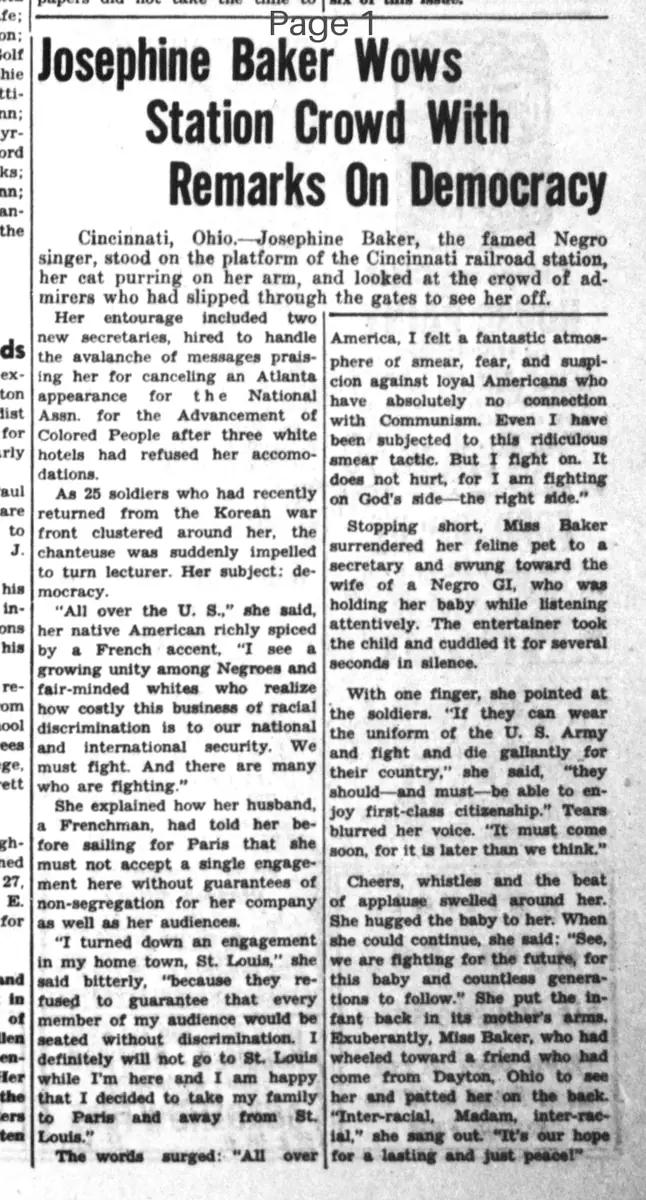
Josephine Baker Wows Station Crowd d With Remarks On Democracy
Cincinnati, Ohio.—Josephine Baker, the famed Negro singer, stood on the platform of the Cincinnati railroad station, her cat purring on her arm, and looked at the crowd of admirers who had slipped through the gates to see her off.
Her entourage included two new secretaries, hired to handle the avalanche of messages praising her for canceling an Atlanta appearance for the National Assn. for the Advancement of Colored People after three white hotels had refused her accommodations.
As 25 soldiers who had recently returned from the Korean war front clustered around her, the chanteuse was suddenly impelled to turn lecturer. Her subject: democracy.
"All over the U. S.," she said, her native American richly spiced by a French accent, "I see a growing unity among Negroes and fair-minded whites who realize how costly this business of racial discrimination is to our national and international security. We must fight. And there are many who are fighting."
She explained how her husband, a Frenchman, had told her before sailing for Paris that she must not accept a single engagement here without guarantees of non-segregation for her company as well as her audiences.
"I turned down an engagement in my home town, St. Louis," she said bitterly, "because they refused to guarantee that every member of my audience would be seated without discrimination. I definitely will not go to St. Louis while I'm here and I am happy that I decided to take my family to Paris and away from St. Louis."
The words surged: "All over America, I felt a fantastic atmosphere of smear, fear, and suspicion against loyal Americans who have absolutely no connection with Communism. Even I have been subjected to this ridiculous smear tactic. But I fight on. It does not hurt, for I am fighting on God's side—the right side."
Stopping short, Miss Baker surrendered her feline pet to a secretary and swung toward the wife of a Negro GI, who was holding her baby while listening attentively. The entertainer took the child and cuddled it for several seconds in silence.
With one finger, she pointed at the soldiers. "If they can wear the uniform of the U. S. Army and fight and die gallantly for their country," she said, "they should—and must—be able to enjoy first-class citizenship." Tears blurred her voice. It must come soon, for it is later than we think.
Cheers, whistles and the beat of applause swelled around her. She hugged the baby to her. When she could continue, she said: "See, we are fighting for the future, for this baby and countless generations to follow." She put the infant back in its mother's arms.
Exuberantly, Miss Baker, who had wheeled toward a friend who had come from Dayton, Ohio to see her and patted her on the back.
"Inter-racial, Madam, inter-racial," she sang out. "It's our hope for a lasting and just peace!"
Cincinnati, Ohio.—Josephine Baker, the famed Negro singer, stood on the platform of the Cincinnati railroad station, her cat purring on her arm, and looked at the crowd of admirers who had slipped through the gates to see her off.
Her entourage included two new secretaries, hired to handle the avalanche of messages praising her for canceling an Atlanta appearance for the National Assn. for the Advancement of Colored People after three white hotels had refused her accommodations.
As 25 soldiers who had recently returned from the Korean war front clustered around her, the chanteuse was suddenly impelled to turn lecturer. Her subject: democracy.
"All over the U. S.," she said, her native American richly spiced by a French accent, "I see a growing unity among Negroes and fair-minded whites who realize how costly this business of racial discrimination is to our national and international security. We must fight. And there are many who are fighting."
She explained how her husband, a Frenchman, had told her before sailing for Paris that she must not accept a single engagement here without guarantees of non-segregation for her company as well as her audiences.
"I turned down an engagement in my home town, St. Louis," she said bitterly, "because they refused to guarantee that every member of my audience would be seated without discrimination. I definitely will not go to St. Louis while I'm here and I am happy that I decided to take my family to Paris and away from St. Louis."
The words surged: "All over America, I felt a fantastic atmosphere of smear, fear, and suspicion against loyal Americans who have absolutely no connection with Communism. Even I have been subjected to this ridiculous smear tactic. But I fight on. It does not hurt, for I am fighting on God's side—the right side."
Stopping short, Miss Baker surrendered her feline pet to a secretary and swung toward the wife of a Negro GI, who was holding her baby while listening attentively. The entertainer took the child and cuddled it for several seconds in silence.
With one finger, she pointed at the soldiers. "If they can wear the uniform of the U. S. Army and fight and die gallantly for their country," she said, "they should—and must—be able to enjoy first-class citizenship." Tears blurred her voice. It must come soon, for it is later than we think.
Cheers, whistles and the beat of applause swelled around her. She hugged the baby to her. When she could continue, she said: "See, we are fighting for the future, for this baby and countless generations to follow." She put the infant back in its mother's arms.
Exuberantly, Miss Baker, who had wheeled toward a friend who had come from Dayton, Ohio to see her and patted her on the back.
"Inter-racial, Madam, inter-racial," she sang out. "It's our hope for a lasting and just peace!"
What sub-type of article is it?
Biography
Historical Event
Heroic Act
What themes does it cover?
Bravery Heroism
Justice
Social Manners
What keywords are associated?
Josephine Baker
Racial Discrimination
Civil Rights
Democracy
Korean War Soldiers
Interracial Unity
What entities or persons were involved?
Josephine Baker
Where did it happen?
Cincinnati Railroad Station, Ohio
Story Details
Key Persons
Josephine Baker
Location
Cincinnati Railroad Station, Ohio
Story Details
Josephine Baker addresses a crowd at Cincinnati station, discusses canceling segregated engagements in Atlanta and St. Louis due to discrimination, praises interracial unity against racial bias and McCarthyism smears, interacts with Korean War soldiers and a baby, advocating for first-class citizenship and peace.