Thank you for visiting SNEWPapers!
Sign up free
New Hampshire Statesman
Concord, Merrimack County, New Hampshire
What is this article about?
Report on U.S. House debates in January 1824 over resolutions supporting Greek independence (Webster's) and opposing European intervention in the Americas (Clay's), with speeches by Poinsett, Randolph, Dwight, Cary, and Baylies opposing or supporting, ending with resolutions printed and adjournment.
Clipping
OCR Quality
Full Text
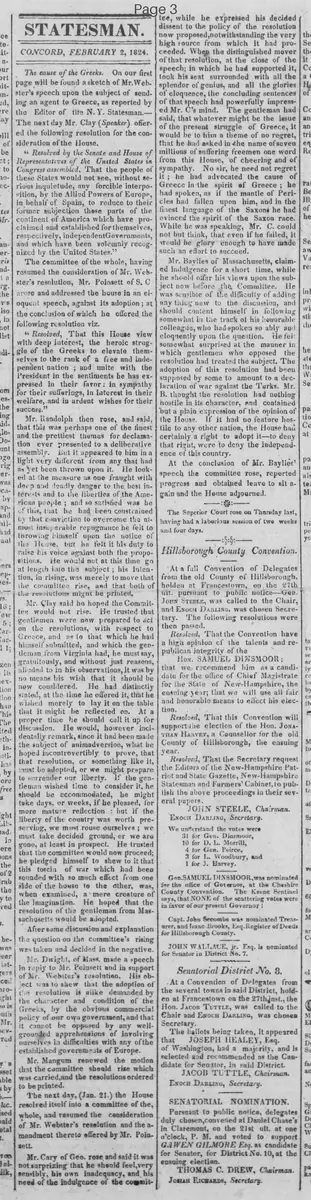
CONCORD, FEBRUARY 2, 1824.
The cause of the Greeks.
On our first page will be found a sketch of Mr. Webster's speech upon the subject of sending an agent to Greece, as reported by the Editor of the N. Y. Statesman.—The next day Mr. Clay (Speaker) offered the following resolution for the consideration of the House.
"Resolved by the Senate and House of Representatives of the United States in Congress assembled, That the people of these States would not see, without serious inquietude, any forcible interposition, by the Allied Powers of Europe, in behalf of Spain, to reduce to their former subjection those parts of the continent of America which have proclaimed and established for themselves, respectively, independent Governments, and which have been solemnly recognized by the United States."
The committee of the whole, having resumed the consideration of Mr. Webster's resolution, Mr. Poinsett of S. C. arose and addressed the house in an eloquent speech, against its adoption; at the conclusion of which he offered the following resolution viz.
"Resolved, That this House view with deep interest, the heroic struggle of the Greeks to elevate themselves to the rank of a free and independent nation; and unite with the President in the sentiments he has expressed in their favor: in sympathy for their sufferings, in interest in their welfare, and in ardent wishes for their success."
Mr. Randolph then rose, and said, that this was perhaps one of the finest and the prettiest themes for declamation ever presented to a deliberative assembly. But it appeared to him in a light very different from any that had as yet been thrown upon it. He looked at the measure as one fraught with deep and deadly danger to the best interests and to the liberties of the American people; and so satisfied was he of this, that he had been constrained by that conviction to overcome the almost insuperable repugnance he felt to throwing himself upon the notice of the House, but he felt it his duty to raise his voice against both the propositions. He would not at this time go at length into the subject; his intention, in rising, was merely to move that the committee rise, and that both of the resolutions might be printed.
Mr. Clay said he hoped the Committee would not rise. He trusted that gentlemen were now prepared to act on the resolutions, with respect to Greece, and as to that which he had himself submitted, and which the gentleman from Virginia had, he must say, gratuitously, and without just reasons, alluded to in his observations, it was by no means his wish that it should be now considered. He had distinctly stated, at the time he offered it, that he wished merely to lay it on the table that it might be reflected on. At a proper time he should call it up for discussion. He would, however incidentally remark, since it had been made the subject of animadversion, what he hoped incontrovertibly to prove, that that resolution, or something like it, must be adopted, or we might prepare to surrender our liberty. If the gentleman wished time, to consider it, he should be accommodated, he might take days, or weeks, if he pleased, for more mature reflection: but if the liberty of the country was worth preserving, we must rouse ourselves; we must take decided ground, or we are gone, at least in prospect. He trusted that the committee would now proceed; he pledged himself to shew to it that this tocsin of war which had been sounded with so much effect from one side of the house to the other, was, when examined, a mere creature of the imagination. He hoped that the resolution of the gentleman from Massachusetts would be adopted.
After some discussion and explanation the question on the committee's rising was taken and decided in the negative.
Mr. Dwight, of Mass. made a speech in reply to Mr. Poinsett and in support of Mr. Webster's resolution. His object was to shew that the adoption of the resolution is alike demanded by the character and condition of the Greeks, by the obvious commercial policy of our own government, and that it cannot be opposed by any well-grounded apprehensions of involving ourselves in difficulties with any of the established governments of Europe.
Mr. Mangum renewed the motion that the committee should rise which was carried, and the resolutions ordered to be printed.
The next day, (Jan. 21.) the House resolved itself into a committee of the whole, and resumed the consideration of Mr. Webster's resolution and the amendment thereto offered by Mr. Poinsett.
Mr. Cary of Geo. rose and said it was not surprizing that he should feel, very sensibly, his own inadequacy, and his need of the indulgence of the committee, while he expressed his decided dissent to the policy of the resolution now proposed, notwithstanding the very high source from which it had proceeded. When the distinguished mover of that resolution, at the close of the speech, in which he had supported it, took his seat surrounded with all the splendor of genius, and all the glories of eloquence, the concluding sentences of that speech had powerfully impressed Mr. C's mind. The gentleman had said, that whatever might be the issue of the present struggle of Greece, it would be to him a theme of no regret, that he had asked in the name of seven millions of suffering freemen one word from this House, of cheering and of sympathy. No sir, he need not regret it; he had advocated the cause of Greece in the spirit of Greece; he had spoken, as if the mantle of Pericles had fallen upon him, and in the finest language of the Saxon he had evinced the spirit of the Saxon race. While he was speaking, Mr. C. could not but think, that even if he failed, it would be glory enough to have made such an effort to succeed.
Mr. Baylies of Massachusetts, claimed indulgence for a short time, while he should offer his views upon the subject now before the Committee. He was sensible of the difficulty of adding any thing new to the discussion, and should content himself in following somewhat in the track of his honourable colleague, who had spoken so ably and eloquently upon the question. He felt somewhat surprised at the manner in which gentlemen who opposed the resolution had treated the subject. The adoption of this resolution had been supposed by some to amount to a declaration of war against the Turks. Mr. B. thought the resolution had nothing hostile in its character, and contained but a plain expression of the opinion of the House. If it had no feature hostile to any other nation, the House had certainly a right to adopt it—to deny that right, were to deny the independence of this country.
At the conclusion of Mr. Baylies' speech the committee rose, reported progress and obtained leave to sit again and the House adjourned.
What sub-type of article is it?
What keywords are associated?
What entities or persons were involved?
Where did it happen?
Domestic News Details
Primary Location
United States House Of Representatives
Event Date
January 1824
Key Persons
Outcome
resolutions ordered to be printed; committee rose and reported progress; house adjourned.
Event Details
Debates in the House on Mr. Webster's resolution to send an agent to Greece and Mr. Clay's resolution opposing European intervention in the Americas, with opposing speeches by Poinsett and Randolph, supporting speeches by Dwight and Baylies, and dissent from Cary; Poinsett offered an amendment expressing sympathy for Greeks.