Thank you for visiting SNEWPapers!
Sign up free
Editorial
July 28, 1943
Midland Cooperator
Minneapolis, Hennepin County, Minnesota
What is this article about?
This editorial discusses the significance of five Midwest cooperatives purchasing a refinery, urging them to prioritize their social gospel and revolutionary principles over mere business operations to influence economic and social life, warning of opposition from capitalist forces if they do so.
Clipping
OCR Quality
98%
Excellent
Full Text
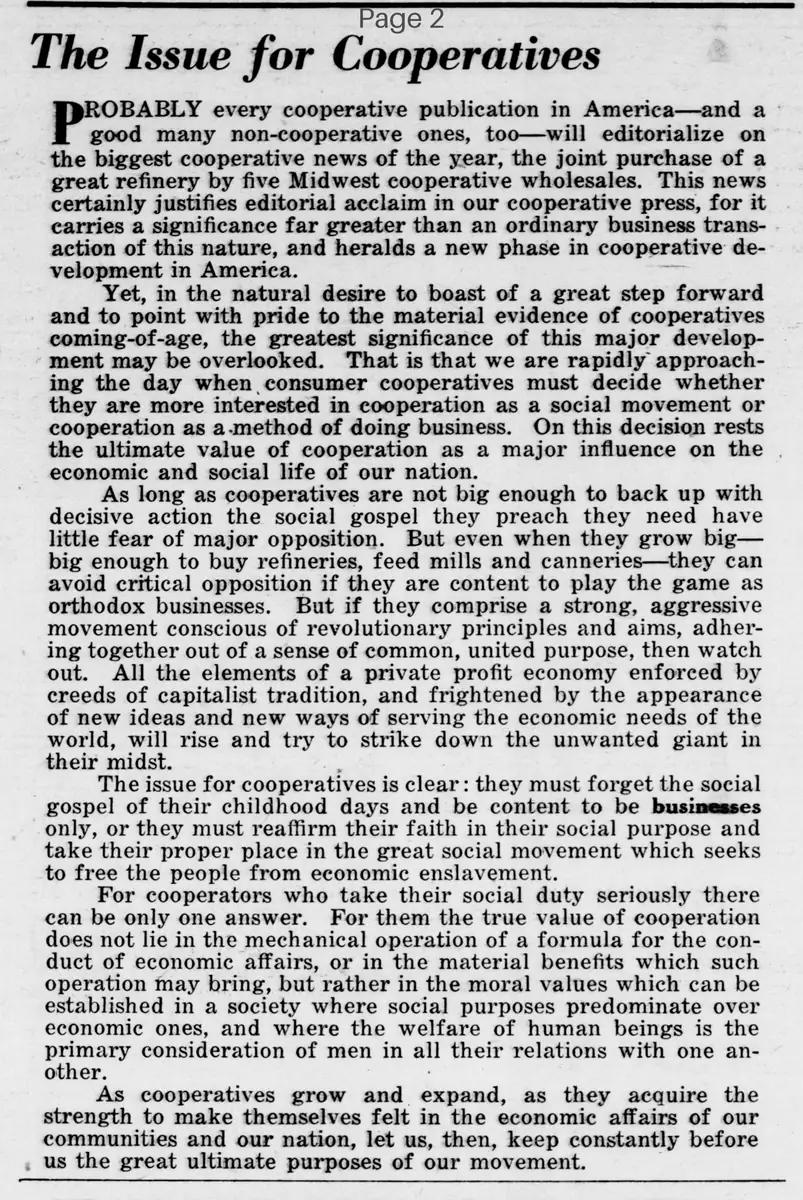
The Issue for Cooperatives
Probably every cooperative publication in America—and a good many non-cooperative ones, too—will editorialize on the biggest cooperative news of the year, the joint purchase of a great refinery by five Midwest cooperative wholesales. This news certainly justifies editorial acclaim in our cooperative press, for it carries a significance far greater than an ordinary business transaction of this nature, and heralds a new phase in cooperative development in America.
Yet, in the natural desire to boast of a great step forward and to point with pride to the material evidence of cooperatives coming-of-age, the greatest significance of this major development may be overlooked. That is that we are rapidly approaching the day when consumer cooperatives must decide whether they are more interested in cooperation as a social movement or cooperation as a method of doing business. On this decision rests the ultimate value of cooperation as a major influence on the economic and social life of our nation.
As long as cooperatives are not big enough to back up with decisive action the social gospel they preach they need have little fear of major opposition. But even when they grow big—big enough to buy refineries, feed mills and canneries—they can avoid critical opposition if they are content to play the game as orthodox businesses. But if they comprise a strong, aggressive movement conscious of revolutionary principles and aims, adhering together out of a sense of common, united purpose, then watch out. All the elements of a private profit economy enforced by creeds of capitalist tradition, and frightened by the appearance of new ideas and new ways of serving the economic needs of the world, will rise and try to strike down the unwanted giant in their midst.
The issue for cooperatives is clear: they must forget the social gospel of their childhood days and be content to be businesses only, or they must reaffirm their faith in their social purpose and take their proper place in the great social movement which seeks to free the people from economic enslavement.
For cooperators who take their social duty seriously there can be only one answer. For them the true value of cooperation does not lie in the mechanical operation of a formula for the conduct of economic affairs, or in the material benefits which such operation may bring, but rather in the moral values which can be established in a society where social purposes predominate over economic ones, and where the welfare of human beings is the primary consideration of men in all their relations with one another.
As cooperatives grow and expand, as they acquire the strength to make themselves felt in the economic affairs of our communities and our nation, let us, then, keep constantly before us the great ultimate purposes of our movement.
Probably every cooperative publication in America—and a good many non-cooperative ones, too—will editorialize on the biggest cooperative news of the year, the joint purchase of a great refinery by five Midwest cooperative wholesales. This news certainly justifies editorial acclaim in our cooperative press, for it carries a significance far greater than an ordinary business transaction of this nature, and heralds a new phase in cooperative development in America.
Yet, in the natural desire to boast of a great step forward and to point with pride to the material evidence of cooperatives coming-of-age, the greatest significance of this major development may be overlooked. That is that we are rapidly approaching the day when consumer cooperatives must decide whether they are more interested in cooperation as a social movement or cooperation as a method of doing business. On this decision rests the ultimate value of cooperation as a major influence on the economic and social life of our nation.
As long as cooperatives are not big enough to back up with decisive action the social gospel they preach they need have little fear of major opposition. But even when they grow big—big enough to buy refineries, feed mills and canneries—they can avoid critical opposition if they are content to play the game as orthodox businesses. But if they comprise a strong, aggressive movement conscious of revolutionary principles and aims, adhering together out of a sense of common, united purpose, then watch out. All the elements of a private profit economy enforced by creeds of capitalist tradition, and frightened by the appearance of new ideas and new ways of serving the economic needs of the world, will rise and try to strike down the unwanted giant in their midst.
The issue for cooperatives is clear: they must forget the social gospel of their childhood days and be content to be businesses only, or they must reaffirm their faith in their social purpose and take their proper place in the great social movement which seeks to free the people from economic enslavement.
For cooperators who take their social duty seriously there can be only one answer. For them the true value of cooperation does not lie in the mechanical operation of a formula for the conduct of economic affairs, or in the material benefits which such operation may bring, but rather in the moral values which can be established in a society where social purposes predominate over economic ones, and where the welfare of human beings is the primary consideration of men in all their relations with one another.
As cooperatives grow and expand, as they acquire the strength to make themselves felt in the economic affairs of our communities and our nation, let us, then, keep constantly before us the great ultimate purposes of our movement.
What sub-type of article is it?
Social Reform
Economic Policy
Moral Or Religious
What keywords are associated?
Cooperatives
Social Movement
Economic Reform
Social Gospel
Revolutionary Principles
Capitalist Opposition
What entities or persons were involved?
Midwest Cooperative Wholesales
Consumer Cooperatives
Private Profit Economy
Editorial Details
Primary Topic
Social Purpose Of Cooperatives Versus Business Operations
Stance / Tone
Advocacy For Reaffirming Social Gospel And Revolutionary Principles
Key Figures
Midwest Cooperative Wholesales
Consumer Cooperatives
Private Profit Economy
Key Arguments
Joint Purchase Of Refinery Heralds New Phase In Cooperative Development
Cooperatives Must Choose Between Social Movement Or Business Method
Growing Cooperatives Face Opposition If Pursuing Revolutionary Aims
Reaffirm Social Purpose To Free People From Economic Enslavement
True Value Lies In Moral Values Prioritizing Human Welfare