Thank you for visiting SNEWPapers!
Sign up free
The Washington Union
Washington, District Of Columbia
What is this article about?
Editorial from the Southern Citizen in Washington, D.C., on Dec. 4, 1858, critiquing the divided Democratic Party, northern dominance, and southern compromises. It demands repeal of slave trade bans, resistance to compromises, and federal protection for slavery in territories, threatening to become abolitionist if unmet by 1859.
Clipping
OCR Quality
Full Text
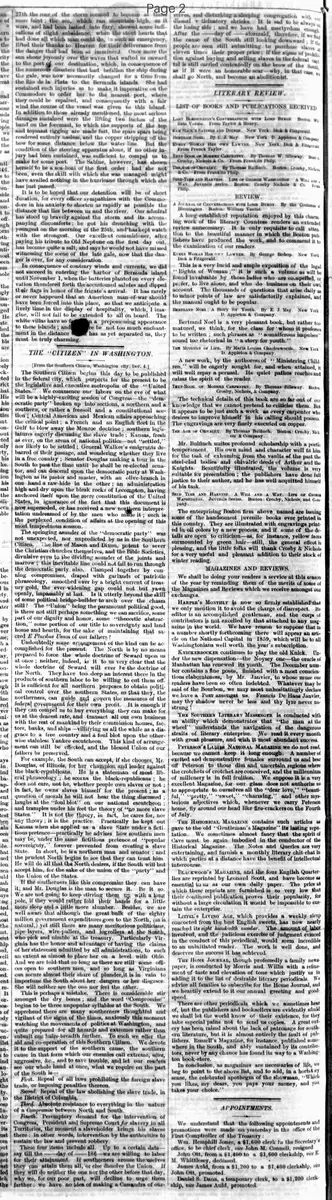
[From the Southern Citizen, Washington city, Dec. 4.]
The Southern Citizen begins this day to be published in the federal city, which purports for the present to be the legislative and executive metropolis of the 'United States.' We commence our labors on the eve of what will be a highly-exciting session of Congress—the 'democratic party' broken up into sections, a northern and a southern, or rather a freesoil and a constitutional section; Central American and Mexican affairs approaching the critical point; a French and an English fleet in the Gulf to blow away the Monroe doctrine; southern legislatures eagerly discussing the slave trade; Kansas, fresh as ever, on the arena of national politics—not 'settled,' nor likely to be settled; General Walker's emigrants debarred of their passage, and wondering whether they live in a free country; Senator Douglas making a tour in the South to pass the time until he shall be re-elected senator, and can descend upon the democratic party at Washington as its pastor and master, with an olive-branch in one hand a raw-hide in the other; an administration high and dry upon the bleak rocks of Lecompton, having anchored itself upon the mere constitution of the United States, in ignorance of the fact that this document is now superseded, or has received a new northern interpretation undreamed of by the men who made it; such is the perplexed condition of affairs at the opening of this most tempestuous session.
The springing asunder of the 'democratic party' was not unexpected, nor unpredicted by us in the Southern Citizen. The line of Mason and Dixon, potent to sever the Christian churches themselves, and the Bible Societies, divisive even to the dividing asunder of the joints and marrow; this inevitable line could not fail to run through the democratic party also. Clamped together by cunning compromises, draped with garlands of patriotic phraseology, smoothed over by a bright current of treasury gold, the ever-widening gap could not but yawn openly, impassably at last. Is it utterly beyond the skill of some political bridge-builder to arch over the chasm still? The 'Union' being the paramount political good is there not still perhaps something we can sacrifice, some part of our dignity and honor, some theoretic abstraction, some portion of our title to sovereignty and land home and hearth, for the sake of maintaining that sacred E Pluribus Unum of our fathers?
Undoubtedly some arrangement of the kind can be accomplished for the present. The North is by no means prepared to force the whole doctrine of Seward upon us at once; neither, indeed, is it to us very clear that the whole doctrine of Seward will ever be the doctrine of the North. They have too deep an interest there in the products of southern labor to be willing to cut them off. It is sufficient for all northern purposes to obtain political control over the southern States, so that they, the northerners, can guide and govern the measures of the federal government for their own profit. It is enough if they can compel us to buy everything they can make for us at the dearest rate, and transact all our own business with the rest of mankind by their commission houses, factors, banks, and ships—villifying us all the while as a disgrace to a free country and a foul blot upon the otherwise stainless Yankee escutcheon. This kind of arrangement can still be effected, and the blessed Union of our fathers be preserved.
For example, the South can accept, if she chooses, Mr. Douglas, of Illinois, for her champion and leader against the black-republicans. He is a statesman of most liberal phraseology; he scorns the black-republicans; he does not care, not he, whether people own slaves or not; in fact, he owns slaves himself for the present; as a question of morals he will not hear the thing discussed; laughs at the 'foul blot' on our national escutcheon; and tramples under his feet the theory of 'no more slave States.' It is not the theory, in fact, he cares for, nor any theory; it is the practice. Practically he kept out Kansas when she applied as a slave State under a fictitious pretence—practically he advises how southern men may be, under the same fictitious pretence of 'popular sovereignty,' forever prevented from creating a slave State. In short, he is a northern man and senator; and the prudent North begins to see that they can trust him. He will do all that the North desires, if the South will but accept him, for the sake of the union of the 'party' and the Union of the States.
If the southerners like this compromise they can have it; and Mr. Douglas is the man to secure it. Be it so. We are not going to keep stirring them up with a long pole, if they would rather fold their hands for a little more sleep and a little more slumber. Besides, we are well aware that although the great bulk of the eighty million government expenditures goes to the North, (as is natural,) yet still there are many meritorious politicians, pipe-layers, wire-pullers, and logrollers at the South, who pick and nibble at the treasury. Particularly Virginia has the honor and advantage of having the claims of her statesmen admitted by all administrations, to such an extent as almost to place her on a level with Ohio. And we are told that so long as there are still some offices open to southern men, and so long as Virginians can secure almost their share of plunder, it is in vain to importune the South about her dangers or her disgrace. She will neither see the one nor feel the other.
This is perhaps a mistake. There is considerable stir amongst the dry bones; and the word 'Compromise' begins to be three unpopular syllables at the South. We apprehend there are many southerners thoughtful and vigilant of the signs of the times, anxiously this moment watching the movements of politics at Washington, and quite prepared for all hazards and extremes rather than submit one hair's-breadth further. To such we offer the aid and co-operation of this Southern Citizen. We devote it to the support of the southern cause, the southern cause in that form which our enemies call extreme, ultra, aggressive, &c., and to save trouble, and let our readers see our whole hand at once, what we require on the part of the South is:
First. Repeal of all laws prohibiting the foreign slave trade, or imposing penalties thereon.
Second. Repeal of the law abolishing the slave trade, in the District of Columbia.
Third. Absolute resistance to everything in the nature of a Compromise between North and South.
Fourth. Peremptory demand for the intervention of Congress, President and Supreme Court for slavery in all Territories, the moment a slaveholder brings his slaves there: in other words, intervention by the authorities to sustain the law and prevent robbery.
These four items include all. Up to a certain date—say till the — day of — 1859—we are willing to labor for their attainment. If southerners arouse themselves they can attain them all, or else dissolve the Union. If they will do neither the one nor the other before that day, why we, for our poor part, will decline to urge them farther: we have no idea of making a Cassandra of ourselves, and disturbing a sleeping congregation with our dismal vaticinatory shrieks. It is sad to be always on the losing side; and we have had martyrdom enough.
After the — day of aforesaid, therefore, if we find the cause of the South still looking downward; if the people are seen still submitting to purchase slaves at eleven times their proper price; if the stigma of prohibition against buying and selling slaves in the federal capital is still carried contentedly on the brow of the South, as if it were an honorable scar—why, in that case, we shall go North, and become an abolitionist.
What sub-type of article is it?
What themes does it cover?
What keywords are associated?
What entities or persons were involved?
Where did it happen?
Story Details
Key Persons
Location
Washington City
Event Date
Dec. 4, 1858
Story Details
The Southern Citizen editorial describes the divided Democratic Party along sectional lines, critiques northern political control and compromises, and demands repeal of slave trade prohibitions, resistance to further compromises, and federal intervention to protect slavery in territories, with a deadline of 1859 or dissolution of the Union.