Thank you for visiting SNEWPapers!
Sign up free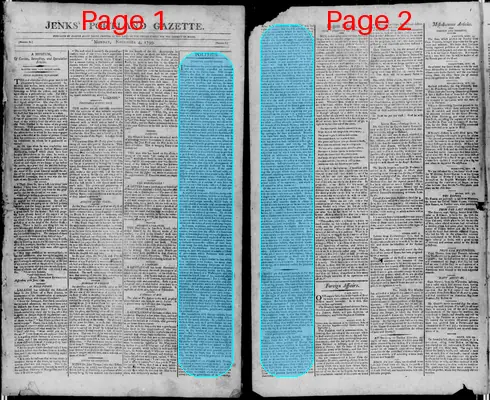
Jenks's Portland Gazette
Portland, Cumberland County, Maine
What is this article about?
This editorial examines the dangers of passionate and misguided public opinion in the democratic US, compares it to revolutionary France, defends the executive's prudent handling of disputes with France, and criticizes partisan opponents (Jacobins) of federal measures like the Alien and Sedition Acts and a permanent army, urging support for government authority.
Merged-components note: This is a continuation of the same editorial piece on politics across pages 1 and 2, with sequential reading order.
Clippings

1 of 2
OCR Quality
Full Text
JUDICIOUS OBSERVATIONS.
In no country is the public opinion so violently and so variously engrossed on national subjects, as in the United States. This circumstance is the effect of the democratic quality which is an ingredient of our government. In one point of view, it may be considered as salutary, while in another, and we fear, the more correct point, it presents nothing but the most gloomy considerations. A passion for the discussion of public questions, were it always under the influence of patriotism, and aided by but a moderate degree of intelligence, would generally produce, between the government and the citizens, a confidence of sentiment, which is not less desirable, than it would prove beneficial.
But when this passion is prompted by erroneous ideas of patriotism; when it is precipitated into heat and intolerance by ignorant enthusiasm; or when it is unnecessarily indulged on improper occasions, it may become a vehicle by which artful and insidious demagogues will rise to undeserved eminence, not to say honors, on the passions and weaknesses of the mob.--The structure of the human mind, which is variously and unequally endowed with particular faculties, will forever render it impracticable to unite men in the same sentiments of right and wrong. It is the excellence of our natures, however, where we experience a disparity of genius in one point, to enjoy a superior refinement in some other particular: And it is the object of society, by the association of these diversified talents, to produce a perfect whole, which, while it can act with harmony, will always act with effect. In numerous societies, such as nations, it is unfortunately the case, that this wise arrangement of omnipotence is generally frustrated by some malignant passion of the heart. If the earth were to refuse to move in its destined orbit, regularly round the sun, what would be the effect? Universal anarchy would ensue. And such precisely is the consequence, in the natural system, when one man, or a number of men born to move in a particular track, rush out of their proper orbit, and attempt to exercise the prerogatives of higher beings.
A popular government, therefore, being composed of various qualities, in order to be successful in its administration, as it regards both its domestic and foreign interests, should study at once to cherish a laudable and temperate spirit of inquiry, and to repress the impertinent curiosity of vanity, and punish the vulgar animadversions of emboldened ignorance. To do this is to evince its fullest dignity: for no government can be dignified, which has not the power to prevent insult, and no one will be respected, which is at the mercy of every traducing tongue.
In France, at present, and indeed during the whole of the late extraordinary convulsion in that country, we have seen the effects of a licentious spirit of freedom prevailing among the people.--Men, whom the temporary applause of the mob has at one moment exalted to command, have as suddenly become the victims of their fury. From being the idol, they have become the execration of the populace. And yet are there among us, men who pretend to admire a system of government which fluctuates with every change of public opinion!
In this country, a spirit similar to that which riots on blood in the former, has more than once exhibited alarming symptoms of fury: and but for the honorable predominance of public virtue in the majority, would, ere this, have obscured the honors of a Washington, and immolated the honest fame of his reverend associates in war and government! For a while, popular clamor had overpowered reason and consideration; and public merit was shrouded with disgrace. As yet the prudence of the majority, and the steady and inflexible perseverance of the government have triumphed over these temporary paroxysms. But we know not how soon the contrary may occur. We have indeed reason to tremble for the Ark of the Constitution, since we behold men, whose fealty to it was undoubted, join in the acclamations of its deriders; and by unguarded suggestions, perplex and impede the administration!
Our transactions with foreign nations, have generally occasioned the most alarming dissensions in the public opinion. In rebellion have we been born, and, as if prone thereto by our nature, we seem to seek pretexts for internal hostility. -We have more than once been as it were, on the borders of a civil war-and for what ?-For ourselves ? No, it has been either for England or France, that we have been divided, that our children have been taught to lisp curses !-Our own country has been thrust from our hearts, and we have panted to fight the battles of a foreign one! It were painful to revive the recollection of these grievous aberrancies, but for the hope, that by viewing their folly, we may in future be prompted to avoid a repetition of them.
On the subject of our disputes with France, uncommon acrimony has been excited. It was but natural that the honest spirit of our countrymen should be roused into indignation by the contumelious treatment which our envoys received from the government of that country.
After such unjustifiable conduct, it was but right to require that the first advances on the road to conciliation should be made by those who had so grossly violated not only the law of nations, but the laws of hospitality; and it was for the Executive alone to appreciate the nature and weight of the assurances which were requisite previous to the renewal of negotiations.
Whatever may be the situation of Europe, it should be a paramount object with us to avoid being involved in a war with any of its nations. It would be preferable even to sacrifice to this purpose, the etiquette of courts. It is better to be humble in our endeavours to avoid a ruinous war, than by stubborn pertinacity or unyielding animosity, to provoke one. I was therefore both candid and honorable in the President to declare, that until he should receive assurances, to him satisfactory, that any future attempt to negotiate, would be received by the French government, with a reciprocal spirit of amity and a due degree of respect, he would forbear all conciliatory measures. It was also proper, that after this declaration, resort should be had to defensive preparations; that in any possible issue we might be ready either to encounter war or to recommence negotiation.
This was the most prudent and honorable demeanor: It was at the same time inviting the languishing virtue of the French government to a fair opportunity to be restored to the friendship of her ally, and acquitting our government from the charge of a wanton determination to provoke a war. These transactions, as was reasonably foreseen, had their proper effect: They wrought powerfully on the self interest of the French Nation: and the late agents of the outrage on the dignities of our government, were the first and loudest in offering apologies for their misconduct. Protestations have been made, declarations have been repeated, and promises multiplied. The President has received these declarations through a confidential channel, and relying on their sincerity, has nominated a new embassy. Here we are tempted to pause, in order to lament that misguided zeal by which some men, who have professed an admiration of the wisdom and integrity of the administration, have been prompted to arraign the policy & expediency of this measure. Self-opinionated and rash, before they knew the nature of the assurances received, or even that any had been offered; and forgetting the precepts which they themselves had advocated, respecting executive dignity, thoughtlessly commenced an outcry, which has been more fatal to the cause of federalism, than the united cabals of its opponents; and which is still uttered in sullen murmurs!
On the exercise of the executive functions, it becomes every one either to be silent, or to speak with the utmost deference and respect. Indeed, it ought to be raised above the popular voice, except when given in a collective form. The individual who exercises them, is always to consult his own knowledge on the matters which his duty may bring before him, independent of the public sentiment. From his commanding station, he is enabled to survey more extensively, and to discriminate more accurately the variety of shades which the same subject may assume, to different judgments, acting under different circumstances and impressions. Hence it is not only imprudent but highly pernicious, to countenance a spirit of animadversion on the operations of the executive department. Being in their nature confidential, and often necessarily private, those only who are engaged in them are competent to decide on their propriety.
Let us therefore believe, that in every transaction of this department, a sincere desire to promote the general honor and happiness predominates. Let us not when the policy of any particular act, is beyond our discernment, descend to ungrateful repinings, or break out in the utterances of despair. The virtue of our government is its best bulwark. It only requires the energy of its friends to ensure its perpetual duration.
MANY are still absurd enough to say that all the complainers against government want, is good information. Strange that facts have not stopped these rather more than silly, because they are deceiving, praters. The hum of sixteen million lies (one million to a state) against the alien and sedition laws, has scarcely ceased. Chief Justice Dana, Judge Addison, and others, confuted all the logic of party so ably, even fools lost confidence, and lost every thing but their obstinacy. But has the Jacobin faction lost any ground in consequence? not an inch. Every law that gives power to the general government, or that calls it forth, creates lies and liars as a hot day breeds maggots or mosquitoes. The permanent army is now the theme. Be it remembered to their shame--an efficient militia was opposed in Congress with equal rage. And every thing that would arm the government to be a terror to evil doers, would be as much the object of their abhorrence.
"What knave e'er felt the halter draw
With good opinion of the law"
Those who wish to raise sedition, abhor the military force that will suppress it. Every Frenchman, every partizan of France that would annex Kentucky and Tennessee to the French republic, would raise a negro rebellion in Carolina, or province of Louisiana, on the Mississippi, is hearty in his hatred of permanent regiments. Is that a reason for the real people to be opposed to so necessary a measure. Surely it is better to prevent invasion than to repel it, to discourage the insurgents than to take the militia to fight them down in the field, to hang judges to try them, than to pardon them. Since 1786 pardons have cost America more than troops.
What sub-type of article is it?
What keywords are associated?
What entities or persons were involved?
Editorial Details
Primary Topic
Defense Of Federal Executive Authority And Foreign Policy With France Against Partisan Criticism
Stance / Tone
Strongly Supportive Of Federal Government And Executive, Critical Of Jacobin Opposition And Demagoguery
Key Figures
Key Arguments