Thank you for visiting SNEWPapers!
Sign up free
Foreign News
November 14, 1837
The Madisonian
Washington, District Of Columbia
What is this article about?
The Ottoman Empire, via a firman dated July 12, 1837, permits the export of surplus grain after supplying the capital and army, to encourage agriculture and commerce. Translation transmitted to US State Department on August 1.
Clipping
OCR Quality
95%
Excellent
Full Text
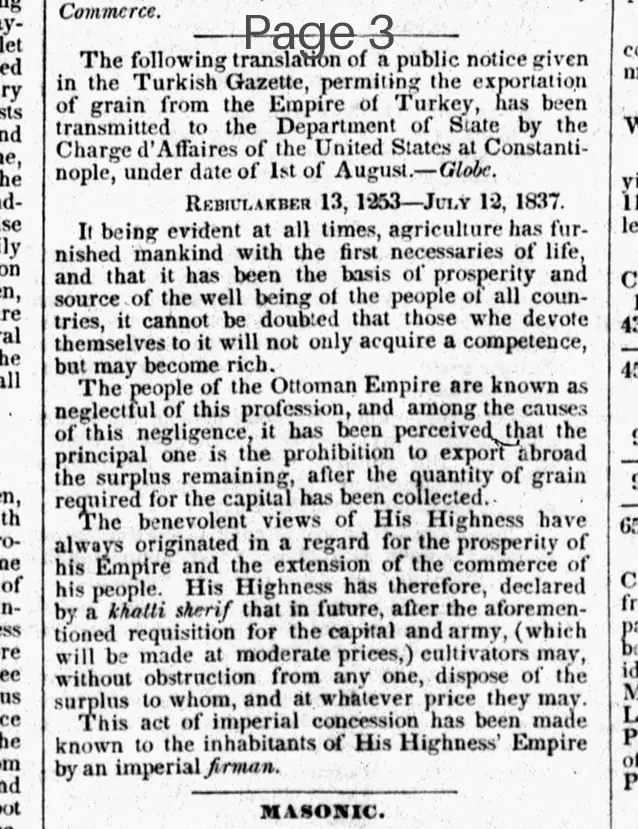
The following translation of a public notice given in the Turkish Gazette, permitting the exportation of grain from the Empire of Turkey, has been transmitted to the Department of State by the Charge d'Affaires of the United States at Constantinople, under date of 1st of August.--Globe.
Rebiulaker 13, 1253 (July 12, 1837.)
It being evident at all times, agriculture has furnished mankind with the first necessaries of life, and that it has been the basis of prosperity and source of the well being of the people of all countries, it cannot be doubted that those who devote themselves to it will not only acquire a competence, but may become rich.
The people of the Ottoman Empire are known as neglectful of this profession, and among the causes of this negligence, it has been perceived that the principal one is the prohibition to export abroad the surplus remaining, after the quantity of grain required for the capital has been collected..
The benevolent views of His Highness have always originated in a regard for the prosperity of his Empire and the extension of the commerce of his people. His Highness has therefore, declared by a khatti sherif that in future, after the aforementioned requisition for the capital and army, (which will be made at moderate prices,) cultivators may, without obstruction from any one, dispose of the surplus to whom, and at whatever price they may.
This act of imperial concession has been made known to the inhabitants of His Highness' Empire by an imperial firman.
Rebiulaker 13, 1253 (July 12, 1837.)
It being evident at all times, agriculture has furnished mankind with the first necessaries of life, and that it has been the basis of prosperity and source of the well being of the people of all countries, it cannot be doubted that those who devote themselves to it will not only acquire a competence, but may become rich.
The people of the Ottoman Empire are known as neglectful of this profession, and among the causes of this negligence, it has been perceived that the principal one is the prohibition to export abroad the surplus remaining, after the quantity of grain required for the capital has been collected..
The benevolent views of His Highness have always originated in a regard for the prosperity of his Empire and the extension of the commerce of his people. His Highness has therefore, declared by a khatti sherif that in future, after the aforementioned requisition for the capital and army, (which will be made at moderate prices,) cultivators may, without obstruction from any one, dispose of the surplus to whom, and at whatever price they may.
This act of imperial concession has been made known to the inhabitants of His Highness' Empire by an imperial firman.
What sub-type of article is it?
Trade Or Commerce
Economic
What keywords are associated?
Ottoman Empire
Grain Export
Trade Policy
Imperial Firman
Agriculture Promotion
Where did it happen?
Empire Of Turkey
Foreign News Details
Primary Location
Empire Of Turkey
Event Date
Rebiulaker 13, 1253 (July 12, 1837)
Outcome
permission granted for cultivators to export surplus grain without obstruction after supplying capital and army at moderate prices.
Event Details
Public notice in Turkish Gazette announces imperial firman allowing export of surplus grain to promote agriculture and commerce in Ottoman Empire, addressing previous prohibition that discouraged cultivation.