Thank you for visiting SNEWPapers!
Sign up free
The Virginia Gazette
Williamsburg, Virginia
What is this article about?
Publication in 1777 of 1776 letters between Admiral Lord Howe and Benjamin Franklin, where Howe expresses hopes for reconciliation with the American colonies on behalf of the King, and Franklin rejects British pardon offers, citing atrocities and predicting the war's folly.
Clipping
OCR Quality
Full Text
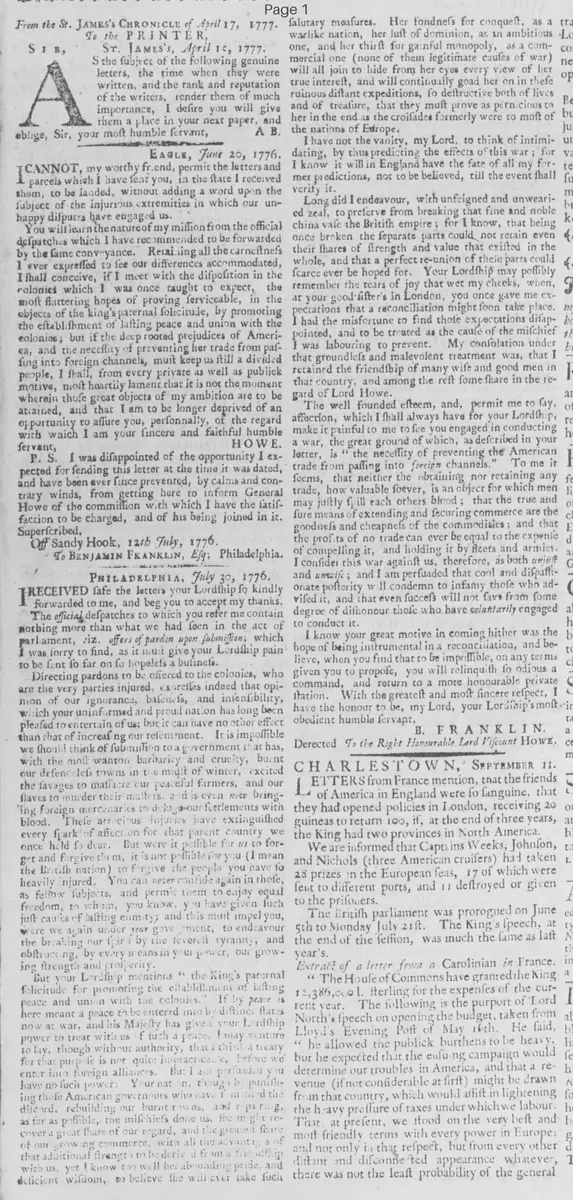
To the PRINTER,
SIR,
St. James's, April 15, 1777.
As the subject of the following genuine letters, the time when they were written, and the rank and reputation of the writers, render them of much importance, I desire you will give them a place in your next paper, and oblige, Sir, your most humble servant,
A B.
EAGLE, June 20, 1776.
I CANNOT, my worthy friend, permit the letters and parcels which I have sent you, in the care I received them, to be landed, without adding a word upon the subject of the injurious extremities in which our unhappy disputes have engaged us.
You will learn the nature of my mission from the official dispatches which I have recommended to be forwarded by the same conveyance. Retaining all the earnestness I ever expressed to see our differences accommodated, I shall conceive, if I meet with the disposition in the colonies which I was once taught to expect, the most flattering hopes of proving serviceable, in the objects of the king's paternal solicitude, by promoting the establishment of lasting peace and union with the colonies; but if the deep rooted prejudices of America, and the necessity of preventing her trade from passing into foreign channels, must keep us still a divided people, I shall, from every private as well as public motive, most heartily lament that it is not the moment wherein those great objects of my ambition are to be attained, and that I am to be longer deprived of an opportunity to assure you, personally, of the regard with which I am your sincere and faithful humble servant,
HOWE.
P. S. I was disappointed of the opportunity I expected for ending this letter at the time it was dated, and have been ever since prevented, by calms and contrary winds, from getting here to inform General Howe of the commission with which I have the satisfaction to be charged, and of his being joined in it.
Superscribed,
Off Sandy Hook, 12th July, 1776.
To Benjamin Franklin, Esq; Philadelphia.
PHILADELPHIA, July 30, 1776.
I RECEIVED safe the letters your Lordship so kindly forwarded to me, and beg you to accept my thanks.
The official dispatches to which you refer me contain nothing more than what we had seen in the act of parliament, viz. offers of pardon upon submission; which I was sorry to find, as it must give your Lordship pain to be sent so far on so hopeless a business.
Directing pardons to be offered to the colonies, who are the very parties injured, excites indeed that opinion of our ignorance, baseness, and insensibility, which your uninformed and proud nation has long been pleased to entertain of us; but it can have no other effect than that of increasing our resentment. It is impossible we should think of submission to a government that has, with the most wanton barbarity and cruelty, burnt our defenceless towns in the midst of winter, excited the savages to massacre our peaceful farmers, and our slaves to murder their masters, and is even now bringing foreign mercenaries to deluge our settlements with blood. These atrocious injuries have extinguished every spark of affection for that parent country we once held so dear. But were it possible for us to forget and forgive them, it is not possible for you (I mean the British nation) to forgive the people you have so heavily injured. You can never confide again in those, as fellow subjects, and permit them to enjoy equal freedom, to whom, you know, you have given such just causes of lasting enmity; and this must impel you, were we again under your government, to endeavour the breaking our spirit by the severest tyranny, and obstructing, by every means in your power, our growing strength and prosperity.
But your Lordship mentions "the King's paternal solicitude for promoting the establishment of lasting peace and union with the colonies." If by peace is here meant a peace to be entered into by distinct states now at war, and his Majesty has given your Lordship power to treat with us for such a peace, I may venture to say, though without authority, that I think a treaty for that purpose is not quite impracticable, before we enter into foreign alliances. But I am persuaded you have no such power; Your nation, though punishing those American governors who have incited this discord, rebuilding our burnt towns, and repairing, as far as possible, the mischiefs done us, might recover a great share of our regard, and the greatest share of our growing commerce, with all the advantages of that additional strength to be derived from a friendship with us, yet I know too well her abounding pride, and deficient wisdom, to believe she will ever take such salutary measures. Her fondness for conquest, as a warlike nation, her lust of dominion, as an ambitious one, and her thirst for gainful monopoly, as a commercial one (none of them legitimate causes of war) will all join to hide from her eyes every view of her true interest, and will continually goad her on in these ruinous distant expeditions, so destructive both of lives and of treasure, that they must prove as pernicious to her in the end as the crusades formerly were to most of the nations of Europe.
I have not the vanity, my Lord, to think of intimidating, by thus predicting the effects of this war; for I know it will in England have the fate of all my former predictions, not to be believed, till the event shall verify it.
Long did I endeavour, with unfeigned and unwearied zeal, to preserve from breaking that fine and noble china vase the British empire; for I knew, that being once broken, the separate parts could not retain even their shares of strength and value that existed in the whole, and that a perfect re-union of those parts could scarce ever be hoped for. Your Lordship may possibly remember the tears of joy that wet my cheeks, when, at your good sister's in London, you once gave me expectations that a reconciliation might soon take place. I had the misfortune to find those expectations disappointed, and to be treated as the cause of the mischief I was labouring to prevent. My consolation under that groundless and malevolent treatment was, that I retained the friendship of many wise and good men in that country, and among the rest some share in the regard of Lord Howe.
The well founded esteem, and, permit me to say, affection, which I shall always have for your Lordship, make it painful to me to see you engaged in conducting a war, the great ground of which, as described in your letter, is "the necessity of preventing the American trade from passing into foreign channels." To me it seems, that neither the obtaining nor retaining any trade, how valuable soever, is an object for which men may justly spill each others blood; that the true and sure means of extending and securing commerce are the goodness and cheapness of the commodities; and that the profits of no trade can ever be equal to the expense of compelling it, and holding it by fleets and armies. I consider this war against us, therefore, as both unjust and unwise; and I am persuaded that cool and dispassionate posterity will condemn to infamy those who advised it, and that even success will not save from some degree of dishonour those who voluntarily engaged to conduct it.
I know your great motive in coming hither was the hope of being instrumental in a reconciliation, and believe, when you find that to be impossible, on any terms you can propose, you will relinquish so odious a command, and return to a more honourable private station. With the greatest and most sincere respect, I have the honour to be, my Lord, your Lordship's most obedient humble servant,
B. FRANKLIN.
Directed To the Right Honourable Lord Viscount Howe.
What sub-type of article is it?
What keywords are associated?
What entities or persons were involved?
Where did it happen?
Foreign News Details
Primary Location
Philadelphia
Event Date
June 20, 1776 July 30, 1776
Key Persons
Outcome
franklin rejects british offers of pardon and reconciliation, citing colonial grievances and predicting the war's unjust nature and inevitable failure.
Event Details
Admiral Lord Howe writes to Benjamin Franklin expressing hopes for peace and union with the colonies under the King's commission. Franklin responds thanking Howe but dismissing the pardon offers as insulting, detailing British atrocities, arguing against submission, and suggesting that only reparations could restore relations, while criticizing the war's motives and foreseeing its ruinous effects on Britain.