Thank you for visiting SNEWPapers!
Sign up free
The Freeman
Fremont, Sandusky County, Ohio
What is this article about?
Henry Clay delivers a Senate speech on May 13, 1850, advocating the Compromise of 1850: admitting California as a free state, establishing New Mexico and Utah territories without slavery, settling Texas boundaries, strengthening fugitive slave laws, and abolishing the D.C. slave trade to preserve the Union amid sectional tensions.
Clipping
OCR Quality
Full Text
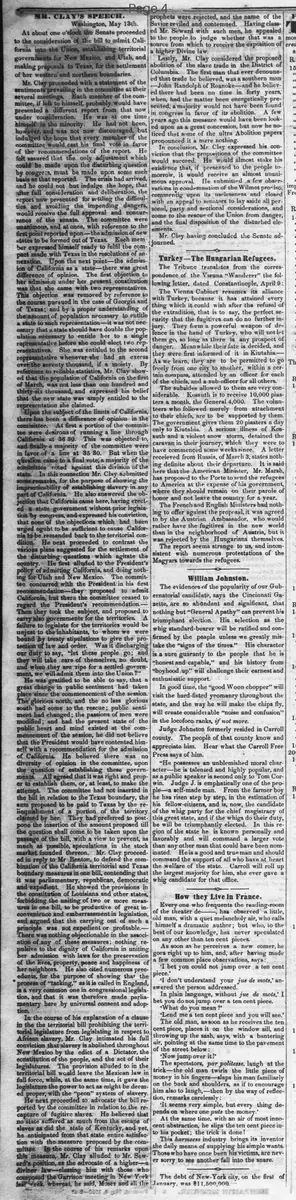
Washington, May 13th.
At about one o'clock the Senate proceeded to the consideration of the bill to admit California into the Union, establishing territorial governments for New Mexico and Utah, and making proposals to Texas for the settlement of her western and northern boundaries.
Mr. Clay proceeded with a statement of the sentiments prevailing in the committee at their several meetings. Each member of the committee, if left to himself, probably would have presented a different report from that now under consideration. He was at one time himself in the minority. He had not been, however, and was not now discouraged, but indulged the hope that every member of the committee would cast his final vote in favor of the recommendations of the report. He felt assured that the only adjustment which could be made upon the disturbing question by Congress, must be made upon some such basis as that reported. The crisis had arrived, and he could not but indulge the hope, that after full consideration and deliberation, the report now presented for settling the difficulties and avoiding the impending dangers, would receive the full approval and concurrence of the Senate. The committee were unanimous, and at once, with reference to the first point reported upon—the admission of new states to be formed out of Texas. Each member expressed himself ready to fulfil the compact made with Texas in the resolutions of annexation. Upon the next point—the admission of California as a state—there was great difference of opinion. The first objection to her admission under her present constitution was that she came with two representatives. This objection was removed by reference to the course pursued in the case of Georgia and of Texas; and by a proper understanding of the amount of population necessary to entitle a state to such representation it was not necessary that a state should have double the population necessary to entitle her to a single representative before she could elect two representatives. She was entitled to the second representative whenever she had an excess over the seventy thousand, if a moiety. By reference to reliable statistics, Mr. Clay showed that the population of California on the first of March, was not less than one hundred and thirty-six thousand, and expressed his belief that the new state was amply entitled to the representation she claimed.
Upon the subject of the limits of California, there has been a difference of opinion in the committee. At first a portion of the committee were desirous of running a line through California at 36° 30'. This was objected to, and finally a majority of the committee were in favor of a line at 35° 30'. But when the question came to a final vote, a majority of the committee voted against this division of the state. In this connection Mr. Clay submitted some remarks, for the purpose of showing the impracticability of establishing slavery in any part of California. He also answered the objection that California came here, having erected a state government without prior legislation by Congress, and expressed his conviction, that none of the objections which had been urged ought to be sufficient to cause California to be remanded back to the territorial condition. He next proceeded to contrast the various plans suggested for the settlement of the disturbing questions which agitate the country. He first alluded to the President's policy of admitting California, and doing nothing for Utah and New Mexico. The committee concurred with the President in his first recommendation they proposed to admit California, but there the committee ceased to regard the President's recommendation. Then they took the subject, and proposed to carry also governments for the territories. A failure to legislate for the territories would be unjust to the inhabitants, to whom we were bound by treaty stipulations to give the protection of law and order. Was it discharging our duty to say, "let these people go; and they will take care of themselves, no doubt and when they are ripe for a settled government, we will admit them into the Union?" He was gratified to be able to say, that a great change in public sentiment had taken place since the commencement of the session. The glorious north, and the no less glorious south had come to the rescue; public sentiment had changed; the passions of men were modified; and had the present state of the public heart and mind existed at the commencement of the session, he did not believe that the President would have contented himself with a recommendation for the admission of California. He believed there was no diversity of opinion in the committee, upon the question of establishing these governments. All agreed that it was right and proper to establish them, or, at least, to make the attempt. The committee had not inserted in the bill in relation to the Texas boundary, the sum proposed to be paid to Texas by the renunciation of a portion of the territory claimed by her. They had preferred to postpone the insertion of the amount proposed till the question shall come to be taken upon the passage of the bill, with a view to prevent, as much as possible, speculations in the stock market founded thereon. Mr. Clay proceeded in reply to Mr. Benton, to defend the combination of the California territorial and Texas boundary measures in one bill, contending that it was parliamentary, republican, democratic and expedient. He showed the provisions in the constitution of Louisiana and other states, forbidding the uniting of two or more measures in one bill, to be productive of great inconvenience and embarrassment in legislation, and argued that the carrying out of such a principle was not expedient or profitable. There was nothing objectionable in the association of any of these measures; nothing repulsive to the dignity of California in uniting her admission with laws for the preservation of the lives, property, peace and happiness of her neighbors. He also cited numerous precedents, for the purpose of showing that the process of "tacking," as it is called in England, is a very common one in congressional legislation, and that it was therefore made parliamentary here by universal consent and adoption.
In the course of his explanation of a clause in the territorial bill prohibiting the territorial legislature from legislating in respect to African slavery, Mr. Clay intimated his full conviction that slavery is abolished throughout New Mexico by the edict of a Dictator, the constitution of the people, and the act of their legislatures. The provision alluded to in the territorial bill would leave the Mexican law in full force, while, at the same time, it gave the legislature the power to act as might be deemed proper, with the "peon" system of slavery. He next proceeded to advocate the bill reported by the committee in relation to the recapture of fugitive slaves. He believed that no state suffered as much from the escape of slaves as did the state of Kentucky, and yet, he anticipated from that state entire satisfaction with the measure proposed by the committee. In the course of his remarks upon this measure, Mr. Clay alluded to Mr. Seward's position, as the advocate of a higher—a diviner law—classing him with those who composed the Garrison meeting in New York last week, whereat, he said, Moses and all the prophets were rejected, and the name of the Savior reviled and contemned. Having classed Mr. Seward with such men, he appealed to the people to judge whether that was a source from which to receive the exposition of a higher Divine law.
Lastly, Mr. Clay considered the proposed abolition of the slave trade in the District of Columbia. The first man that ever denounced that trade he believed, was a southern man—John Randolph of Roanoke—and he believed there had been no time in forty years, when, had the matter been energetically presented, a majority would not have been found in Congress in favor of its abolition. A few years ago this measure would have been looked upon as a great concession, but now he noticed that some of the ultra Abolition papers pronounced it a mere nothing.
In conclusion, Mr. Clay expressed his conviction that the propositions of the committee would succeed. He would almost stake his existence that, if presented to the people tomorrow, it would receive an almost unanimous approval. He submitted a few observations in condemnation of the Wilmot proviso, commenting upon its uselessness and closed with an appeal to senators to lay aside all personal, party and sectional considerations, and come to the rescue of the Union from danger, and the final disposition of the disturbed elements.
Mr. Clay having concluded the Senate adjourned.
What sub-type of article is it?
What themes does it cover?
What keywords are associated?
What entities or persons were involved?
Where did it happen?
Story Details
Key Persons
Location
Washington
Event Date
May 13th
Story Details
Mr. Clay delivers a comprehensive speech defending the committee's compromise bill, addressing California's admission as a free state with sufficient population for two representatives, territorial governments for New Mexico and Utah without slavery provisions, Texas boundary settlement, fugitive slave recapture, and abolition of the D.C. slave trade, urging senators to approve it to avert national crisis and preserve the Union.