Thank you for visiting SNEWPapers!
Sign up free
Herald Of The United States
Warren, Bristol County, Rhode Island
What is this article about?
Russian official note refutes misrepresentations in French bulletins about a diplomatic mission by Prince Dolgorucki to Napoleon Bonaparte. Details a conversation where a Russian officer, sent at Bonaparte's request, discusses peace terms, denies aggressive proposals, and reaffirms Russia's support for European independence, ending with Bonaparte declaring they shall fight.
Merged-components note: Cross-page continuation of the Russian note refuting misrepresentations.
Clippings
1 of 2
OCR Quality
Full Text
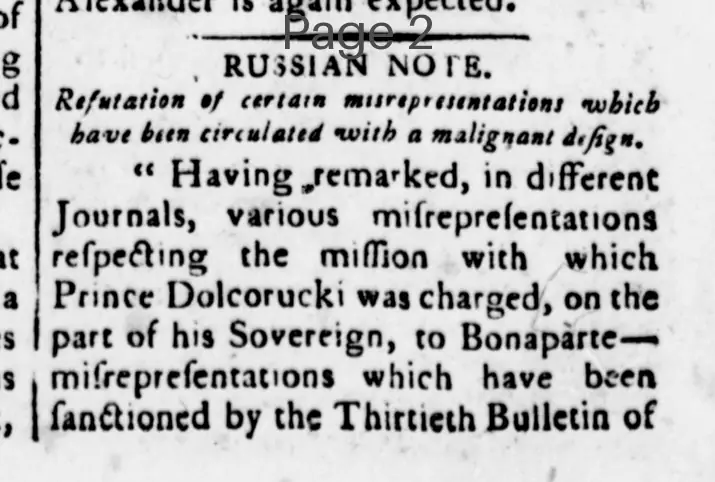
Refutation of certain misrepresentations which have been circulated with a malignant design.
"Having remarked, in different Journals, various misrepresentations respecting the mission with which Prince Dolgorucki was charged, on the part of his Sovereign, to Bonaparte—misrepresentations which have been sanctioned by the Thirtieth Bulletin of the Grand Army,
the French Army—it is become necessary to refuse them, to prevent the forgers of false intelligence from continuing their practices.
The Russian Officer who was sent to Bonaparte at his request, after the refusal of the Emperor of Russia to have an interview with him, upon his arrival at the advanced posts of the French Army, did not wait long before he saw Bonaparte approach guarded by two Squadrons. He approached the Russian officer with great politeness and conversed with him for some time, as they walked on the road, about uninteresting subjects; then making a sudden stop, he said, "Well then, are we to fight much longer?"—Upon receiving for answer that it was impossible to decide that point, he asked, "What do they want of me?"—Why, does the Emperor of Russia, make war upon me?" "What does he require of me?"—Upon which a political discussion arose, which was not begun by the Russian officer: on the contrary, he was drawn into it by the questions, of a political tendency, put to him by Bonaparte. It would take up too much time to relate all that passed in this conversation; Bonaparte frequently repeated, that the Emperor of Russia had only to invade the possessions of his allies, and that all discussion with France would cease. He spoke of the Ottoman Porte and, in a vague manner, of other countries bordering upon Russia. Upon the visible repugnance manifested by the Russian officer towards proposals so little worthy of the acknowledged character of his Sovereign, Bonaparte returned to the subject of his being ignorant why they made war upon him, although it had been mentioned to him several times, that the Emperor of Russia's only reason for arming was to succour Austria, and to preserve the independence of the other States of Europe, without having the least hostile views against France, and still less against the French nation, which the Emperor Alexander esteemed it as it deserved, and far from wishing it any harm, his greatest wish was to see it happy and tranquil, as well as all the Powers of Europe. As to himself, he wanted nothing: content with the vast Empire over which he reigned, and having no other ambition than to contribute, as he does, to the happiness of his subjects, and to fulfil one of the noblest duties of a great Sovereign, that of his being useful to his Allies, in securing their independence, and not in attacking it, after the example of those who bring affliction on the human race by the abuse of the power which chance has placed in their hands.
"As to the proposals of giving up Belgium, and placing the Iron Crown upon the head of his most implacable enemy (it was the King of Sardinia he meant,) they were never made; on the contrary, upon Bonaparte's affecting to assert that such demands had been made to him, the Russian officer positively denied that any such Article had ever existed; and he only mentioned among the others, that which regarded the real Independence of the Batavian Republic, which had been already verbally acknowledged by Bonaparte, and that of an Establishment for the King of Sardinia in Italy, and indemnity for his States, which had been invaded by France, referring in support of these proposals to the tenor of the treaties and conventions which existed between the Emperor and the First Consul of the French Republic. The whole of the conversation, which lasted more than one hour, was confined to these points: Bonaparte always reverting to his projects of invasion, and the Russian Officer rejecting them in the name of his Sovereign, and requiring nothing more than the real security and tranquillity of all the States of Europe. At last, convinced by the conversation of the Russian officer, that it was impossible to prevail upon the Emperor Alexander to intimate his conduct, to betray his Allies, and to take possession of other States, Bonaparte put an end to the discourse, by abruptly declaring, "Well then, we shall fight;" to which the Russian Officer made no answer, but returned.
S:
What sub-type of article is it?
What keywords are associated?
What entities or persons were involved?
Where did it happen?
Foreign News Details
Primary Location
Advanced Posts Of The French Army
Key Persons
Outcome
conversation ends with bonaparte declaring 'well then, we shall fight'; no agreement reached, russia reaffirms support for european independence.
Event Details
Russian note refutes misrepresentations in French bulletins about Prince Dolgorucki's mission to Bonaparte. Describes a conversation between a Russian officer and Bonaparte at French advanced posts, where Bonaparte probes for peace terms, suggests Russian invasion of allies, but the officer denies aggressive proposals, emphasizes Russia's defensive aims to aid Austria and preserve European independence, and rejects Bonaparte's overtures.