Thank you for visiting SNEWPapers!
Sign up free
Story
December 28, 1892
Mower County Transcript
Austin, Lansing, Mower County, Minnesota
What is this article about?
Historical account of New Year beginnings across cultures: lunar in Orient, March 25 in old England until 1752, winter solstice for Greeks, varying dates in Latin countries, autumn for ancient Near Eastern peoples.
Clipping
OCR Quality
98%
Excellent
Full Text
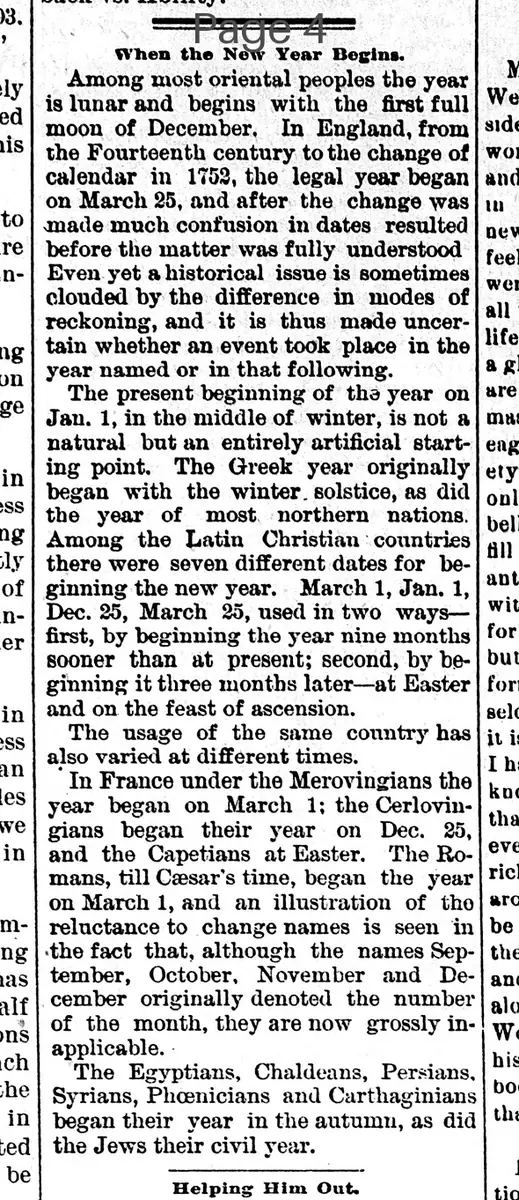
When the New Year Begins.
Among most oriental peoples the year is lunar and begins with the first full moon of December. In England, from the Fourteenth century to the change of calendar in 1752, the legal year began on March 25, and after the change was made much confusion in dates resulted before the matter was fully understood. Even yet a historical issue is sometimes clouded by the difference in modes of reckoning, and it is thus made uncertain whether an event took place in the year named or in that following.
The present beginning of the year on Jan. 1, in the middle of winter, is not a natural but an entirely artificial starting point. The Greek year originally began with the winter solstice, as did the year of most northern nations. Among the Latin Christian countries there were seven different dates for beginning the new year. March 1, Jan. 1, Dec. 25. March 25, used in two ways- first, by beginning the year nine months sooner than at present; second, by beginning it three months later at Easter and on the feast of ascension. The usage of the same country has also varied at different times. In France under the Merovingians the year began on March 1; the Carolingians began their year on Dec. 25. and the Capetians at Easter. The Romans, till Cæsar's time, began the year on March 1, and an illustration of the reluctance to change names is seen in the fact that, although the names September, October, November and December originally denoted the number of the month, they are now grossly inapplicable.
The Egyptians, Chaldeans, Persians, Syrians, Phœnicians and Carthaginians began their year in the autumn, as did the Jews their civil year.
Among most oriental peoples the year is lunar and begins with the first full moon of December. In England, from the Fourteenth century to the change of calendar in 1752, the legal year began on March 25, and after the change was made much confusion in dates resulted before the matter was fully understood. Even yet a historical issue is sometimes clouded by the difference in modes of reckoning, and it is thus made uncertain whether an event took place in the year named or in that following.
The present beginning of the year on Jan. 1, in the middle of winter, is not a natural but an entirely artificial starting point. The Greek year originally began with the winter solstice, as did the year of most northern nations. Among the Latin Christian countries there were seven different dates for beginning the new year. March 1, Jan. 1, Dec. 25. March 25, used in two ways- first, by beginning the year nine months sooner than at present; second, by beginning it three months later at Easter and on the feast of ascension. The usage of the same country has also varied at different times. In France under the Merovingians the year began on March 1; the Carolingians began their year on Dec. 25. and the Capetians at Easter. The Romans, till Cæsar's time, began the year on March 1, and an illustration of the reluctance to change names is seen in the fact that, although the names September, October, November and December originally denoted the number of the month, they are now grossly inapplicable.
The Egyptians, Chaldeans, Persians, Syrians, Phœnicians and Carthaginians began their year in the autumn, as did the Jews their civil year.
What sub-type of article is it?
Historical Event
Curiosity
What themes does it cover?
Social Manners
What keywords are associated?
New Year
Calendar History
Lunar Calendar
Gregorian Change
Roman Months
Cultural Variations
Story Details
Story Details
Overview of diverse historical and cultural practices for starting the new year, including lunar calendars, shifts in England to 1752, variations in Christian Europe, Roman origins, and autumn starts in ancient Near East.