Thank you for visiting SNEWPapers!
Sign up free
Story
March 29, 1881
Public Ledger
Memphis, Shelby County, Tennessee
What is this article about?
Article from Popular Science Monthly explains that a 'cold' is actually a mild fever triggered by cold on the body, urging readers not to neglect it as it may precede serious illnesses. (187 characters)
Clipping
OCR Quality
98%
Excellent
Full Text
What is a Cold!
[Popular Science Monthly for April.]
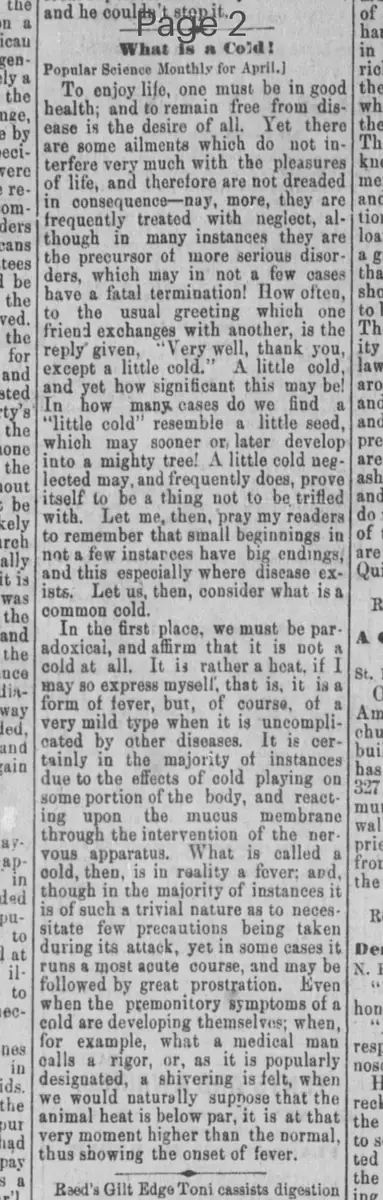
To enjoy life, one must be in good health; and to remain free from disease is the desire of all. Yet there are some ailments which do not interfere very much with the pleasures of life, and therefore are not dreaded in consequence—nay, more, they are frequently treated with neglect, although in many instances they are the precursor of more serious disorders, which may in not a few cases have a fatal termination! How often, to the usual greeting which one friend exchanges with another, is the reply given, "Very well, thank you, except a little cold." A little cold, and yet how significant this may be. In how many cases do we find a "little cold" resemble a little seed, which may sooner or later develop into a mighty tree! A little cold neglected may, and frequently does, prove itself to be a thing not to be trifled with. Let me, then, pray my readers to remember that small beginnings in not a few instances have big endings, and this especially where disease exists. Let us, then, consider what is a common cold.
In the first place, we must be paradoxical, and affirm that it is not a cold at all. It is rather a heat, if I may so express myself, that is, it is a form of fever, but, of course, of a very mild type when it is uncomplicated by other diseases. It is certainly in the majority of instances due to the effects of cold playing on some portion of the body, and reacting upon the mucous membrane through the intervention of the nervous apparatus. What is called a cold, then, is in reality a fever; and, though in the majority of instances it is of such a trivial nature as to necessitate few precautions being taken during its attack, yet in some cases it runs a most acute course, and may be followed by great prostration. Even when the premonitory symptoms of a cold are developing themselves; when, for example, what a medical man calls a rigor, or, as it is popularly designated, a shivering is felt, when we would naturally suppose that the animal heat is below par, it is at that very moment higher than the normal, thus showing the onset of fever.
[Popular Science Monthly for April.]
To enjoy life, one must be in good health; and to remain free from disease is the desire of all. Yet there are some ailments which do not interfere very much with the pleasures of life, and therefore are not dreaded in consequence—nay, more, they are frequently treated with neglect, although in many instances they are the precursor of more serious disorders, which may in not a few cases have a fatal termination! How often, to the usual greeting which one friend exchanges with another, is the reply given, "Very well, thank you, except a little cold." A little cold, and yet how significant this may be. In how many cases do we find a "little cold" resemble a little seed, which may sooner or later develop into a mighty tree! A little cold neglected may, and frequently does, prove itself to be a thing not to be trifled with. Let me, then, pray my readers to remember that small beginnings in not a few instances have big endings, and this especially where disease exists. Let us, then, consider what is a common cold.
In the first place, we must be paradoxical, and affirm that it is not a cold at all. It is rather a heat, if I may so express myself, that is, it is a form of fever, but, of course, of a very mild type when it is uncomplicated by other diseases. It is certainly in the majority of instances due to the effects of cold playing on some portion of the body, and reacting upon the mucous membrane through the intervention of the nervous apparatus. What is called a cold, then, is in reality a fever; and, though in the majority of instances it is of such a trivial nature as to necessitate few precautions being taken during its attack, yet in some cases it runs a most acute course, and may be followed by great prostration. Even when the premonitory symptoms of a cold are developing themselves; when, for example, what a medical man calls a rigor, or, as it is popularly designated, a shivering is felt, when we would naturally suppose that the animal heat is below par, it is at that very moment higher than the normal, thus showing the onset of fever.
What sub-type of article is it?
Medical Curiosity
Curiosity
What themes does it cover?
Moral Virtue
Misfortune
What keywords are associated?
Common Cold
Fever
Health Warning
Disease Precursor
Medical Explanation
Story Details
Story Details
A common cold is explained as a mild form of fever caused by cold affecting the body's mucous membrane via the nervous system, not to be neglected as it can lead to serious disorders.