Thank you for visiting SNEWPapers!
Sign up free
Gazette Of The United States, & Philadelphia Daily Advertiser
Philadelphia, Philadelphia County, Pennsylvania
What is this article about?
The ship Ulysses arrived in Salem on July 12 from Bengal, reporting a British naval victory: Capt. Cooke's La Sybille (44 guns) captured the French La Forte (54 guns) after a 45-minute battle off Sand Heads, with heavy French losses. Broader context includes British army preparations against Tippoo Saib.
Clipping
OCR Quality
Full Text
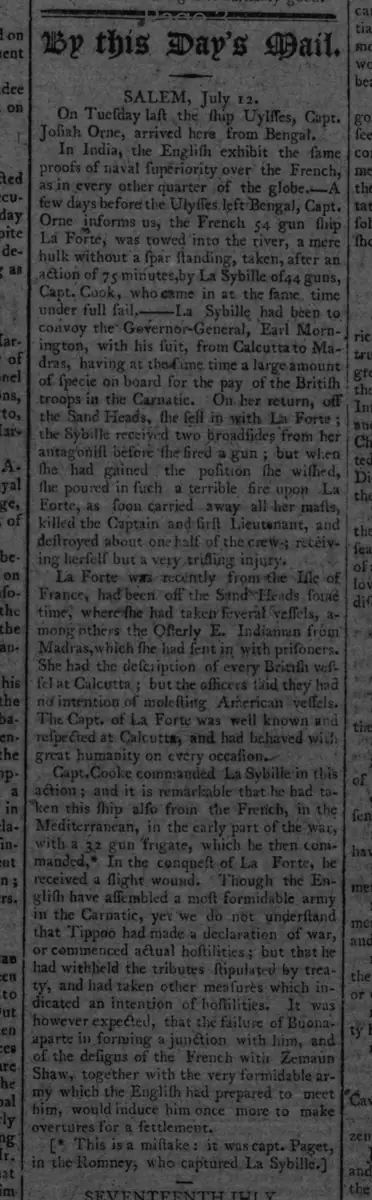
SALEM, July 12.
On Tuesday last the Ship Ulysses, Capt. Josiah Orne, arrived here from Bengal.
In India, the English exhibit the same proofs of naval superiority over the French, as in every other quarter of the globe.—A few days before the Ulysses left Bengal, Capt. Orne informs us, the French 54 gun ship La Forte, was towed into the river, a mere hulk without a spar standing, taken, after an action of ¾ minutes, by La Sybille of 44 guns, Capt. Cook, who came in at the same time under full sail.—La Sybille had been to convoy the Governor-General, Earl Mornington, with his suite, from Calcutta to Madras, having at the same time a large amount of specie on board for the pay of the British troops in the Carnatic. On her return, off the Sand Heads, She fell in with La Forte; the Sybille received two broadsides from her antagonist before she fired a gun; but when she had gained the position she wished, she poured in such a terrible fire upon La Forte, as soon carried away all her masts, killed the Captain and first Lieutenant, and destroyed about one half of the crew; receiving herself but a very trifling injury.
La Forte was recently from the Isle of France, had been off the Sand Heads some time, where she had taken several vessels, among others the Osterley E. Indiaman from Madras, which she had sent in with prisoners. She had the description of every British vessel at Calcutta; but the officers said they had no intention of molesting American vessels.
The Capt. of La Forte was well known and respected at Calcutta, and had behaved with great humanity on every occasion.
Capt. Cooke commanded La Sybille in this action; and it is remarkable that he had taken this ship also from the French, in the Mediterranean, in the early part of the war, with a 32 gun frigate, which he then commanded. * In the conquest of La Forte, he received a slight wound. Though the English have assembled a most formidable army in the Carnatic, yet we do not understand that Tippoo had made a declaration of war, or commenced actual hostilities; but that he had withheld the tributes stipulated by treaty, and had taken other measures which indicated an intention of hostilities. It was however expected, that the failure of Buonaparte in forming a junction with him, and of the designs of the French with Zemaun Shaw, together with the very formidable army which the English had prepared to meet him, would induce him once more to make overtures for a settlement.
[* This is a mistake: it was capt. Paget, in the Romney, who captured La Sybille.]
What sub-type of article is it?
What keywords are associated?
What entities or persons were involved?
Where did it happen?
Foreign News Details
Primary Location
Bengal
Event Date
A Few Days Before The Ulysses Left Bengal
Key Persons
Outcome
la forte captured after 3/4 hour action; french captain and first lieutenant killed, about half crew destroyed; la sybille received trifling injury; capt. cooke slightly wounded.
Event Details
The French 54-gun ship La Forte was towed into the river as a hulk without spars after being taken by the British 44-gun La Sybille, Capt. Cook, following a 3/4-hour action off the Sand Heads. La Sybille had convoyed Earl Mornington from Calcutta to Madras with specie. She received two broadsides before firing, then destroyed La Forte's masts and inflicted heavy casualties. La Forte had recently arrived from Isle of France, captured several vessels including the Osterley, but spared American ships. Tippoo withheld tribute and prepared for hostilities, but expected to negotiate due to British preparations and French failures.