Thank you for visiting SNEWPapers!
Sign up free
The Diamond Drill
Crystal Falls, Iron County, Michigan
What is this article about?
Elizabeth Cady Stanton's 80th birthday is celebrated in New York by the National Council of Women, with speeches from prominent suffragists. The article recounts her Puritan background, early activism against women's exclusion from education, and lifelong work for suffrage starting in 1848 at Seneca Falls.
Clipping
OCR Quality
Full Text
80th Birthday Celebrated.
New York.
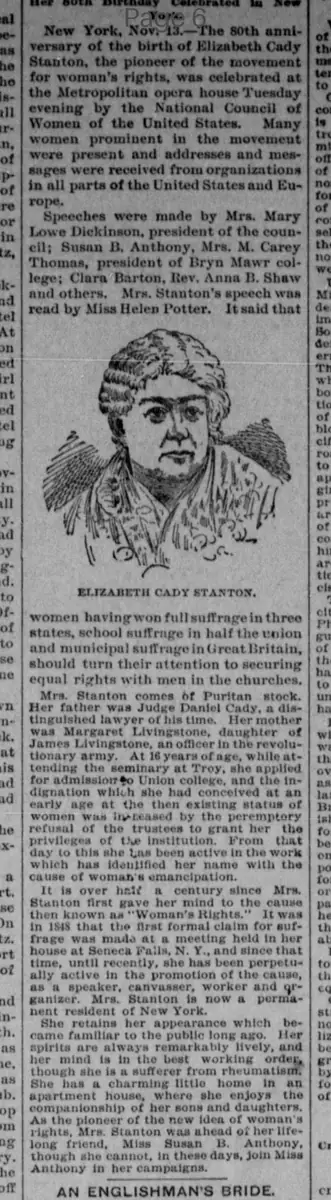
New York, Nov. 13.—The 80th anniversary of the birth of Elizabeth Cady Stanton, the pioneer of the movement for woman's rights, was celebrated at the Metropolitan opera house Tuesday evening by the National Council of Women of the United States. Many women prominent in the movement were present and addresses and messages were received from organizations in all parts of the United States and Europe.
Speeches were made by Mrs. Mary Lowe Dickinson, president of the council; Susan B. Anthony, Mrs. M. Carey Thomas, president of Bryn Mawr college; Clara Barton, Rev. Anna B. Shaw and others. Mrs. Stanton's speech was read by Miss Helen Potter. It said that women having won full suffrage in three states, school suffrage in half the country and municipal suffrage in Great Britain, should turn their attention to securing equal rights with men in the churches.
Mrs. Stanton comes of Puritan stock. Her father was Judge Daniel Cady, a distinguished lawyer of his time. Her mother was Margaret Livingstone, daughter of James Livingstone, an officer in the revolutionary army. At 16 years of age, while attending the seminary at Troy, she applied for admission to Union college, and the indignation which she had conceived at an early age at the then existing status of women was intensified by the peremptory refusal of the trustees to grant her the privileges of the institution. From that day to this she has been active in the work which has identified her name with the cause of woman's emancipation.
It is over half a century since Mrs. Stanton first gave her mind to the cause then known as "Woman's Rights." It was in 1848 that the first formal claim for suffrage was made at a meeting held in her house at Seneca Falls, N. Y., and since that time, until recently, she has been perpetually active in the promotion of the cause, as a speaker, canvasser, worker and organizer. Mrs. Stanton is now a permanent resident of New York.
She retains her appearance which became familiar to the public long ago. Her spirits are always remarkably lively, and her mind is in the best working order though she is a sufferer from rheumatism. She has a charming little home in an apartment house, where she enjoys the companionship of her sons and daughters. As the pioneer of the new idea of woman's rights, Mrs. Stanton was ahead of her life-long friend, Miss Susan B. Anthony, though she cannot, in these days, join Miss Anthony in her campaigns.
Elizabeth Cady Stanton.
What sub-type of article is it?
What themes does it cover?
What keywords are associated?
What entities or persons were involved?
Where did it happen?
Story Details
Key Persons
Location
New York
Event Date
Nov. 13
Story Details
The 80th birthday of Elizabeth Cady Stanton, pioneer of women's rights, is celebrated at the Metropolitan Opera House in New York by the National Council of Women. Speeches highlight her lifelong activism, starting from her rejection from Union College at 16, the 1848 Seneca Falls convention, and calls for church equality. She remains active despite rheumatism, ahead of friend Susan B. Anthony.