Thank you for visiting SNEWPapers!
Sign up free
Story
February 26, 1838
Lynchburg Virginian
Lynchburg, Virginia
What is this article about?
Henry G. Jones accuses Senator John Ruggles of Maine of attempting to bribe him for influence in securing a patent and adoption of his lock for mail bags by the Post Office, but Jones refused and succeeded independently.
Clipping
OCR Quality
88%
Good
Full Text
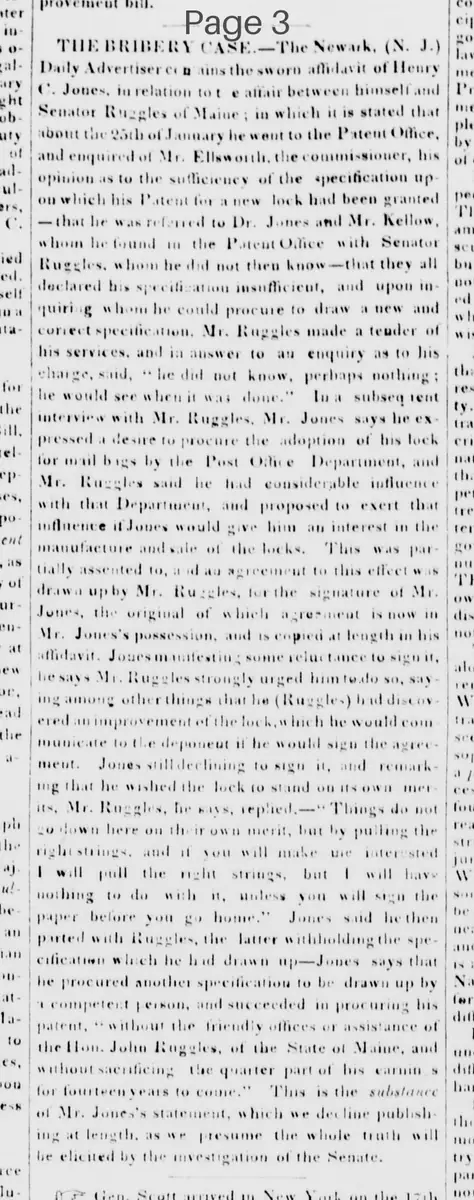
THE BRIBERY CASE.—The Newark, (N. J.) Daily Advertiser contains the sworn affidavit of Henry G. Jones, in relation to the affair between himself and Senator Ruggles of Maine; in which it is stated that about the 25th of January he went to the Patent Office, and enquired of Mr. Ellsworth, the commissioner, his opinion as to the sufficiency of the specification upon which his Patent for a new lock had been granted—that he was referred to Dr. Jones and Mr. Kellow, whom he found in the Patent Office with Senator Ruggles, whom he did not then know—that they all declared his specification insufficient, and upon inquiring whom he could procure to draw a new and correct specification, Mr. Ruggles made a tender of his services, and in answer to an enquiry as to his charge, said, 'he did not know, perhaps nothing: he would see when it was done.'
In a subsequent interview with Mr. Ruggles, Mr. Jones says he expressed a desire to procure the adoption of his lock for mail bags by the Post Office Department, and Mr. Ruggles said he had considerable influence with that Department, and proposed to exert that influence if Jones would give him an interest in the manufacture and sale of the locks. This was partially assented to, and an agreement to this effect was drawn up by Mr. Ruggles, for the signature of Mr. Jones, the original of which agreement is now in Mr. Jones's possession, and is copied at length in his affidavit.
Jones manifesting some reluctance to sign it, he says Mr. Ruggles strongly urged him to do so, saying among other things that he (Ruggles) had discovered an improvement of the lock, which he would communicate to the deponent if he would sign the agreement. Jones still declining to sign it, and remarking that he wished the lock to stand on its own merits, Mr. Ruggles, he says, replied—'Things do not go on here on their own merit, but by pulling the right strings, and if you will make me interested I will pull the right strings, but I will have nothing to do with it, unless you will sign the paper before you go home.'
Jones said he then parted with Ruggles, the latter withholding the specification which he had drawn up—Jones says that he procured another specification to be drawn up by a competent person, and succeeded in procuring his patent, 'without the friendly offices or assistance of the Hon. John Ruggles, of the State of Maine, and without sacrificing the quarter part of his earnings for fourteen years to come.'
This is the substance of Mr. Jones's statement, which we decline publishing at length, as we presume the whole truth will be elicited by the investigation of the Senate.
In a subsequent interview with Mr. Ruggles, Mr. Jones says he expressed a desire to procure the adoption of his lock for mail bags by the Post Office Department, and Mr. Ruggles said he had considerable influence with that Department, and proposed to exert that influence if Jones would give him an interest in the manufacture and sale of the locks. This was partially assented to, and an agreement to this effect was drawn up by Mr. Ruggles, for the signature of Mr. Jones, the original of which agreement is now in Mr. Jones's possession, and is copied at length in his affidavit.
Jones manifesting some reluctance to sign it, he says Mr. Ruggles strongly urged him to do so, saying among other things that he (Ruggles) had discovered an improvement of the lock, which he would communicate to the deponent if he would sign the agreement. Jones still declining to sign it, and remarking that he wished the lock to stand on its own merits, Mr. Ruggles, he says, replied—'Things do not go on here on their own merit, but by pulling the right strings, and if you will make me interested I will pull the right strings, but I will have nothing to do with it, unless you will sign the paper before you go home.'
Jones said he then parted with Ruggles, the latter withholding the specification which he had drawn up—Jones says that he procured another specification to be drawn up by a competent person, and succeeded in procuring his patent, 'without the friendly offices or assistance of the Hon. John Ruggles, of the State of Maine, and without sacrificing the quarter part of his earnings for fourteen years to come.'
This is the substance of Mr. Jones's statement, which we decline publishing at length, as we presume the whole truth will be elicited by the investigation of the Senate.
What sub-type of article is it?
Crime Story
Deception Fraud
What themes does it cover?
Deception
Crime Punishment
Justice
What keywords are associated?
Bribery Case
Patent Lock
Senator Influence
Post Office Department
Affidavit
Senate Investigation
What entities or persons were involved?
Henry G. Jones
Senator Ruggles
Mr. Ellsworth
Dr. Jones
Mr. Kellow
Where did it happen?
Patent Office
Story Details
Key Persons
Henry G. Jones
Senator Ruggles
Mr. Ellsworth
Dr. Jones
Mr. Kellow
Location
Patent Office
Event Date
About The 25th Of January
Story Details
Henry G. Jones sought advice on his lock patent specification at the Patent Office, where Senator Ruggles offered services and influence for an interest in the locks in exchange for helping secure post office adoption; Jones refused to sign the agreement and obtained his patent independently.