Thank you for visiting SNEWPapers!
Sign up free
The Nome Nugget
Nome, Nome County, Alaska
What is this article about?
The Atomic Energy Commission's Environmental Studies Committee for Project Chariot stated on Dec. 10, 1959, that the proposed nuclear blast at Cape Thompson could proceed in spring with debris directed to sea, ensuring no excess radiation or damage to local humans and wildlife, based on available but incomplete data.
Clipping
OCR Quality
Full Text
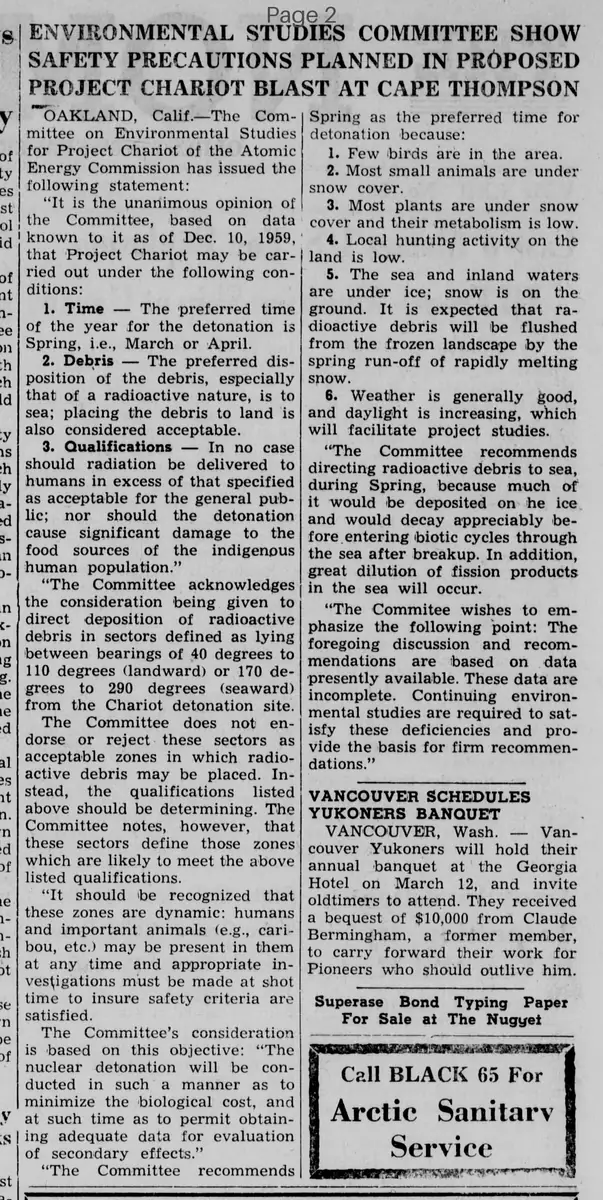
SAFETY PRECAUTIONS PLANNED IN PROPOSED
PROJECT CHARIOT BLAST AT CAPE THOMPSON
OAKLAND, Calif.-The Committee
on Environmental Studies
for Project Chariot of the Atomic
Energy Commission has issued the
following statement:
"It is the unanimous opinion of
the Committee, based on data
known to it as of Dec. 10, 1959,
that Project Chariot may be car-
ried out under the following con-
ditions:
1. Time -- The preferred time
of the year for the detonation is
Spring, i.e., March or April.
2. Debris -- The preferred dis-
position of the debris, especially
that of a radioactive nature, is to
sea; placing the debris to land is
also considered acceptable.
3. Qualifications -
In no case
should radiation be delivered to
humans in excess of that specified
as acceptable for the general pub-
lic;
nor
should the detonation
cause
significant damage to the
food
sources
of
the
indigenous
human population."
"The Committee acknowledges
the consideration being given to
direct deposition of radioactive
debri in sectors defined as lying
between bearings of 40 degrees to
110 degrees (landward) or 170 de-
grees to 290 degrees (seaward)
from the Chariot detonation site.
The Committee does not en-
dorse or reject. these sectors as
acceptable zones in which radio-
active debris may be placed. In-
stead, the qualifications listed
above should be determining. The
Committee notes, however, that
these sectors define those zones
which are likely to meet the above
listed qualifications.
"It should be recognized that
these zones are dynamic: humans
and important animals (e.g., cari-
bou, etc.) may be present in them
at any time and appropriate in-
vestigations must be made at shot
time to insure safety criteria are
satisfied.
The Committee's consideration
is based on this objective: "The
nuclear detonation will be con-
ducted in such a manner as to
minimize the biological cost, and
at such time as to permit obtain-
ing adequate data for evaluation
of secondary effects."
"The Committee recommends
Spring as the preferred time for
detonation because:
l. Few birds are in the area.
2. Most small animals are under
snow cover.
3. Most plants are under snow
cover and their metabolism is low.
4. Local hunting activity on the
land is low.
5. The sea and inland waters
are under ice; snow is on the
ground. It is expected that ra-
dioactiye debris will be flushed
from the frozen landscape by the
spring run-off of rapidly melting
snow.
6. Weather is generally good,
and daylight is increasing, which
will facilitate project studies.
"The
Committee recommends
directing radioactive debris to sea,
during Spring, because much of
it would be deposited on he ice
and would decay appreciably be-
fore entering biotic cycles through
the sea after breakup. In addition,
great dilution of fission products
in the sea will occur.
"The Commitee wishes to em-
phasize the following point: The
foregoing discussion and recom-
mendations are based on data
presently available. These data are
incomplete. Continuing environ-
mental studies are required to sat-
isfy these deficiencies and pro-
vide the basis for firm recommen-
dations."
What sub-type of article is it?
What keywords are associated?
What entities or persons were involved?
Where did it happen?
Domestic News Details
Primary Location
Cape Thompson
Event Date
Dec. 10, 1959
Key Persons
Outcome
no actual detonation occurred; recommendations provided for safe execution including timing in spring, debris disposal to sea, and radiation limits to protect humans and food sources.
Event Details
The Committee issued a statement approving Project Chariot under conditions: detonation in spring (March or April), debris preferably to sea, no excess radiation to humans, no significant damage to indigenous food sources. Sectors for debris deposition noted but not endorsed; zones dynamic, requiring investigations. Objective to minimize biological cost and obtain data. Reasons for spring: low wildlife activity, snow cover, low hunting, ice cover, good weather. Sea disposal allows decay on ice and dilution. Data incomplete, further studies needed.