Thank you for visiting SNEWPapers!
Sign up free
Literary
February 26, 1846
The Voice Of Freedom
Montpelier, Brandon, Washington County, Rutland County, Vermont
What is this article about?
This essay, part III on education, discusses its importance for institutions and practical methods for acquisition by all classes. It contrasts genius with systematic self-improvement, praises Washington's balanced character as an ideal, and emphasizes physical, moral, and intellectual cultivation through habits, reading, reflection, and Dr. Watts' methods, concluding that knowledge is power when applied usefully.
Clipping
OCR Quality
95%
Excellent
Full Text
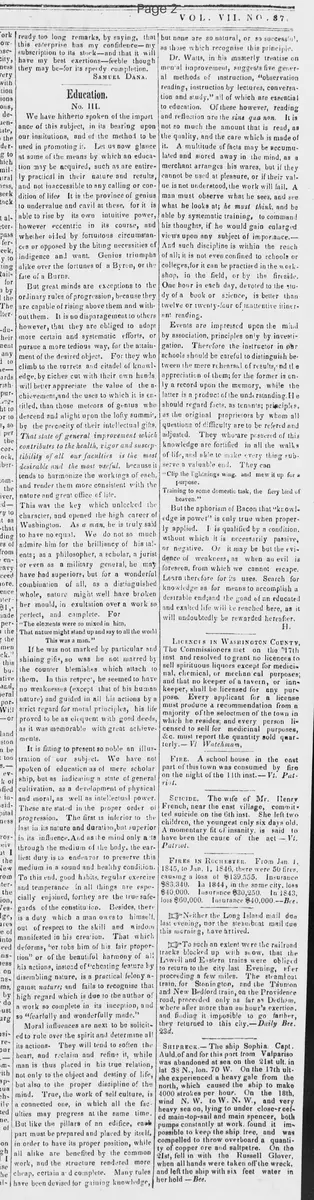
Education.
No. III.
We have hitherto spoken of the importance of this subject, in its bearing upon our institutions, and of the method to be used in promoting it. Let us now glance at some of the means by which an education may be acquired, such as are entirely practical in their nature and results, and not inaccessible to any calling or condition of life It is the province of genius to undervalue and cavil at these, for it is able to rise by its own intuitive power, however eccentric in its course, and whether aided by fortuitous circumstances or opposed by the biting necessities of indigence and want. Genius triumphs alike over the fortunes of a Byron, or the fate of a Burns.
But great minds are exceptions to the ordinary rules of progression, because they are capable of rising above them and without them. It is no disparagement to others however, that they are obliged to adopt more certain and systematic efforts, or pursue a more tedious way, for the attainment of the desired object. For they who climb to the turrets and citadel of knowledge, by niches cut with their own hands will better appreciate the value of the achievement,and the uses to which it is entitled, than those meteors of genius who descend and alight upon the lofty summit, by the precocity of their intellectual gifts.
That state of general improvement which contributes to the health, rigor and susceptibility of all our faculties is the most desirable and the most useful, because it tends to harmonize the workings of each, and render them more consistent with the nature and great office of life.
This was the key which unlocked the character, and opened the high career of Washington. As a man, he is truly said to have no equal. We do not so much admire him for the brilliancy of his talents; as a philosopher, a scholar, a jurist or even as a military general, he may have had superiors, but for a wonderful combination of all, as a distinguished whole, nature might well have broken her mould, in exultation over a work so perfect, and complete. For
"The elements were so mixed in him. That nature might stand up and say to all the world This was a man."
If he was not marked by particular and shining gifts, so was he not marred by the counter blemishes which attach to them. In this respect, he seemed to have no weaknesses (except that of his human nature) and guided in all his actions by a strict regard for moral principles, his life proved to be as eloquent with good deeds as it was memorable with great achievements.
It is fitting to present so noble an illustration of our subject. We have not spoken of education as of mere scholarship, but as indicating a state of general cultivation, as a development of physical and moral, as well as intellectual power. These are stated in the proper order of progression. The first is inferior to the last in its nature and duration,but superior in its influence.And as the mind only acts through the medium of the body. the earliest duty is to endeavor to preserve this medium in a sound and healthy condition.
To this end, good habits, regular exercise and temperance in all things are especially enjoined, for they are the true safeguards of the constitution. Besides, there is a duty which a man owes to himself. out of respect to the skill and wisdom manifested in his creation. That which deforms, "or robs him of his fair proportion" or of the beautiful harmony of all his actions, instead of"cheating feature by dissembling nature, is a practical felony against nature; and fails to recognise that high regard which is due to the author of a work so complete in its inception, and so "fearfully and wonderfully made."
Moral influences are next to be solicited to rule over the spirit and determine all its actions- They will tend to soften the heart, and reclaim and refine it, while man is thus placed in his true relation, not only to the object and destiny of life, but also to the proper discipline of the mind. True, the work of self culture, is a connected one, in which all the faculties may progress at the same time. But like the pillars of an edifice, each part must be prepared and placed by itself, in order to have its proper position, while all alike are benefited by the common work, and the structure rendered more cheap, certain and complete. Many rules have been devised for gaining knowledge, but none are so natural, or so successful as those which recognise this principle.
Dr. Watts, in his masterly treatise on mental improvement, suggests five general methods of instruction, "observation reading, instruction by lectures, conversation and study." all of which are essential to education. Of these however, reading and reflection are the sine qua non.
It is not so much the amount that is read, as the quality, and the care which is made of it. A multitude of facts may be accumulated and stored away in the mind, as a merchant arranges his wares, but if they cannot be used at pleasure, or if their value is not understood, the work will fail. A man must observe what he sees, and see what he looks at; he must think, and be able by systematic training, to command his thoughts, if he would gain enlarged views upon any subject of importance.-
And such discipline is within the reach of all; it is not even confined to schools or colleges,for it can be practised in the work-shop, in the field, or by the fireside. One hour in each day, devoted to the study of a book or science, is better than twelve or twenty-four of inattentive itinerant reading.
Events are impressed upon the mind by association, principles only by investigation. Therefore the instructor in our schools should be careful to distinguish between the mere rehearsal of results. and the appreciation of them; for the former is only a record upon the memory, while the latter is a product of the understanding.He should regard facts, as tenants; principles, as the original proprietors by whom all questions of difficulty are to be referred and adjusted. They who are possessed of this knowledge are fortified in all the walks of life, and able to make every thing subservient a valuable end. They can
"Clip the lightnings wing, and mew it up for a purpose.
Training to some domestic task, the fiery bird of heaven."
But the aphorism of Bacon that "knowledge is power'' is only true when properly applied. It is qualified by a condition, without which it is necessarily passive, or negative. Or it may be but the evidence of weakness, as when an evil is foreseen, from which we cannot escape.
Learn therefore for its uses. Search for knowledge as for means to accomplish a desirable end;and the goal of an educated and exalted life will be reached here, as it will undoubtedly be rewarded hereafter.
H,
No. III.
We have hitherto spoken of the importance of this subject, in its bearing upon our institutions, and of the method to be used in promoting it. Let us now glance at some of the means by which an education may be acquired, such as are entirely practical in their nature and results, and not inaccessible to any calling or condition of life It is the province of genius to undervalue and cavil at these, for it is able to rise by its own intuitive power, however eccentric in its course, and whether aided by fortuitous circumstances or opposed by the biting necessities of indigence and want. Genius triumphs alike over the fortunes of a Byron, or the fate of a Burns.
But great minds are exceptions to the ordinary rules of progression, because they are capable of rising above them and without them. It is no disparagement to others however, that they are obliged to adopt more certain and systematic efforts, or pursue a more tedious way, for the attainment of the desired object. For they who climb to the turrets and citadel of knowledge, by niches cut with their own hands will better appreciate the value of the achievement,and the uses to which it is entitled, than those meteors of genius who descend and alight upon the lofty summit, by the precocity of their intellectual gifts.
That state of general improvement which contributes to the health, rigor and susceptibility of all our faculties is the most desirable and the most useful, because it tends to harmonize the workings of each, and render them more consistent with the nature and great office of life.
This was the key which unlocked the character, and opened the high career of Washington. As a man, he is truly said to have no equal. We do not so much admire him for the brilliancy of his talents; as a philosopher, a scholar, a jurist or even as a military general, he may have had superiors, but for a wonderful combination of all, as a distinguished whole, nature might well have broken her mould, in exultation over a work so perfect, and complete. For
"The elements were so mixed in him. That nature might stand up and say to all the world This was a man."
If he was not marked by particular and shining gifts, so was he not marred by the counter blemishes which attach to them. In this respect, he seemed to have no weaknesses (except that of his human nature) and guided in all his actions by a strict regard for moral principles, his life proved to be as eloquent with good deeds as it was memorable with great achievements.
It is fitting to present so noble an illustration of our subject. We have not spoken of education as of mere scholarship, but as indicating a state of general cultivation, as a development of physical and moral, as well as intellectual power. These are stated in the proper order of progression. The first is inferior to the last in its nature and duration,but superior in its influence.And as the mind only acts through the medium of the body. the earliest duty is to endeavor to preserve this medium in a sound and healthy condition.
To this end, good habits, regular exercise and temperance in all things are especially enjoined, for they are the true safeguards of the constitution. Besides, there is a duty which a man owes to himself. out of respect to the skill and wisdom manifested in his creation. That which deforms, "or robs him of his fair proportion" or of the beautiful harmony of all his actions, instead of"cheating feature by dissembling nature, is a practical felony against nature; and fails to recognise that high regard which is due to the author of a work so complete in its inception, and so "fearfully and wonderfully made."
Moral influences are next to be solicited to rule over the spirit and determine all its actions- They will tend to soften the heart, and reclaim and refine it, while man is thus placed in his true relation, not only to the object and destiny of life, but also to the proper discipline of the mind. True, the work of self culture, is a connected one, in which all the faculties may progress at the same time. But like the pillars of an edifice, each part must be prepared and placed by itself, in order to have its proper position, while all alike are benefited by the common work, and the structure rendered more cheap, certain and complete. Many rules have been devised for gaining knowledge, but none are so natural, or so successful as those which recognise this principle.
Dr. Watts, in his masterly treatise on mental improvement, suggests five general methods of instruction, "observation reading, instruction by lectures, conversation and study." all of which are essential to education. Of these however, reading and reflection are the sine qua non.
It is not so much the amount that is read, as the quality, and the care which is made of it. A multitude of facts may be accumulated and stored away in the mind, as a merchant arranges his wares, but if they cannot be used at pleasure, or if their value is not understood, the work will fail. A man must observe what he sees, and see what he looks at; he must think, and be able by systematic training, to command his thoughts, if he would gain enlarged views upon any subject of importance.-
And such discipline is within the reach of all; it is not even confined to schools or colleges,for it can be practised in the work-shop, in the field, or by the fireside. One hour in each day, devoted to the study of a book or science, is better than twelve or twenty-four of inattentive itinerant reading.
Events are impressed upon the mind by association, principles only by investigation. Therefore the instructor in our schools should be careful to distinguish between the mere rehearsal of results. and the appreciation of them; for the former is only a record upon the memory, while the latter is a product of the understanding.He should regard facts, as tenants; principles, as the original proprietors by whom all questions of difficulty are to be referred and adjusted. They who are possessed of this knowledge are fortified in all the walks of life, and able to make every thing subservient a valuable end. They can
"Clip the lightnings wing, and mew it up for a purpose.
Training to some domestic task, the fiery bird of heaven."
But the aphorism of Bacon that "knowledge is power'' is only true when properly applied. It is qualified by a condition, without which it is necessarily passive, or negative. Or it may be but the evidence of weakness, as when an evil is foreseen, from which we cannot escape.
Learn therefore for its uses. Search for knowledge as for means to accomplish a desirable end;and the goal of an educated and exalted life will be reached here, as it will undoubtedly be rewarded hereafter.
H,
What sub-type of article is it?
Essay
What themes does it cover?
Moral Virtue
Political
Temperance
What keywords are associated?
Education
Self Culture
Washington
Moral Principles
Reading Reflection
Genius
Temperance
Knowledge Power
What entities or persons were involved?
H
Literary Details
Title
Education. No. Iii.
Author
H
Subject
On The Importance And Practical Methods Of Education
Key Lines
"The Elements Were So Mixed In Him. That Nature Might Stand Up And Say To All The World This Was A Man."
"Clip The Lightnings Wing, And Mew It Up For A Purpose. Training To Some Domestic Task, The Fiery Bird Of Heaven."
The Aphorism Of Bacon That "Knowledge Is Power'' Is Only True When Properly Applied.