Thank you for visiting SNEWPapers!
Sign up free
The Daily Alaska Empire
Juneau, Juneau County, Alaska
What is this article about?
Washington, May 14: Senate passes union regulation bill 68-24, aligning with House's earlier vote, signaling decline in labor's congressional influence. Compromise pending; President Truman's veto stance unknown, but override would need two-thirds majority.
Merged-components note: Continuation of the same domestic news story across pages; relabeled the page 3 portion from 'story' to 'domestic_news' for consistency
Clippings
1 of 2
OCR Quality
Full Text
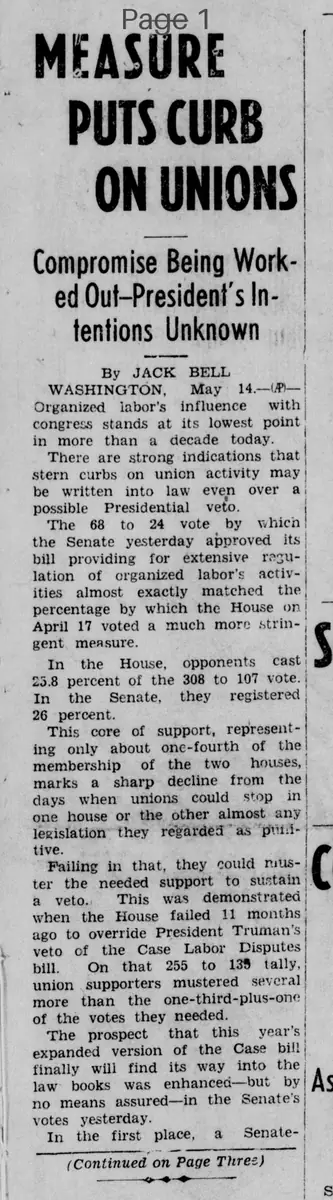
Compromise Being Worked Out-President's Intentions Unknown
By JACK BELL
WASHINGTON, May 14.-(RP)-
Organized labor's influence with congress stands at its lowest point in more than a decade today.
There are strong indications that stern curbs on union activity may be written into law even over a possible Presidential veto.
The 68 to 24 vote by which the Senate yesterday approved its bill providing for extensive regulation of organized labor's activities almost exactly matched the percentage by which the House on April 17 voted a much more stringent measure.
In the House, opponents cast 25.8 percent of the 308 to 107 vote.
In the Senate, they registered 26 percent.
This core of support, representing only about one-fourth of the membership of the two houses, marks a sharp decline from the days when unions could stop in one house or the other almost any legislation they regarded as punitive.
Failing in that, they could muster the needed support to sustain a veto. This was demonstrated when the House failed 11 months ago to override President Truman's veto of the Case Labor Disputes bill. On that 255 to 135 tally, union supporters mustered several more than the one-third-plus-one of the votes they needed.
The prospect that this year's expanded version of the Case bill finally will find its way into the law books was enhanced-but by no means assured-in the Senate's votes yesterday.
In the first place, a Senate-
(Continued on Page Three)
MEASURE
PUTS CURB
ON UNIONS
(Continued from Page One)
House conference committee must work out a compromise version. If it follows the tough form that many House members would like, leaders unquestionably will be able to force its acceptance by both houses. But the chances that it would be vetoed by President Truman would be increased.
A milder edition, more in line with that approved by the Senate apparently would encounter less risk of a veto.
Mr. Truman has kept his own counsel about what he intends to do.
But if he vetoes the measure he finally receives, Capitol Hill undoubtedly will witness the most intensive campaign in years by organized labor and administration leaders to get the veto sustained.
It requires two-thirds approval of those voting in each house to override.
What sub-type of article is it?
What keywords are associated?
What entities or persons were involved?
Where did it happen?
Domestic News Details
Primary Location
Washington
Event Date
May 14
Key Persons
Outcome
senate approved bill 68 to 24; house approved similar measure 308 to 107 on april 17; prospects of law enhanced but not assured, possible veto by president truman requiring two-thirds to override
Event Details
Organized labor's influence with Congress at lowest in over a decade. Senate approved bill for extensive regulation of union activities 68 to 24, matching House's April 17 vote percentage. Compromise to be worked out by conference committee; President's intentions unknown. If vetoed, intensive campaign expected to sustain it.