Thank you for visiting SNEWPapers!
Sign up free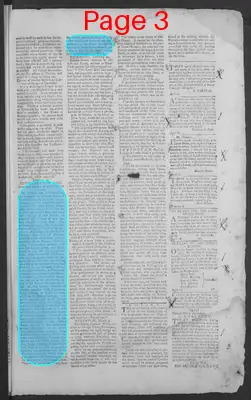
The Kentucky Gazette
Lexington, Fayette County, Kentucky
What is this article about?
The U.S. Supreme Court in Philadelphia ruled on whether individuals or citizens of one state can sue another state or the United States. Majority opinion by Chief Justice Jay and others affirmed the right, in a case involving South Carolina executors suing Georgia over a pre-Revolution bond.
Clipping
OCR Quality
Full Text
SUPREME COURT OF THE UNITED STATES
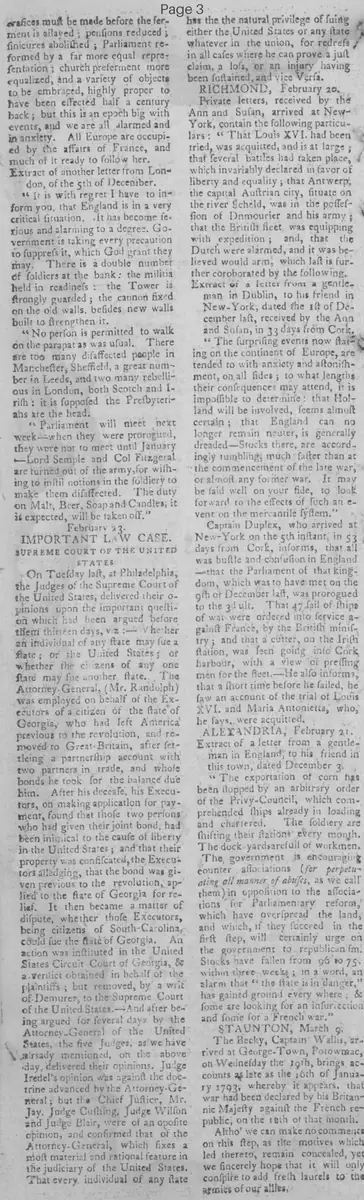
On Tuesday last, at Philadelphia, the Judges of the Supreme Court of the United States, delivered their opinions upon the important question which had been argued before them thirteen days, viz:-- Whether an individual of any state may sue a State: or the United States; or whether the citizens of any one state may sue another state. The Attorney General, (Mr. Randolph) was employed on behalf of the Executors of a citizen of the state of Georgia, who had left America previous to the revolution, and removed to Great Britain, after settling a partnership account with two partners in trade, and whose bonds he took for the balance due him. After his decease, his Executors, on making application for payment, found that those two persons who had given their joint bond, had been inimical to the cause of liberty in the United States; and that their property was confiscated, the Executors alleging, that the bond was given previous to the revolution, applied to the state of Georgia for relief. It then became a matter of dispute, whether those Executors, being citizens of South-Carolina, could sue the state of Georgia. An action was instituted in the United States Circuit Court of Georgia, & a verdict obtained in behalf of the plaintiffs; but removed, by a writ of Demurrer, to the Supreme Court of the United States.--And after being argued for several days by the Attorney-General of the United States, the five judges, as we have already mentioned, on the above day, delivered their opinions. Judge Iredell's opinion was against the doctrine advanced by the Attorney-General; but the Chief Justice, Mr. Jay, Judge Cushing, Judge Wilson and Judge Blair, were of an opposite opinion, and confirmed that of the Attorney-General, which fixes a most material and rational feature in the judiciary of the United States. That every individual of any state has the natural privilege of suing either the United States or any state whatever in the union, for redress in all cases where he can prove a just claim, a loss, or an injury having been sustained, and vice versa.
What sub-type of article is it?
What keywords are associated?
What entities or persons were involved?
Where did it happen?
Domestic News Details
Primary Location
Philadelphia
Event Date
On Tuesday Last
Key Persons
Outcome
majority opinion (chief justice jay, judges cushing, wilson, blair) confirmed the attorney-general's doctrine, affirming that individuals of any state may sue the united states or any state for redress of just claims, losses, or injuries.
Event Details
The Supreme Court delivered opinions on whether an individual of any state may sue a state or the United States, or citizens of one state may sue another. The case involved Executors of a Georgia citizen, now South Carolina citizens, seeking payment on a pre-Revolution bond from Georgia after the debtors' property was confiscated. Argued for thirteen days, with Attorney General Randolph representing the plaintiffs.