Thank you for visiting SNEWPapers!
Sign up free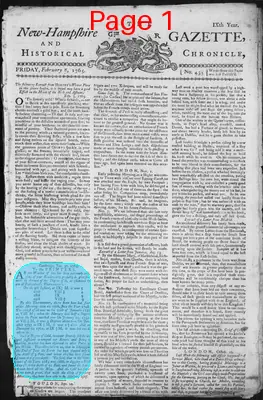
Letter to Editor
February 8, 1765
The New Hampshire Gazette And Historical Chronicle
Portsmouth, Greenland, Rockingham County, New Hampshire
What is this article about?
Letter from Cambridge, January 30, 1765, reports recent extreme cold weather, providing Fahrenheit thermometer readings from January 9-29, noting the 27th as one of the coldest mornings since 1748, with comparisons to prior cold snaps and Siberian extremes.
Clipping
OCR Quality
92%
Excellent
Full Text
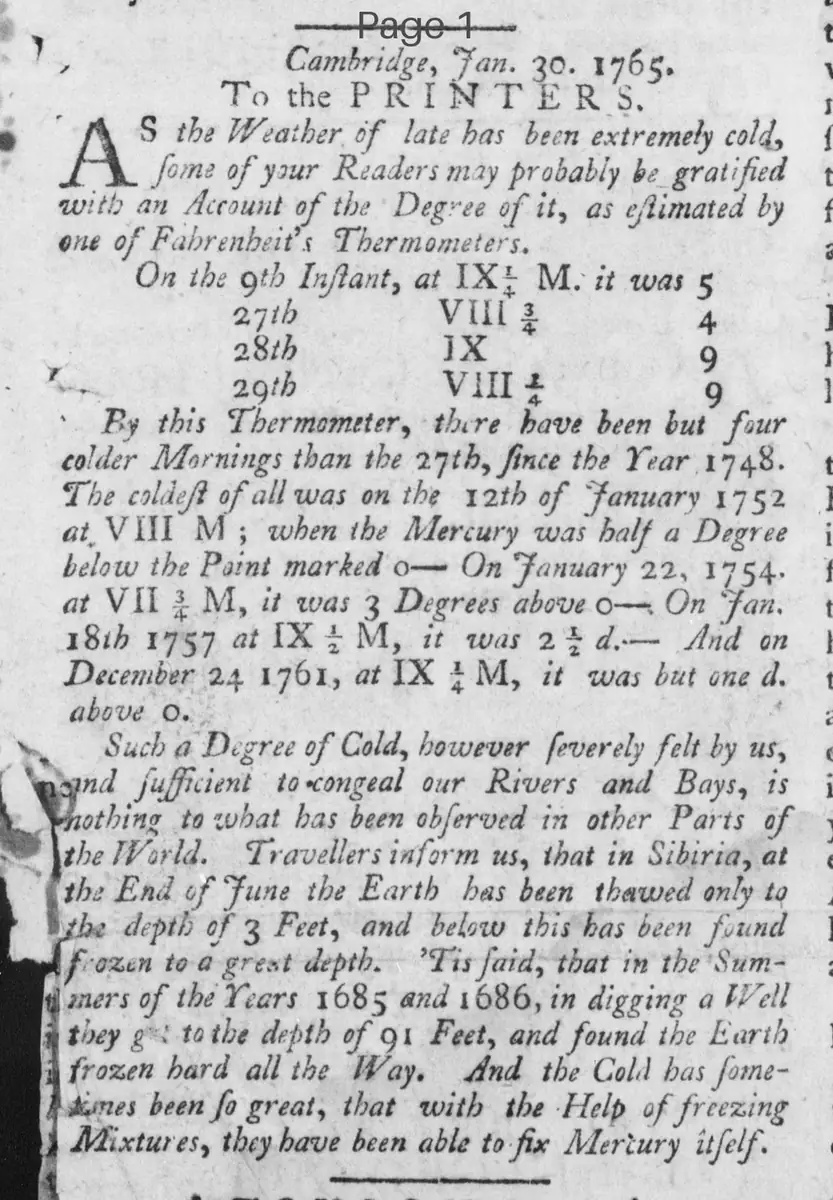
Cambridge, Jan. 30. 1765.
To the PRINTERS.
As the Weather of late has been extremely cold. As our Readers may probably be with an Account of the Degree of it, as estimated by one of Fahrenheit's Thermometers.
On the 9th Instant, at IX o'clock A.M. it was 5
27th VIII M. 4
28th IX 9
29th VIII 9
By this Thermometer, there have been but four colder Mornings than the 27th, since the Year 1748. The coldest of all was on the 12th of January 1752 at VIII M; when the Mercury was half a Degree below the Point marked 0 On January 22, 1754. at VII 3 M, it was 3 Degrees above 0-- On Jan. 18th 1757 at IX A M, it was 2 d.-- And on December 24 1761, at IX A M, it was but one d. above 0.
Such a Degree of Cold, however Severely felt by us, no wind sufficient to congeal our Rivers and Bays, is nothing to what has been observed in other Parts of the World. Travellers inform us, that in Siberia, at the End of June the Earth has been thawed only to the depth of 3 Feet, and below this has been found frozen to a great depth. Tis said, that in the Summers of the Years 1685 and 1686, in digging a Well they went to the depth of 91 Feet, and found the Earth frozen hard all the Way. And the Cold has sometimes been so great, that with the Help of freezing Mixtures, they have been able to fix Mercury itself.
To the PRINTERS.
As the Weather of late has been extremely cold. As our Readers may probably be with an Account of the Degree of it, as estimated by one of Fahrenheit's Thermometers.
On the 9th Instant, at IX o'clock A.M. it was 5
27th VIII M. 4
28th IX 9
29th VIII 9
By this Thermometer, there have been but four colder Mornings than the 27th, since the Year 1748. The coldest of all was on the 12th of January 1752 at VIII M; when the Mercury was half a Degree below the Point marked 0 On January 22, 1754. at VII 3 M, it was 3 Degrees above 0-- On Jan. 18th 1757 at IX A M, it was 2 d.-- And on December 24 1761, at IX A M, it was but one d. above 0.
Such a Degree of Cold, however Severely felt by us, no wind sufficient to congeal our Rivers and Bays, is nothing to what has been observed in other Parts of the World. Travellers inform us, that in Siberia, at the End of June the Earth has been thawed only to the depth of 3 Feet, and below this has been found frozen to a great depth. Tis said, that in the Summers of the Years 1685 and 1686, in digging a Well they went to the depth of 91 Feet, and found the Earth frozen hard all the Way. And the Cold has sometimes been so great, that with the Help of freezing Mixtures, they have been able to fix Mercury itself.
What sub-type of article is it?
Informative
Historical
What themes does it cover?
Science Nature
What keywords are associated?
Cold Weather
Fahrenheit Thermometer
Cambridge Cold
Historical Weather
Siberia Freeze
Mercury Freezing
What entities or persons were involved?
The Printers
Letter to Editor Details
Recipient
The Printers
Main Argument
provides an account of recent extreme cold weather in cambridge, measured by fahrenheit's thermometer, with historical comparisons to previous cold periods and global extremes in siberia.
Notable Details
Thermometer Readings From January 9 29, 1765
Coldest Morning Since 1748 On January 27
Comparisons To Cold Snaps In 1752, 1754, 1757, 1761
Siberian Permafrost Examples From 1685 1686