Thank you for visiting SNEWPapers!
Sign up free
Story
September 25, 1950
The Daily Alaska Empire
Juneau, Juneau County, Alaska
What is this article about?
Dr. Victor E. Levine, on his tenth Alaska visit, conducts blood studies on natives and envisions a thriving 'Greater Alaska' with improved health, education, population, and tourism, drawing from his extensive Arctic research career since 1921.
Clipping
OCR Quality
88%
Good
Full Text
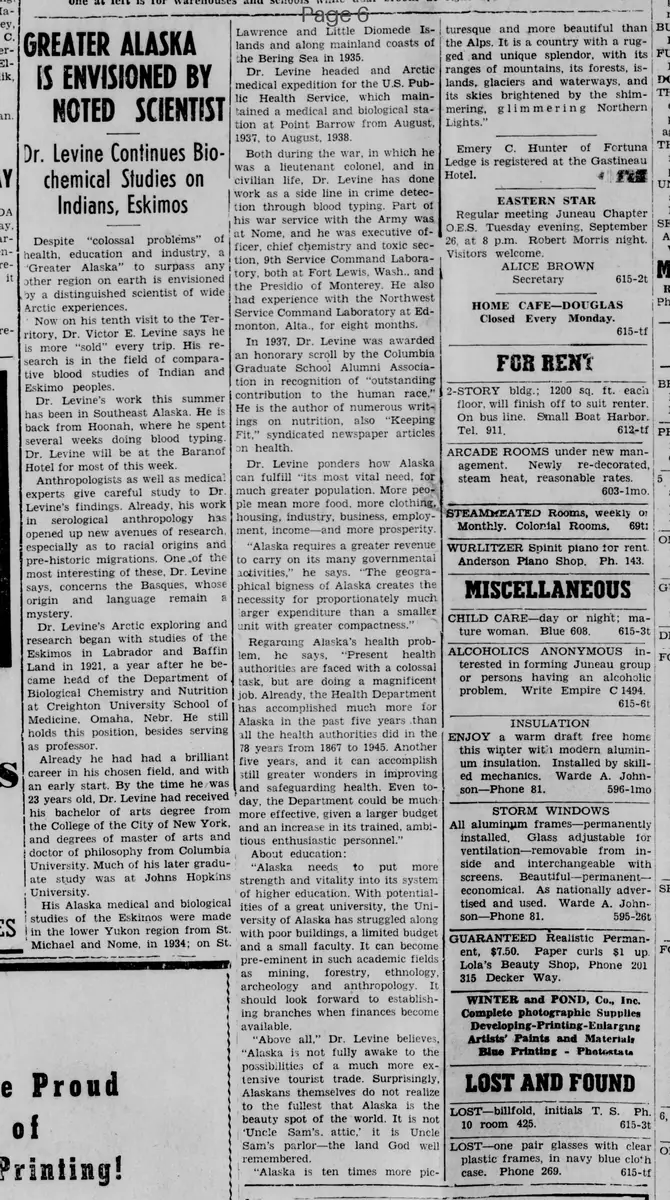
GREATER ALASKA IS ENVISIONED BY NOTED SCIENTIST
Dr. Levine Continues Biochemical Studies on Indians, Eskimos
Despite "colossal problems" of health, education and industry, a 'Greater Alaska' to surpass any other region on earth is envisioned by a distinguished scientist of wide Arctic experiences.
Now on his tenth visit to the Territory, Dr. Victor E. Levine says he is more "sold" every trip. His research is in the field of comparative blood studies of Indian and Eskimo peoples.
Dr. Levine's work this summer has been in Southeast Alaska. He is back from Hoonah, where he spent several weeks doing blood typing. Dr. Levine will be at the Baranof Hotel for most of this week.
Anthropologists as well as medical experts give careful study to Dr. Levine's findings. Already, his work in serological anthropology has opened up new avenues of research, especially as to racial origins and pre-historic migrations. One of the most interesting of these, Dr. Levine says, concerns the Basques, whose origin and language remain a mystery.
Dr. Levine's Arctic exploring and research began with studies of the Eskimos in Labrador and Baffin Land in 1921, a year after he became head of the Department of Biological Chemistry and Nutrition at Creighton University School of Medicine, Omaha, Nebr. He still holds this position, besides serving as professor.
Already he had had a brilliant career in his chosen field, and with an early start. By the time he was 23 years old, Dr. Levine had received his bachelor of arts degree from the College of the City of New York, and degrees of master of arts and doctor of philosophy from Columbia University. Much of his later graduate study was at Johns Hopkins University.
His Alaska medical and biological studies of the Eskimos were made in the lower Yukon region from St. Michael and Nome, in 1934; on St. Lawrence and Little Diomede Islands and along mainland coasts of the Bering Sea in 1935.
Dr. Levine headed an Arctic medical expedition for the U.S. Public Health Service, which maintained a medical and biological station at Point Barrow from August 1937, to August 1938.
Both during the war, in which he was a lieutenant colonel, and in civilian life, Dr. Levine has done work as a side line in crime detection through blood typing. Part of his war service with the Army was at Nome, and he was executive officer, chief chemistry and toxic section, 9th Service Command Laboratory, both at Fort Lewis, Wash., and the Presidio of Monterey. He also had experience with the Northwest Service Command Laboratory at Edmonton, Alta., for eight months.
In 1937, Dr. Levine was awarded an honorary scroll by the Columbia Graduate School Alumni Association in recognition of "outstanding contribution to the human race." He is the author of numerous writings on nutrition, also "Keeping Fit," syndicated newspaper articles on health.
Dr. Levine ponders how Alaska can fulfill "its most vital need, for much greater population. More people mean more food, more clothing, housing, industry, business, employment, income-and more prosperity.
"Alaska requires a greater revenue to carry on its many governmental activities," he says. "The geographical bigness of Alaska creates the necessity for proportionately much larger expenditure than a smaller unit with greater compactness."
Regarding Alaska's health problem, he says, "Present health authorities are faced with a colossal task, but are doing a magnificent job. Already, the Health Department has accomplished much more for Alaska in the past five years than all the health authorities did in the 78 years from 1867 to 1945. Another five years, and it can accomplish still greater wonders in improving and safeguarding health. Even today, the Department could be much more effective, given a larger budget and an increase in its trained, ambitious enthusiastic personnel."
About education:
"Alaska needs to put more strength and vitality into its system of higher education. With potentialities of a great university, the University of Alaska has struggled along with poor buildings, a limited budget and a small faculty. It can become pre-eminent in such academic fields as mining, forestry, ethnology, archeology and anthropology. It should look forward to establishing branches when finances become available.
"Above all," Dr. Levine believes, "Alaska is not fully awake to the possibilities of a much more extensive tourist trade. Surprisingly, Alaskans themselves do not realize to the fullest that Alaska is the beauty spot of the world. It is not 'Uncle Sam's attic,' it is Uncle Sam's parlor--the land God well remembered.
"Alaska is ten times more picturesque and more beautiful than the Alps. It is a country with a rugged and unique splendor, with its ranges of mountains, its forests, islands, glaciers and waterways, and its skies brightened by the shimmering, glimmering Northern Lights."
Dr. Levine Continues Biochemical Studies on Indians, Eskimos
Despite "colossal problems" of health, education and industry, a 'Greater Alaska' to surpass any other region on earth is envisioned by a distinguished scientist of wide Arctic experiences.
Now on his tenth visit to the Territory, Dr. Victor E. Levine says he is more "sold" every trip. His research is in the field of comparative blood studies of Indian and Eskimo peoples.
Dr. Levine's work this summer has been in Southeast Alaska. He is back from Hoonah, where he spent several weeks doing blood typing. Dr. Levine will be at the Baranof Hotel for most of this week.
Anthropologists as well as medical experts give careful study to Dr. Levine's findings. Already, his work in serological anthropology has opened up new avenues of research, especially as to racial origins and pre-historic migrations. One of the most interesting of these, Dr. Levine says, concerns the Basques, whose origin and language remain a mystery.
Dr. Levine's Arctic exploring and research began with studies of the Eskimos in Labrador and Baffin Land in 1921, a year after he became head of the Department of Biological Chemistry and Nutrition at Creighton University School of Medicine, Omaha, Nebr. He still holds this position, besides serving as professor.
Already he had had a brilliant career in his chosen field, and with an early start. By the time he was 23 years old, Dr. Levine had received his bachelor of arts degree from the College of the City of New York, and degrees of master of arts and doctor of philosophy from Columbia University. Much of his later graduate study was at Johns Hopkins University.
His Alaska medical and biological studies of the Eskimos were made in the lower Yukon region from St. Michael and Nome, in 1934; on St. Lawrence and Little Diomede Islands and along mainland coasts of the Bering Sea in 1935.
Dr. Levine headed an Arctic medical expedition for the U.S. Public Health Service, which maintained a medical and biological station at Point Barrow from August 1937, to August 1938.
Both during the war, in which he was a lieutenant colonel, and in civilian life, Dr. Levine has done work as a side line in crime detection through blood typing. Part of his war service with the Army was at Nome, and he was executive officer, chief chemistry and toxic section, 9th Service Command Laboratory, both at Fort Lewis, Wash., and the Presidio of Monterey. He also had experience with the Northwest Service Command Laboratory at Edmonton, Alta., for eight months.
In 1937, Dr. Levine was awarded an honorary scroll by the Columbia Graduate School Alumni Association in recognition of "outstanding contribution to the human race." He is the author of numerous writings on nutrition, also "Keeping Fit," syndicated newspaper articles on health.
Dr. Levine ponders how Alaska can fulfill "its most vital need, for much greater population. More people mean more food, more clothing, housing, industry, business, employment, income-and more prosperity.
"Alaska requires a greater revenue to carry on its many governmental activities," he says. "The geographical bigness of Alaska creates the necessity for proportionately much larger expenditure than a smaller unit with greater compactness."
Regarding Alaska's health problem, he says, "Present health authorities are faced with a colossal task, but are doing a magnificent job. Already, the Health Department has accomplished much more for Alaska in the past five years than all the health authorities did in the 78 years from 1867 to 1945. Another five years, and it can accomplish still greater wonders in improving and safeguarding health. Even today, the Department could be much more effective, given a larger budget and an increase in its trained, ambitious enthusiastic personnel."
About education:
"Alaska needs to put more strength and vitality into its system of higher education. With potentialities of a great university, the University of Alaska has struggled along with poor buildings, a limited budget and a small faculty. It can become pre-eminent in such academic fields as mining, forestry, ethnology, archeology and anthropology. It should look forward to establishing branches when finances become available.
"Above all," Dr. Levine believes, "Alaska is not fully awake to the possibilities of a much more extensive tourist trade. Surprisingly, Alaskans themselves do not realize to the fullest that Alaska is the beauty spot of the world. It is not 'Uncle Sam's attic,' it is Uncle Sam's parlor--the land God well remembered.
"Alaska is ten times more picturesque and more beautiful than the Alps. It is a country with a rugged and unique splendor, with its ranges of mountains, its forests, islands, glaciers and waterways, and its skies brightened by the shimmering, glimmering Northern Lights."
What sub-type of article is it?
Biography
Historical Event
Curiosity
What themes does it cover?
Exploration
Triumph
Providence Divine
What keywords are associated?
Alaska Development
Arctic Research
Blood Studies
Eskimo Indians
Biochemical Science
Tourist Potential
What entities or persons were involved?
Dr. Victor E. Levine
Where did it happen?
Alaska
Story Details
Key Persons
Dr. Victor E. Levine
Location
Alaska
Event Date
1921 Onwards
Story Details
Dr. Victor E. Levine, a biochemist, conducts comparative blood studies on Indians and Eskimos during his tenth visit to Alaska, envisioning a prosperous 'Greater Alaska' despite challenges in health, education, and industry. His career includes Arctic expeditions since 1921, academic positions, war service, and contributions to crime detection via blood typing.