Thank you for visiting SNEWPapers!
Sign up free
Editorial
October 27, 1802
The Recorder, Or, Lady's And Gentleman's Miscellany
Richmond, Virginia
What is this article about?
Editorial addressed to Virginians above the Blue Ridge, highlighting regional disparities in prosperity, transportation infrastructure, slavery distribution, and taxation burdens, arguing for a separate government to foster western development.
Clipping
OCR Quality
85%
Good
Full Text
TO THE
PEOPLE OF VIRGINIA.
ABOVE THE BLUE RIDGE.
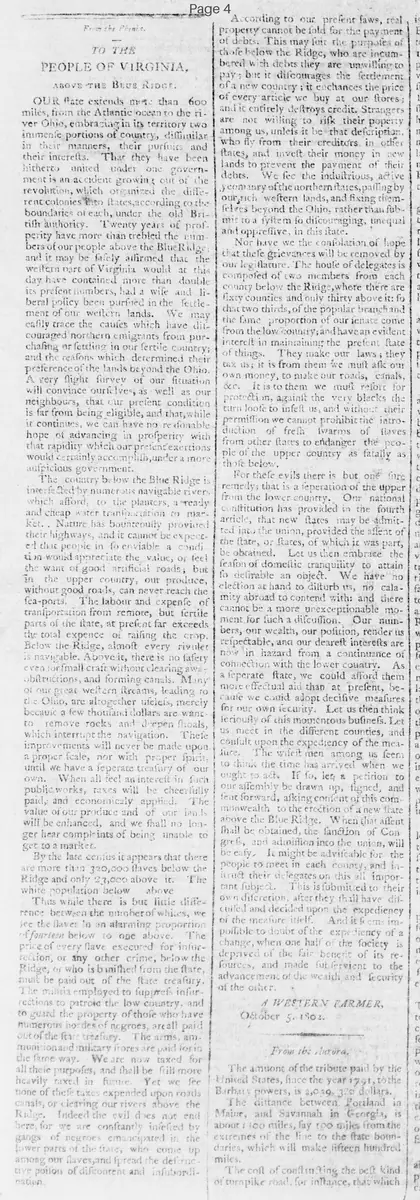
OUR state extends more than 600 miles, from the Atlantic ocean to the river Ohio, embracing in its territory two immense portions of country, dissimilar in their manners, their pursuits and their interests. That they have been hitherto united under one government is an accident growing out of the revolution, which organized the different colonies into states, according to the boundaries of each, under the old British authority. Twenty years of prosperity have more than trebled the numbers of our people above the Blue Ridge: and it may be safely affirmed that the western part of Virginia would at this day have contained more than double its present numbers, had a wise and liberal policy been pursued in the settlement of our western lands. We may easily trace the causes which have discouraged northern emigrants from purchasing or settling in our fertile country: and the reasons which determined their preference of the lands beyond the Ohio. A very slight survey of our situation will convince ourselves, as well as our neighbours, that our present condition is far from being eligible, and that, while it continues, we can have no reasonable hope of advancing in prosperity with that rapidity which our present exertions would certainly accomplish, under a more auspicious government.
The country below the Blue Ridge is intersected by numerous navigable rivers, which afford, to the planters, a ready and cheap water transportation to market. Nature has bountifully provided their highways, and it cannot be expected that people in so enviable a condition would appreciate the value, or feel the want of good artificial roads; but in the upper country, our produce, without good roads, can never reach the sea-ports. The labour and expense of transportation from remote, but fertile parts of the state, at present far exceeds the total expense of raising the crop. Below the Ridge, almost every rivulet is navigable. Above it, there is no safety even for small craft without clearing away obstructions, and forming canals. Many of our great western streams, leading to the Ohio, are altogether useless, merely because a few thousand dollars are wanting to remove rocks and deepen shoals, which interrupt the navigation. These improvements will never be made upon a proper scale, nor with proper spirit, until we have a separate treasury of our own. When all feel an interest in such public works, taxes will be cheerfully paid, and economically applied. The value of our produce and of our land will be enhanced, and we shall no longer hear complaints of being unable to get to a market.
By the late census it appears that there are more than 320,000 slaves below the Ridge and only 23,000 above it. The white population below and above. Thus while there is but little difference between the number of whites, we see the slaves in an alarming proportion of fourteen below to one above. The price of every slave executed for insurrection, or any other crime, below the Ridge, or who is banished from the state, must be paid out of the state treasury. The militia employed to suppress insurrections to patrol the low country, and to guard the property of those who have numerous hordes of negroes, are all paid out of the state treasury. The arms, ammunition and military stores are paid for in the same way. We are now taxed for all these purposes, and shall be still more heavily taxed in future Yet we see none of these taxes expended upon roads canals, or clearing our rivers above the Ridge. Indeed the evil does not end here, for we are constantly infested by gangs of negroes emancipated in the lower parts of the state, who come up among our slaves, and spread the destructive poison of discontent and insubordination.
PEOPLE OF VIRGINIA.
ABOVE THE BLUE RIDGE.
OUR state extends more than 600 miles, from the Atlantic ocean to the river Ohio, embracing in its territory two immense portions of country, dissimilar in their manners, their pursuits and their interests. That they have been hitherto united under one government is an accident growing out of the revolution, which organized the different colonies into states, according to the boundaries of each, under the old British authority. Twenty years of prosperity have more than trebled the numbers of our people above the Blue Ridge: and it may be safely affirmed that the western part of Virginia would at this day have contained more than double its present numbers, had a wise and liberal policy been pursued in the settlement of our western lands. We may easily trace the causes which have discouraged northern emigrants from purchasing or settling in our fertile country: and the reasons which determined their preference of the lands beyond the Ohio. A very slight survey of our situation will convince ourselves, as well as our neighbours, that our present condition is far from being eligible, and that, while it continues, we can have no reasonable hope of advancing in prosperity with that rapidity which our present exertions would certainly accomplish, under a more auspicious government.
The country below the Blue Ridge is intersected by numerous navigable rivers, which afford, to the planters, a ready and cheap water transportation to market. Nature has bountifully provided their highways, and it cannot be expected that people in so enviable a condition would appreciate the value, or feel the want of good artificial roads; but in the upper country, our produce, without good roads, can never reach the sea-ports. The labour and expense of transportation from remote, but fertile parts of the state, at present far exceeds the total expense of raising the crop. Below the Ridge, almost every rivulet is navigable. Above it, there is no safety even for small craft without clearing away obstructions, and forming canals. Many of our great western streams, leading to the Ohio, are altogether useless, merely because a few thousand dollars are wanting to remove rocks and deepen shoals, which interrupt the navigation. These improvements will never be made upon a proper scale, nor with proper spirit, until we have a separate treasury of our own. When all feel an interest in such public works, taxes will be cheerfully paid, and economically applied. The value of our produce and of our land will be enhanced, and we shall no longer hear complaints of being unable to get to a market.
By the late census it appears that there are more than 320,000 slaves below the Ridge and only 23,000 above it. The white population below and above. Thus while there is but little difference between the number of whites, we see the slaves in an alarming proportion of fourteen below to one above. The price of every slave executed for insurrection, or any other crime, below the Ridge, or who is banished from the state, must be paid out of the state treasury. The militia employed to suppress insurrections to patrol the low country, and to guard the property of those who have numerous hordes of negroes, are all paid out of the state treasury. The arms, ammunition and military stores are paid for in the same way. We are now taxed for all these purposes, and shall be still more heavily taxed in future Yet we see none of these taxes expended upon roads canals, or clearing our rivers above the Ridge. Indeed the evil does not end here, for we are constantly infested by gangs of negroes emancipated in the lower parts of the state, who come up among our slaves, and spread the destructive poison of discontent and insubordination.
What sub-type of article is it?
Infrastructure
Taxation
Constitutional
What keywords are associated?
Blue Ridge Division
Western Virginia Infrastructure
Taxation Disparities
Slave Population Imbalance
Regional Separation
What entities or persons were involved?
People Above The Blue Ridge
People Below The Blue Ridge
Virginia State Treasury
Editorial Details
Primary Topic
Regional Disparities And Need For Separate Government In Western Virginia
Stance / Tone
Advocacy For Western Virginia's Separation Due To Neglect By Eastern Interests
Key Figures
People Above The Blue Ridge
People Below The Blue Ridge
Virginia State Treasury
Key Arguments
State's East West Division Is Accidental From Revolution, Leading To Dissimilar Interests
Western Population Growth Hindered By Poor Land Settlement Policies
Eastern Areas Have Natural Navigable Rivers, West Lacks Roads And Needs Improvements
Western Produce Transportation Costs Exceed Production Costs
Slave Population Disproportionate: 320,000 Below Vs 23,000 Above Ridge, With Similar White Numbers
Taxes Fund Eastern Slave Control (Executions, Militia) But Not Western Infrastructure
Separate Treasury Needed For Western Public Works To Enhance Prosperity
Emancipated Negroes From East Incite Discontent Among Western Slaves