Thank you for visiting SNEWPapers!
Sign up free
Letter to Editor
February 12, 1795
Gazette Of The United States And Daily Evening Advertiser
Philadelphia, Philadelphia County, Pennsylvania
What is this article about?
In Letter IX, Germanicus defends exposing societies critical of the U.S. government, arguing they promote division and misrepresentation, unlike pro-government groups which would face ridicule. He warns of the dangers of partisan societies eroding national unity and urges citizens to oppose them.
Clipping
OCR Quality
95%
Excellent
Full Text
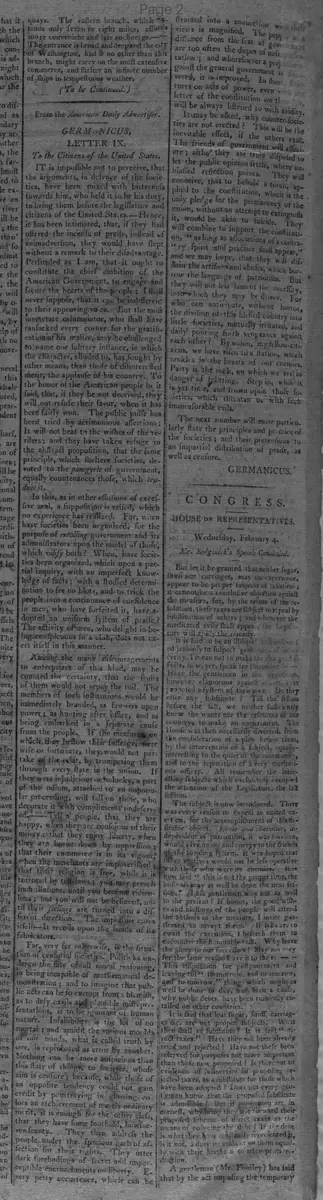
From the American Daily Advertiser.
GERMANICUS,
LETTER IX.
To the Citizens of the United States.
IT is impossible not to perceive, that the arguments, in defence of the societies, have been mixed with bitterness towards him, who held it to be his duty, to bring them before the legislature and citizens of the United States.—Hence, it has been intimated, that, if they had offered the incense of praise, instead of animadversion, they would have slept without a remark to their disadvantage.
Persuaded as I am, that it ought to constitute the chief ambition of the American Government, to engage and secure the hearts of the people; I shall never suppose, that it can be indifferent to their approving voice. But the most inveterate calumniator, who shall have ransacked every corner for the gratification of his malice, may be challenged to name one solitary instance, in which the character, alluded to, has sought by other means, than those of disinterested merit, the applause of his country. To the honor of the American people be it said, that, if they be not deceived, they will not refuse their favor, when it has been fairly won. The public pulse has been tried—by acrimonious assertions: It will not beat to the wishes of the revilers; and they have taken refuge in the abstract proposition, that the same principle, which shelters societies, devoted to the panegyric of government, equally countenances those, which traduce it.
In this, as in other effusions of excessive zeal, a supposition is raised, which no experience has realized. For, when have societies been organized, for the purpose of extolling government and its administrators upon the model of those, which vilify both? When, have societies been organized, which upon a partial inquiry, with an imperfect knowledge of facts; with a studied determination to see no blots, and to trick the people into a continuance of confidence in men, who have forfeited it, have adopted an uniform system of praise?
The activity of men, who delight in being conspicuous in a club, does not exert itself in this manner.
Among the many discouragements to enterprizes of this kind, may be counted the certainty, that the fruits of them would not repay the toil. The members of such institutions would be immediately branded, as fawners upon power; as hunting after office, and as being embarked in a separate cause from the people. If the measure, on which they bestow their suffrage, were wise or fortunate, they would not partake of the eclat, by trumpeting them through every state in the union. If they were injudicious or unlucky, a part of the odium, attached to an unpopular proceeding, will fall on those, who decorate it with compliments undeserved. Tell a people, that they are happy, when they are conscious of their misery; that they enjoy liberty, when they are borne down by oppression; that their commerce is in its vigour, when the merchants are impoverished; that their religion is free, while it is tortured by test-laws; you may preach such illusions, until you become ridiculous; but you will not be believed, until their feelings are turned into a different direction. The imposture cures itself—It recoils upon the heads of its fabricators.
Far, very far otherwise, is the situation of cenforial societies. Politicks undergo the fate of all moral reasoning, in being incapable of mathematical demonstration; and to imagine that public acts can be so exempt from a blemish, as to defy cavils and plausible misrepresentations, is to be ignorant of human nature. "Infallibility is the lot of no mortal; and amidst the various moulds of our minds, what is called truth by one, is reprobated as error by another."
Nothing can be more auspicious than this state of things, to societies, whose aim is censure; because, while those of an opposite tendency could not gain credit by portraying in glowing colors an achievement of merely ordinary merit, it is enough for the other class, that they have some foothold, howsoever scanty. They then address the people under the specious garb of affection for their rights. They utter dark forebodings of secret and imperceptible encroachments on liberty. Every petty occurrence, which can be strained into a connection with their views is magnified. The people at a distance from the seat of government are too often the dupes of misrepresentation; and wherever a prejudice against the general government is discovered, it is improved. In short, Strictures on acts of power, even with the letter of the constitution on their side, will be always listened to with avidity.
It may be asked, why counter-societies are not erected? This will be the inevitable effect, if the others exist. The friends of government will associate; altho' they are truly disposed to let the public opinion settle, where unbiased reflection points. They will conceive, that to behold a torch, applied to the constitution, which is the only pledge for the permanency of the union, without an attempt to extinguish it, would be akin to suicide. They will combine to support the constitution, "as long as associations of a contrary spirit and practice shall appear," and we may hope, that they will disdain the sacrifices and abuses, which borrow the language of patriotism. But they will not less lament the necessity, into which they may be driven. For who can anticipate, without horror, the division of this blessed country into little societies, mutually irritated, and daily pouring forth vengeance against each other? By union, my fellow-citizens, we have risen to a station, which rankles in the hearts of our enemies. Party is the rock, on which we are in danger of splitting. Step in, while it is yet time, and frown upon those societies, which threaten us with such immeasurable evils.
The next number will more particularly state the principles and practice of the societies; and their pretensions to an impartial distribution of praise, as well as censure.
GERMANICUS.
GERMANICUS,
LETTER IX.
To the Citizens of the United States.
IT is impossible not to perceive, that the arguments, in defence of the societies, have been mixed with bitterness towards him, who held it to be his duty, to bring them before the legislature and citizens of the United States.—Hence, it has been intimated, that, if they had offered the incense of praise, instead of animadversion, they would have slept without a remark to their disadvantage.
Persuaded as I am, that it ought to constitute the chief ambition of the American Government, to engage and secure the hearts of the people; I shall never suppose, that it can be indifferent to their approving voice. But the most inveterate calumniator, who shall have ransacked every corner for the gratification of his malice, may be challenged to name one solitary instance, in which the character, alluded to, has sought by other means, than those of disinterested merit, the applause of his country. To the honor of the American people be it said, that, if they be not deceived, they will not refuse their favor, when it has been fairly won. The public pulse has been tried—by acrimonious assertions: It will not beat to the wishes of the revilers; and they have taken refuge in the abstract proposition, that the same principle, which shelters societies, devoted to the panegyric of government, equally countenances those, which traduce it.
In this, as in other effusions of excessive zeal, a supposition is raised, which no experience has realized. For, when have societies been organized, for the purpose of extolling government and its administrators upon the model of those, which vilify both? When, have societies been organized, which upon a partial inquiry, with an imperfect knowledge of facts; with a studied determination to see no blots, and to trick the people into a continuance of confidence in men, who have forfeited it, have adopted an uniform system of praise?
The activity of men, who delight in being conspicuous in a club, does not exert itself in this manner.
Among the many discouragements to enterprizes of this kind, may be counted the certainty, that the fruits of them would not repay the toil. The members of such institutions would be immediately branded, as fawners upon power; as hunting after office, and as being embarked in a separate cause from the people. If the measure, on which they bestow their suffrage, were wise or fortunate, they would not partake of the eclat, by trumpeting them through every state in the union. If they were injudicious or unlucky, a part of the odium, attached to an unpopular proceeding, will fall on those, who decorate it with compliments undeserved. Tell a people, that they are happy, when they are conscious of their misery; that they enjoy liberty, when they are borne down by oppression; that their commerce is in its vigour, when the merchants are impoverished; that their religion is free, while it is tortured by test-laws; you may preach such illusions, until you become ridiculous; but you will not be believed, until their feelings are turned into a different direction. The imposture cures itself—It recoils upon the heads of its fabricators.
Far, very far otherwise, is the situation of cenforial societies. Politicks undergo the fate of all moral reasoning, in being incapable of mathematical demonstration; and to imagine that public acts can be so exempt from a blemish, as to defy cavils and plausible misrepresentations, is to be ignorant of human nature. "Infallibility is the lot of no mortal; and amidst the various moulds of our minds, what is called truth by one, is reprobated as error by another."
Nothing can be more auspicious than this state of things, to societies, whose aim is censure; because, while those of an opposite tendency could not gain credit by portraying in glowing colors an achievement of merely ordinary merit, it is enough for the other class, that they have some foothold, howsoever scanty. They then address the people under the specious garb of affection for their rights. They utter dark forebodings of secret and imperceptible encroachments on liberty. Every petty occurrence, which can be strained into a connection with their views is magnified. The people at a distance from the seat of government are too often the dupes of misrepresentation; and wherever a prejudice against the general government is discovered, it is improved. In short, Strictures on acts of power, even with the letter of the constitution on their side, will be always listened to with avidity.
It may be asked, why counter-societies are not erected? This will be the inevitable effect, if the others exist. The friends of government will associate; altho' they are truly disposed to let the public opinion settle, where unbiased reflection points. They will conceive, that to behold a torch, applied to the constitution, which is the only pledge for the permanency of the union, without an attempt to extinguish it, would be akin to suicide. They will combine to support the constitution, "as long as associations of a contrary spirit and practice shall appear," and we may hope, that they will disdain the sacrifices and abuses, which borrow the language of patriotism. But they will not less lament the necessity, into which they may be driven. For who can anticipate, without horror, the division of this blessed country into little societies, mutually irritated, and daily pouring forth vengeance against each other? By union, my fellow-citizens, we have risen to a station, which rankles in the hearts of our enemies. Party is the rock, on which we are in danger of splitting. Step in, while it is yet time, and frown upon those societies, which threaten us with such immeasurable evils.
The next number will more particularly state the principles and practice of the societies; and their pretensions to an impartial distribution of praise, as well as censure.
GERMANICUS.
What sub-type of article is it?
Persuasive
Political
Reflective
What themes does it cover?
Politics
Constitutional Rights
What keywords are associated?
Germanicus
Societies
Government Criticism
National Unity
Constitution
Political Division
Censorial Societies
What entities or persons were involved?
Germanicus
To The Citizens Of The United States
Letter to Editor Details
Author
Germanicus
Recipient
To The Citizens Of The United States
Main Argument
defends the duty to expose societies critical of the government, argues that such censorial societies promote division and misrepresentation unlike pro-government ones, and urges citizens to oppose them to preserve national unity and the constitution.
Notable Details
Quotes: 'Infallibility Is The Lot Of No Mortal; And Amidst The Various Moulds Of Our Minds, What Is Called Truth By One, Is Reprobated As Error By Another.'
References Test Laws And Encroachments On Liberty.
Warns Of Party Divisions As A Rock On Which The Nation May Split.