Thank you for visiting SNEWPapers!
Sign up free
Story
March 18, 1938
The Indian Leader
Lawrence, Douglas County, Kansas
What is this article about?
The Indian Office presents an educational exhibit in the U.S. Department of the Interior Museum, reenacting the advancement of American Indians over the past 100 years, from early trading to modern citizenship and crafts, as part of the Conservation Exposition.
Clipping
OCR Quality
99%
Excellent
Full Text
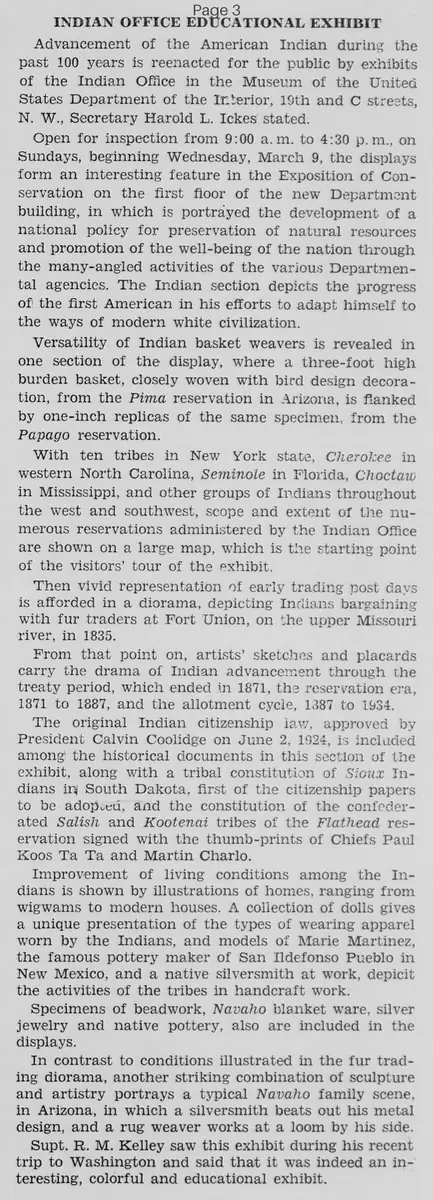
INDIAN OFFICE EDUCATIONAL EXHIBIT
Advancement of the American Indian during the past 100 years is reenacted for the public by exhibits of the Indian Office in the Museum of the United States Department of the Interior, 19th and C streets, N. W., Secretary Harold L. Ickes stated.
Open for inspection from 9:00 a. m. to 4:30 p.m., on Sundays, beginning Wednesday, March 9, the displays form an interesting feature in the Exposition of Conservation on the first floor of the new Department building, in which is portrayed the development of a national policy for preservation of natural resources and promotion of the well-being of the nation through the many-angled activities of the various Departmental agencies. The Indian section depicts the progress of the first American in his efforts to adapt himself to the ways of modern white civilization.
Versatility of Indian basket weavers is revealed in one section of the display, where a three-foot high burden basket, closely woven with bird design decoration, from the Pima reservation in Arizona, is flanked by one-inch replicas of the same specimen, from the Papago reservation.
With ten tribes in New York state, Cherokee in western North Carolina, Seminole in Florida, Choctaw in Mississippi, and other groups of Indians throughout the west and southwest, scope and extent of the numerous reservations administered by the Indian Office are shown on a large map, which is the starting point of the visitors' tour of the exhibit.
Then vivid representation of early trading post days is afforded in a diorama, depicting Indians bargaining with fur traders at Fort Union, on the upper Missouri river, in 1835.
From that point on, artists' sketches and placards carry the drama of Indian advancement through the treaty period, which ended in 1871, the reservation era, 1871 to 1887, and the allotment cycle, 1887 to 1934.
The original Indian citizenship law, approved by President Calvin Coolidge on June 2, 1924, is included among the historical documents in this section of the exhibit, along with a tribal constitution of Sioux Indians in South Dakota, first of the citizenship papers to be adopted, and the constitution of the confederated Salish and Kootenai tribes of the Flathead reservation signed with the thumb-prints of Chiefs Paul Koos Ta Ta and Martin Charlo.
Improvement of living conditions among the Indians is shown by illustrations of homes, ranging from wigwams to modern houses. A collection of dolls gives a unique presentation of the types of wearing apparel worn by the Indians, and models of Marie Martinez, the famous pottery maker of San Ildefonso Pueblo in New Mexico, and a native silversmith at work, depict the activities of the tribes in handcraft work.
Specimens of beadwork, Navaho blanket ware, silver jewelry and native pottery, also are included in the displays.
In contrast to conditions illustrated in the fur trading diorama, another striking combination of sculpture and artistry portrays a typical Navaho family scene, in Arizona, in which a silversmith beats out his metal design, and a rug weaver works at a loom by his side.
Supt. R. M. Kelley saw this exhibit during his recent trip to Washington and said that it was indeed an interesting, colorful and educational exhibit.
Advancement of the American Indian during the past 100 years is reenacted for the public by exhibits of the Indian Office in the Museum of the United States Department of the Interior, 19th and C streets, N. W., Secretary Harold L. Ickes stated.
Open for inspection from 9:00 a. m. to 4:30 p.m., on Sundays, beginning Wednesday, March 9, the displays form an interesting feature in the Exposition of Conservation on the first floor of the new Department building, in which is portrayed the development of a national policy for preservation of natural resources and promotion of the well-being of the nation through the many-angled activities of the various Departmental agencies. The Indian section depicts the progress of the first American in his efforts to adapt himself to the ways of modern white civilization.
Versatility of Indian basket weavers is revealed in one section of the display, where a three-foot high burden basket, closely woven with bird design decoration, from the Pima reservation in Arizona, is flanked by one-inch replicas of the same specimen, from the Papago reservation.
With ten tribes in New York state, Cherokee in western North Carolina, Seminole in Florida, Choctaw in Mississippi, and other groups of Indians throughout the west and southwest, scope and extent of the numerous reservations administered by the Indian Office are shown on a large map, which is the starting point of the visitors' tour of the exhibit.
Then vivid representation of early trading post days is afforded in a diorama, depicting Indians bargaining with fur traders at Fort Union, on the upper Missouri river, in 1835.
From that point on, artists' sketches and placards carry the drama of Indian advancement through the treaty period, which ended in 1871, the reservation era, 1871 to 1887, and the allotment cycle, 1887 to 1934.
The original Indian citizenship law, approved by President Calvin Coolidge on June 2, 1924, is included among the historical documents in this section of the exhibit, along with a tribal constitution of Sioux Indians in South Dakota, first of the citizenship papers to be adopted, and the constitution of the confederated Salish and Kootenai tribes of the Flathead reservation signed with the thumb-prints of Chiefs Paul Koos Ta Ta and Martin Charlo.
Improvement of living conditions among the Indians is shown by illustrations of homes, ranging from wigwams to modern houses. A collection of dolls gives a unique presentation of the types of wearing apparel worn by the Indians, and models of Marie Martinez, the famous pottery maker of San Ildefonso Pueblo in New Mexico, and a native silversmith at work, depict the activities of the tribes in handcraft work.
Specimens of beadwork, Navaho blanket ware, silver jewelry and native pottery, also are included in the displays.
In contrast to conditions illustrated in the fur trading diorama, another striking combination of sculpture and artistry portrays a typical Navaho family scene, in Arizona, in which a silversmith beats out his metal design, and a rug weaver works at a loom by his side.
Supt. R. M. Kelley saw this exhibit during his recent trip to Washington and said that it was indeed an interesting, colorful and educational exhibit.
What sub-type of article is it?
Historical Event
Curiosity
What themes does it cover?
Triumph
Fortune Reversal
Recovery
What keywords are associated?
Indian Exhibit
American Indian Advancement
Department Of Interior
Conservation Exposition
Native Crafts
Historical Documents
Reservations Map
What entities or persons were involved?
Harold L. Ickes
Calvin Coolidge
Paul Koos Ta Ta
Martin Charlo
Marie Martinez
R. M. Kelley
Where did it happen?
Museum Of The United States Department Of The Interior, 19th And C Streets, N. W.
Story Details
Key Persons
Harold L. Ickes
Calvin Coolidge
Paul Koos Ta Ta
Martin Charlo
Marie Martinez
R. M. Kelley
Location
Museum Of The United States Department Of The Interior, 19th And C Streets, N. W.
Event Date
Beginning Wednesday, March 9
Story Details
Exhibits reenact American Indian advancement over 100 years, including maps of reservations, dioramas of trading posts, historical documents like the 1924 citizenship law, illustrations of homes and crafts, and models of artisans.