Thank you for visiting SNEWPapers!
Sign up free
Editorial
August 11, 1905
The Courier Journal
Louisville, Shelbyville, Jefferson County, Kentucky
What is this article about?
Editorial critiques Mr. Wu Ting Fang's push for admitting Chinese laborers to Hawaii and Philippines amid boycott complaints, highlighting benefits to employers, wage issues, competition with natives, and conflict with benevolent assimilation policy.
Clipping
OCR Quality
98%
Excellent
Full Text
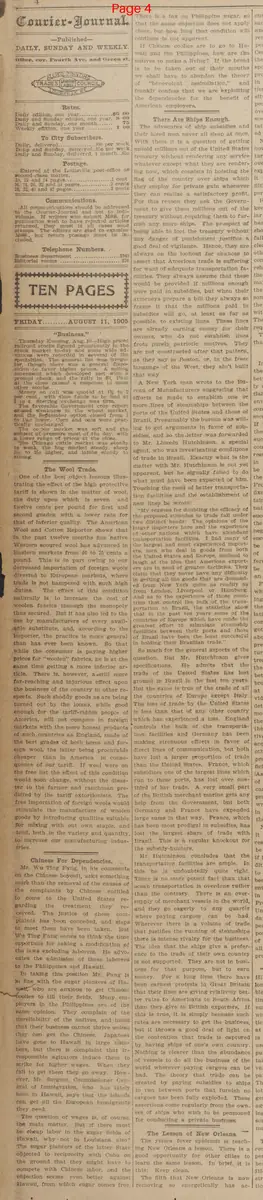
Chinese For Dependencies.
Mr. Wu Ting Fang, in his comments on the Chinese boycott, asks something more than the removal of the causes of the complaints by Chinese entitled to come to the United States regarding the treatment they received. The justice of these complaints has been conceded, and steps to meet them have been taken. But Wu Ting Fang seems to think the time opportune for asking a modification of the laws excluding laborers. He advocates the admission of these laborers to the Philippines and Hawaii.
In taking this position Mr. Fang is in line with the sugar planters of Hawaii, who are anxious to get Chinese coolies to till their fields. Many employers in the Philippines are of the same opinion. They complain of the unreliability of the natives, and insist that their business cannot thrive unless they can get the Chinese. Japanese have gone to Hawaii in large numbers, but there is complaint that irresponsible agitators induce them to strike for higher wages. When they fail to get them they go away. However, Mr. Sargent, Commissioner General of Immigration, who has lately been in Hawaii, says that the islands can get all the European immigrants they need.
The question of wages is, of course, the main matter. But if there must be cheap labor in the sugar fields of Hawaii, why not in Louisiana also? The sugar planters of the latter State objected to reciprocity with Cuba on the ground that they might have to compete with Chinese labor, and the objection seems even better against Hawaii, from which sugar comes free.
There is a tax on Philippine sugar, so that the same objection does not apply there, but how long that condition will continue is not apparent.
If Chinese coolies are to go to Hawaii and the Philippines how are the natives to make a living? If the bread is to be taken out of their mouths we shall have to abandon the theory of "benevolent assimilation," and frankly confess that we are exploiting the dependencies for the benefit of American employers.
Mr. Wu Ting Fang, in his comments on the Chinese boycott, asks something more than the removal of the causes of the complaints by Chinese entitled to come to the United States regarding the treatment they received. The justice of these complaints has been conceded, and steps to meet them have been taken. But Wu Ting Fang seems to think the time opportune for asking a modification of the laws excluding laborers. He advocates the admission of these laborers to the Philippines and Hawaii.
In taking this position Mr. Fang is in line with the sugar planters of Hawaii, who are anxious to get Chinese coolies to till their fields. Many employers in the Philippines are of the same opinion. They complain of the unreliability of the natives, and insist that their business cannot thrive unless they can get the Chinese. Japanese have gone to Hawaii in large numbers, but there is complaint that irresponsible agitators induce them to strike for higher wages. When they fail to get them they go away. However, Mr. Sargent, Commissioner General of Immigration, who has lately been in Hawaii, says that the islands can get all the European immigrants they need.
The question of wages is, of course, the main matter. But if there must be cheap labor in the sugar fields of Hawaii, why not in Louisiana also? The sugar planters of the latter State objected to reciprocity with Cuba on the ground that they might have to compete with Chinese labor, and the objection seems even better against Hawaii, from which sugar comes free.
There is a tax on Philippine sugar, so that the same objection does not apply there, but how long that condition will continue is not apparent.
If Chinese coolies are to go to Hawaii and the Philippines how are the natives to make a living? If the bread is to be taken out of their mouths we shall have to abandon the theory of "benevolent assimilation," and frankly confess that we are exploiting the dependencies for the benefit of American employers.
What sub-type of article is it?
Immigration
Labor
Imperialism
What keywords are associated?
Chinese Boycott
Immigration Policy
Chinese Laborers
Hawaii Sugar
Philippines Employers
Cheap Labor
Benevolent Assimilation
What entities or persons were involved?
Mr. Wu Ting Fang
Sugar Planters Of Hawaii
Employers In The Philippines
Mr. Sargent
Natives
American Employers
Editorial Details
Primary Topic
Opposition To Admitting Chinese Laborers To Us Dependencies
Stance / Tone
Critical Of Cheap Labor Importation And Exploitation Of Natives
Key Figures
Mr. Wu Ting Fang
Sugar Planters Of Hawaii
Employers In The Philippines
Mr. Sargent
Natives
American Employers
Key Arguments
Justice Of Chinese Complaints Conceded, But No Need To Modify Exclusion Laws
Admission Aligns With Interests Of Hawaiian Sugar Planters And Philippine Employers Seeking Cheap, Reliable Labor
Japanese Immigrants Cause Strikes For Higher Wages In Hawaii
European Immigrants Sufficient For Hawaii Per Commissioner Sargent
Cheap Labor In Hawaii Raises Fairness Issues For Louisiana Sugar Planters
Tax On Philippine Sugar Mitigates Competition Concerns Temporarily
Importing Chinese Coolies Would Displace Natives And Contradict Benevolent Assimilation