Thank you for visiting SNEWPapers!
Sign up free
Literary
July 18, 1868
Springfield Weekly Republican
Springfield, Hampden County, Massachusetts
What is this article about?
An essay compares eating fresh oysters to fruit, advocating immediate consumption after picking for peak flavor and vitality. It discusses optimal times like morning or afternoon, the decay process, and the challenge of describing distinct fruit tastes.
Clipping
OCR Quality
98%
Excellent
Full Text
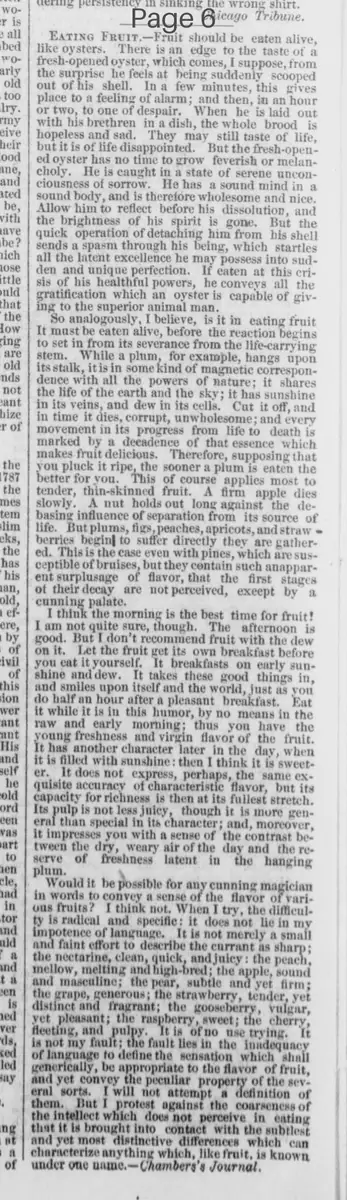
Eating Fruit.—Fruit should be eaten alive, like oysters. There is an edge to the taste of a fresh-opened oyster, which comes, I suppose, from the surprise he feels at being suddenly scooped out of his shell. In a few minutes, this gives place to a feeling of alarm; and then, in an hour or two, to one of despair. When he is laid out with his brethren in a dish, the whole brood is hopeless and sad. They may still taste of life, but it is of life disappointed. But the fresh-opened oyster has no time to grow feverish or melancholy. He is caught in a state of serene unconsciousness of sorrow. He has a sound mind in a sound body, and is therefore wholesome and nice. Allow him to reflect before his dissolution, and the brightness of his spirit is gone. But the quick operation of detaching him from his shell sends a spasm through his being, which startles all the latent excellence he may possess into sudden and unique perfection. If eaten at this crisis of his healthful powers, he conveys all the gratification which an oyster is capable of giving to the superior animal man.
So analogously, I believe, is it in eating fruit. It must be eaten alive, before the reaction begins to set in from its severance from the life-carrying stem. While a plum, for example, hangs upon its stalk, it is in some kind of magnetic correspondence with all the powers of nature; it shares the life of the earth and the sky; it has sunshine in its veins, and dew in its cells. Cut it off, and in time it dies, corrupt, unwholesome; and every movement in its progress from life to death is marked by a decadence of that essence which makes fruit delicious. Therefore, supposing that you pluck it ripe, the sooner a plum is eaten the better for you. This of course applies most to tender, thin-skinned fruit. A firm apple dies slowly. A nut holds out long against the debasing influence of separation from its source of life. But plums, figs, peaches, apricots, and strawberries begin to suffer directly they are gathered. This is the case even with pines, which are susceptible of bruises, but they contain such an apparent surplusage of flavor, that the first stages of their decay are not perceived, except by a cunning palate.
I think the morning is the best time for fruit! I am not quite sure, though. The afternoon is good. But I don't recommend fruit with the dew on it. Let the fruit get its own breakfast before you eat it yourself. It breakfasts on early sun shine and dew. It takes these good things in, and smiles upon itself and the world, just as you do half an hour after a pleasant breakfast. Eat it while it is in this humor, by no means in the raw and early morning; thus you have the young freshness and virgin flavor of the fruit. It has another character later in the day, when it is filled with sunshine: then I think it is sweeter. It does not express, perhaps, the same exquisite accuracy of characteristic flavor, but its capacity for richness is then at its fullest stretch. Its pulp is not less juicy, though it is more general than special in its character; and, moreover, it impresses you with a sense of the contrast between the dry, weary air of the day and the reserve of freshness latent in the hanging plum.
Would it be possible for any cunning magician in words to convey a sense of the flavor of various fruits? I think not. When I try, the difficulty is radical and specific: it does not lie in my impotence of language. It is not merely a small and faint effort to describe the currant as sharp; the nectarine, clean, quick, and juicy: the peach, mellow, melting and high-bred; the apple, sound and masculine; the pear, subtle and yet firm; the grape, generous; the strawberry, tender, yet distinct and fragrant; the gooseberry, vulgar, yet pleasant; the raspberry, sweet; the cherry, fleeting, and pulpy. It is of no use trying. It is not my fault; the fault lies in the inadequacy of language to define the sensation which shall generically, be appropriate to the flavor of fruit, and yet convey the peculiar property of the several sorts. I will not attempt a definition of them. But I protest against the coarseness of the intellect which does not perceive in eating that it is brought into contact with the subtlest and yet most distinctive differences which can characterize anything which, like fruit, is known under one name.
Chambers's Journal.
So analogously, I believe, is it in eating fruit. It must be eaten alive, before the reaction begins to set in from its severance from the life-carrying stem. While a plum, for example, hangs upon its stalk, it is in some kind of magnetic correspondence with all the powers of nature; it shares the life of the earth and the sky; it has sunshine in its veins, and dew in its cells. Cut it off, and in time it dies, corrupt, unwholesome; and every movement in its progress from life to death is marked by a decadence of that essence which makes fruit delicious. Therefore, supposing that you pluck it ripe, the sooner a plum is eaten the better for you. This of course applies most to tender, thin-skinned fruit. A firm apple dies slowly. A nut holds out long against the debasing influence of separation from its source of life. But plums, figs, peaches, apricots, and strawberries begin to suffer directly they are gathered. This is the case even with pines, which are susceptible of bruises, but they contain such an apparent surplusage of flavor, that the first stages of their decay are not perceived, except by a cunning palate.
I think the morning is the best time for fruit! I am not quite sure, though. The afternoon is good. But I don't recommend fruit with the dew on it. Let the fruit get its own breakfast before you eat it yourself. It breakfasts on early sun shine and dew. It takes these good things in, and smiles upon itself and the world, just as you do half an hour after a pleasant breakfast. Eat it while it is in this humor, by no means in the raw and early morning; thus you have the young freshness and virgin flavor of the fruit. It has another character later in the day, when it is filled with sunshine: then I think it is sweeter. It does not express, perhaps, the same exquisite accuracy of characteristic flavor, but its capacity for richness is then at its fullest stretch. Its pulp is not less juicy, though it is more general than special in its character; and, moreover, it impresses you with a sense of the contrast between the dry, weary air of the day and the reserve of freshness latent in the hanging plum.
Would it be possible for any cunning magician in words to convey a sense of the flavor of various fruits? I think not. When I try, the difficulty is radical and specific: it does not lie in my impotence of language. It is not merely a small and faint effort to describe the currant as sharp; the nectarine, clean, quick, and juicy: the peach, mellow, melting and high-bred; the apple, sound and masculine; the pear, subtle and yet firm; the grape, generous; the strawberry, tender, yet distinct and fragrant; the gooseberry, vulgar, yet pleasant; the raspberry, sweet; the cherry, fleeting, and pulpy. It is of no use trying. It is not my fault; the fault lies in the inadequacy of language to define the sensation which shall generically, be appropriate to the flavor of fruit, and yet convey the peculiar property of the several sorts. I will not attempt a definition of them. But I protest against the coarseness of the intellect which does not perceive in eating that it is brought into contact with the subtlest and yet most distinctive differences which can characterize anything which, like fruit, is known under one name.
Chambers's Journal.
What sub-type of article is it?
Essay
What themes does it cover?
Nature
Agriculture Rural
What keywords are associated?
Eating Fruit
Freshness
Oyster Analogy
Fruit Flavors
Natural Essence
What entities or persons were involved?
Chambers's Journal.
Literary Details
Title
Eating Fruit.
Author
Chambers's Journal.
Key Lines
Fruit Should Be Eaten Alive, Like Oysters.
While A Plum, For Example, Hangs Upon Its Stalk, It Is In Some Kind Of Magnetic Correspondence With All The Powers Of Nature; It Shares The Life Of The Earth And The Sky; It Has Sunshine In Its Veins, And Dew In Its Cells.
I Think The Morning Is The Best Time For Fruit!
Would It Be Possible For Any Cunning Magician In Words To Convey A Sense Of The Flavor Of Various Fruits? I Think Not.