Thank you for visiting SNEWPapers!
Sign up free
Editorial
February 10, 1888
The Iola Register
Iola, Allen County, Kansas
What is this article about?
Rev. T. DeWitt Talmage's sermon critiques the 'Dominion of Fashion,' arguing from Deuteronomy that women should not wear men's attire and vice versa, as it defies divine law and reflects moral decline. He condemns excessive fashion for promoting vice, social inequality, dishonesty, unhappiness, and spiritual ruin, urging righteous fashion and moral living.
Clipping
OCR Quality
95%
Excellent
Full Text
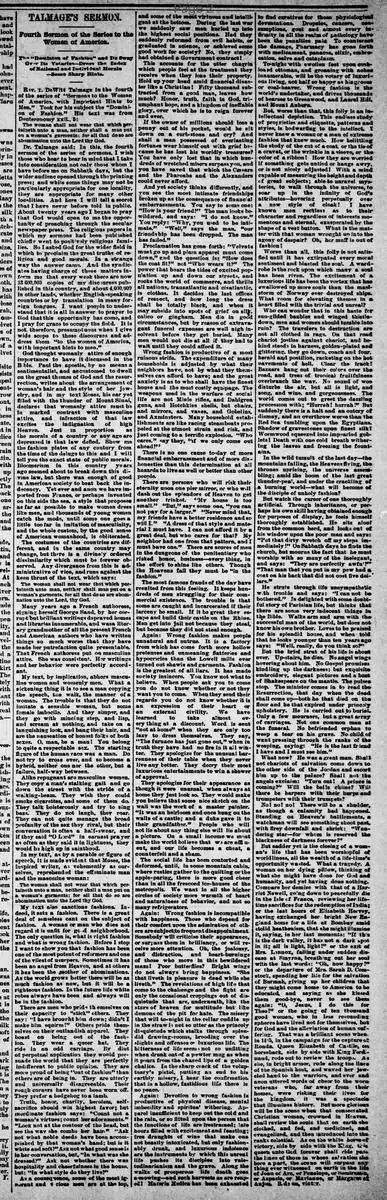
TALMAGE'S SERMON:
Fourth Sermon of the Series to the Women of America.
The "Dominion of Fashion" and Its Sway Over Its Votaries—Dress the Index of National and Individual Morals. Some Sharp Hints.
Rev. T. DeWitt Talmage in the fourth of the series of "Sermons to the Women of America, with Important Hints to Men," took for his subject the "Dominion of Fashion." His text was from Deuteronomy xxii., 5:
The woman shall not wear that which pertaineth unto a man, neither shall a man put on a woman's garments; for all that do so are abomination unto the Lord thy God.
Dr. Talmage said: In this, the fourth sermon of the series of sermons, I wish those who hear to bear in mind that I take into consideration not only those whom I have before me on Sabbath days, but the wider audience opened through the printing press; and while some things may not be particularly appropriate for one locality, they are appropriate for many other localities. And here I will tell a secret that I have never before told in public. About twenty years ago I began to pray that God would open to me the opportunity of preaching through the secular newspaper press. The religious papers in which my sermons had been published chiefly went to positively religious families. So I asked God for the wider field in which to proclaim the great truths of religion and good morals. In a strange way the answer came. And the syndicates having charge of these matters inform me that every week there are now 1,300,000 copies of my discourses published in this country, and about 4,000,000 in other lands, whether English-speaking countries or by translation in many foreign tongues. I want people to understand that it is all in answer to prayer to God that this opportunity has come, and I pray for grace to occupy the field. It is not, therefore, presumptuous when I give wide scope to these discourses and address them "to the women of America, with important hints to men."
God thought womanly attire of enough importance to have it discussed in the Bible. Paul the apostle, by no means a sentimentalist, and accustomed to dwell on the great themes of God and the resurrection, writes about the arrangement of woman's hair and the style of her jewelry, and in my text Moses, his ear yet filled with the thunder of Mount Sinai, declares that womanly attire must be in marked contrast with masculine attire, and infraction of that law excites the indignation of high Heaven. Just in proportion as the morals of a country or any age are depressed is that law defied. Show me the fashion plates of any century from the time of the deluge to this and I will tell you the exact state of public morals. Bloomerism in this country years ago seemed about to break down this divine law, but there was enough of good in American society to beat back the indecency. Yet ever and anon we have imported from France, or perhaps invented on this side the sea, a style that proposes as far as possible to make women dress like men, and thousands of young women catch the mode, until some one goes a little too far in imitation of masculinity and the whole custom, by the good sense of American womanhood, is obliterated.
The costumes of the countries are different, and in the same country may change, but there is a divinely ordered dissimilarity which must be forever observed. Any divergence from this is administrative of vice, and runs against the keen thrust of the text, which says: The woman shall not wear that which pertaineth unto man, neither shall man put on a woman's garments, for all that do so are abomination unto the Lord, thy God.
Many years ago a French authoress, signing herself George Sand, by her corrupt but brilliant writings depraved homes and libraries innumerable, and was a literary grandmother of all the present French and American authors who have written things so much worse that they have made her putrefaction quite presentable. That French authoress put on masculine attire. She was consistent. Her writings and her behavior were perfectly accordant.
My text, by implication, abhors masculine women and womanly men. What a sickening thing it is to see a man copying the speech, the walk, the manner of a woman. The trouble is that they do not imitate a sensible woman, but some female imbecile. And they simper, and they go with mincing step, and lisp, and scream at nothing, and take on a languishing look, and bang their hair, and are the nauseation of honest folks of both sexes. O, man, be a man! You belong to quite a respectable sex. The starting figure of the human race was a man. Do not try to cross over, and so become a hybrid, neither one nor the other, but a failure, half-way between.
Alike repugnant are masculine women. They copy a man's stalking gait and go down the street with the stride of a walking-beam. They wish they could smoke cigarettes, and some of them do. They talk boisterously and try to sing bass. They do not laugh, they roar. They can not quite manage the broad profanity of the sex they rival, but their conversation is often a half-swear, and if they said "O Lord" in earnest prayer as often as they said it in lightness, they would be high up in sainthood.
In my text, as by a parable or figure of speech, it is made evident that Moses, the inspired writer, as vehemently as ourselves, reprehended the effeminate man and the masculine woman: The woman shall not wear that which pertaineth unto a man, neither shall a man put on a woman's garments; for all that do so are abomination unto the Lord thy God.
My text also sanctions fashions. Indeed, it sets a fashion. There is a great deal of senseless cant on the subject of fashion. A woman or man who does not regard it is unfit for good neighborhood. The only question is, what is right fashion and what is wrong fashion. Before I stop I want to show you that fashion has been one of the most potent of reformers and one of the vilest of usurpers. Sometimes it has been an angel from Heaven, and at others it has been the mother of abominations. As the world grows better there will be as much fashion as now, but it will be a righteous fashion. In the future life white robes always have been and always will be in the fashion.
There are men who pride themselves on their capacity to "stick" others. They say: "I have brought him down; didn't I make him squirm!" Others pride themselves on their outlandish apparel. They boast of being out of the fashion. They wear queer hat. They ride in an odd carriage. By dint of perpetual application they would persuade the world that they are perfectly indifferent to public opinion. They are more proud of being "out of fashion" than others are of being in. They are utterly and universally disagreeable. Their rough corners have never been worn off. They prefer a hedgehog to a lamb.
Truth, honor, charity, heroism, self-sacrifice should win highest favor; but inordinate fashion says: "Count not a woman's virtues; count her adornments." "Look not at the contour of the head, but see the way she combs her hair." "Ask not what noble deeds have been accomplished by that woman's hand; but is it white and soft?" Ask not what good sense is in her conversation, but, "In what was she dressed?" Ask not whether there was hospitality and cheerfulness in the house, but: "In what style do they live?"
As a consequence, some of the most ignorant and vicious men are at the top, and some of the most virtuous and intelligent at the bottom. During the last war we suddenly saw men hurled up into the highest social positions. Had they suddenly reformed from evil habits, or graduated in science, or achieved some good work for society? No, they simply had obtained a Government contract!
This accounts for the utter chagrin which people feel at the treatment they receive when they lose their property. Hold up your head amid financial disaster like a Christian! Fifty thousand subtracted from a good man, leaves how much? Honor, truth, faith in God, triumphant hope, and a kingdom of ineffable glory, over which he is to reign forever and ever.
If the owner of millions should lose a penny out of his pocket, would he sit down on a curb-stone and cry? And shall a man possessed of everlasting fortunes wear himself out with grief because he has lost his worldly treasures? You have only lost that in which hundreds of wretched misers surpass you, and you have saved that which the Caesars and the Pharaohs and the Alexanders could never afford.
And yet society thinks differently, and you see the most intimate friendships broken up as the consequence of financial embarrassments. You say to some one: "How is your friend?" The man looks bewildered, and says: "I do not know." You reply: "Why, you used to be intimate."
"Well," says the man, "our friendship has been dropped. The man has failed."
Proclamation has gone forth: "Velvets must go up and plain apparel must come down," and the question is: "How does the coat fit?" not "who wears it?" The power that bears the tides of excited population up and down our streets, and rocks the world of commerce, and thrills all nations, transatlantic and cisatlantic, is clothes. It decides the last offices of respect, and how long the dress shall be totally black, and when it may subside into spots of grief on silk, calico or gingham. Men die in good circumstances, but by reason of extravagant funeral expenses are well nigh insolvent before they get buried. Many men would not die at all if they had to wait until they could afford it.
Wrong fashion is productive of a most ruinous strife. The expenditure of many households is adjusted by what their neighbors have, not by what they themselves can afford to have; and the great anxiety is as to who shall have the finest house and the most costly equipage. The weapons used in the warfare of social life are not Minie rifles, and Dahlgren guns, and Hotchkiss shells, but chairs, and mirrors, and vases, and Gobelins, and Axminsters. Many household establishments are like racing steamboats propelled at the utmost strain and risk, and just coming to a terrific explosion. "Who cares," say they, "if we only come out ahead?"
There is no one cause to-day of more financial embarrassment and of more dishonesties than this determination at all hazards to live as well or better than other people.
There are persons who will risk their eternity upon one pier mirror, or who will dash out the splendors of Heaven to get another trinket.
"My house is too small." "But," says some one, "you can not pay for a larger."
"Never mind that, my friends have a better residence and so will I." "A dress of that style and material I must have. I can not afford it by a great deal, but who cares for that? My neighbor had one from that pattern, and I must have one."
There are scores of men in the dungeons of the penitentiary who risked honor, business—everything, in the effort to shine like others. Though the Heavens fall they must be "in the fashion."
The most famous frauds of the day have resulted from this feeling. It keeps hundreds of men struggling for their commercial existence. The trouble is that some are caught and incarcerated if their larceny be small. If it be great they escape and build their castle on the Rhine. Men get into jail not because they steal, but because they did not steal enough.
Again: Wrong fashion makes people unnatural and untrue. It is a factory from which has come forth more hollow pretenses and unmeaning flatteries and hypocrisies than the Lowell mills ever turned out shawls and garments. Fashion is the greatest of all liars. It has made society insincere. You know not what to believe. When people ask you to come you do not know whether or not they want you to come. When they send their regards you do not know whether it is an expression of their heart or an external civility. We have learned to take almost everything at a discount. Word is sent "not at home" when they are only too lazy to dress themselves. They say "The furnace has just gone out," when in truth they have had no fire in it all winter. They apologize for the unusual barrenness of their table when they never live any better. They decry their most luxurious entertainments to win a shower of approval. They apologize for their appearance as though it were unusual, when always at home they just look so. They would make you believe that some nice sketch on the wall was the work of a master painter. "It was an heirloom and once hung on the walls of a castle; and a duke gave it to their grandfather." People who will not lie about anything else will lie about a picture. On a small income we must make the world believe that we are affluent, and our life becomes a cheat, counterfeit and a sham.
The social life has been contorted and deformed, until, in some mountain cabin, where rustics gather to the quilting or the apple-paring, there is more good cheer than in all the frescoed ice-houses of the metropolis. We want in all the higher circles of society more warmth of heart and naturalness of behavior, and not so many refrigerators.
Again: Wrong fashion is incompatible with happiness. Those who depend for their comfort upon the admiration of others are subject to frequent disappointment. Somebody will criticize their appearance, or surpass them in brilliancy, or will receive more attention. Oh, the jealousy, and distraction, and heart-burnings of those who move in this bewildered maze! Poor butterflies! Bright wings do not always bring happiness. "She that liveth in pleasure is dead while she liveth." The revelations of high life that come to the challenge and the fight are only the occasional croppings out of disquietude that are, underneath, like the stars of heaven for multitude but like demons of the pit for hate. The misery that will to-night in the cellar cuddle up in the straw is not so utter as the princely disquietude which stalks through splendid drawing-rooms, brooding over the slights and offenses of luxurious life. The bitterness of life seems not so unfitting when drunk out of a pewter mug as when it pours from the chased lips of a golden chalice. In the sharp crack of the voluptuary's pistol, putting an end to his earthly misery, I hear the confirmation that in a hollow, fastidious life there is no peace.
Again: Devotion to wrong fashion is productive of physical disease, mental imbecility and spiritual withering. Apparel insufficient to keep out the cold and the rain, or so fitted upon the person that the functions of life are restrained; late hours filled with excitement and feasting; free draughts of wine that make one not beastly intoxicated, but only fashionably drunk, and luxurious indolence are the instruments by which this unreal life pushes its disciples into valetudinarianism and the grave. Along the walks of prosperous life death goes a-mowing—and such harvests as are reaped! Materia Medica has been exhausted to find curatives for those physiological devastations. Dropsies, cancers, consumptions, gout and almost every infirmity in all the realm of pathology have been the penalties paid. To counteract the damage, Pharmacy has gone forth with medicament, panacea, elixir, embrocation, salve and cataplasm. To-night with swollen feet upon cushioned ottoman, and groaning with aches innumerable, will be the votary of luxurious living, not half so happy as his groom or coal-heaver.
Wrong fashion is the world's undertaker, and drives thousands of hearses to Greenwood, and Laurel Hill, and Mount Auburn.
But, worse than all, this folly is not satisfied until it has extirpated every moral sentiment and blasted the soul. A wardrobe is the rock upon which many a soul has been riven. The excitement of a luxurious life has been the vortex that has swallowed up more souls than the maelstrom of Norway ever destroyed ships.
What room for elevating themes in heart filled with the trivial and unreal? Who can wonder that in this haste for sun-gilded baubles and winged thistle-down, men and women should tumble into ruin? The travelers to destruction are not all clothed in rags. On that road chariot jostles against chariot, and behind steeds in harness, golden-plated and glittering, they go down, coach and four, herald and postilion, racketing on the hot pavements of hell. Clear the track! Bazaars hang out their colors over the road, and trees of tropical fruitfulness overbranch the way. No sound of woe disturbs the air, but all is light, and song, and wine, and gorgeousness. The world comes out to greet the dazzling procession with: "Hurrah! hurrah!" But suddenly there is a halt and an outcry of dismay, and an overthrow worse than the Red Sea tumbling upon the Egyptians. Shadow of gravestones upon finest silk! Wormwood squeezed into impearled goblets! Death with one cold breath withering the leaves and freezing the fountains!
In the wild tumult of the last day—the mountains falling, the heavens flying, the thrones uprising, the universe assembling; amid the boom of the last great thunder-peal, and under the crackling of a burning world—what will become of the disciple of unholy fashion?
But watch the career of one thoroughly artificial. Through inheritance, or perhaps his own skill having obtained enough for purposes of display, he feels himself thoroughly established. He sits aloof from the common herd, and looks out of his window upon the poor man and says: "Put that dirty wretch off my steps immediately!" On Sabbath days he finds the church, but mourns the fact that he must worship with so many of the inelegant, and says: "They are perfectly awful?" "That man that you put in my pew had coat on his back that did not cost five dollars."
He struts through life unsympathetic with trouble and says: "I can not be bothered." Is delighted with some doubtful story of Parisian life, but thinks that there are some very indecent things in the Bible. Walks arm in arm with the successful man of the world, but does not know his own brother. Loves to be praised for his splendid house, and when told that he looks younger than ten years ago says: "Well, really, do you think so?"
But the brief strut of his life is about over. Up-stairs, he dies. No angel wings hovering about him. No Gospel promises kindling up the darkness: but exquisite embroidery, elegant pictures and a bust of Shakespeare on the mantle. The pulses stop. The minister comes in to read the Resurrection, that day when the dead shall come up—both he that died on the floor and he that expired under princely upholstery.
He is carried out to burial. Only a few mourners, but a great array of carriages. Not one common man at the funeral. No befriended orphan to weep a tear on his grave. No child of want pressing through the ranks of the weeping, saying: "He is the last friend I have and I must see him."
What now? He was a great man. Shall not chariots of salvation come down to the other side of the Jordan and escort him up to the palace? Shall not the angels exclaim: "Turn out! A prince is coming?" Will the bells chime? Will there be harpers with their harps and trumpeters with their trumpets?
No! no! no! There will be a shudder, as though a calamity had happened. Standing on Heaven's battlements, a watchman will see something shoot past, with fiery downfall and shriek: "Wandering star—for whom is reserved the blackness of darkness forever!"
But sadder yet is the closing of a woman's life that has been worshipful of worldliness, all the wealth of a life-time's opportunity wasted. What a tragedy. A woman on her dying pillow, thinking of what she might have done for God and humanity, and yet having done nothing. Compare her demise with that of a Harriet Newell, going down to peacefully die in the Isle of France, reviewing her life-time sacrifices for the redemption of India; or the last hours of Elizabeth Hervey, having exchanged her bright New England home for a life at Bombay amid stolid heathenism, that she might illumine it, saying, in her last moments: "If this is the dark valley, it has not a dark spot in it; all is light, light!" or the exit of Mrs. Lennox, falling under sudden disease at Smyrna, breathing out her soul with the last words: "Oh, now happy!" or the departure of Mrs. Sarah D. Comstock, spending her life for the salvation of Burmah, giving up her children that they might come home to America to be educated, and saying as she kissed them good-bye, never to see them again: "O, Jesus, I do this for Thee!" or the going of ten thousand good women, who in less resounding spheres have lived not for themselves, but for God and the alleviation of human suffering. That was a brilliant scene when, in 1485, in the campaign for the capture of Ronda, Queen Elizabeth of Castile, on horseback, side by side with King Ferdinand, rode out to review the troops. As she, in bright armor, rode along the lines of the Spanish host, and waved her jeweled hand to the warriors, and ever and anon uttered words of cheer to the worn veterans who, far away from their homes, were risking their lives for the kingdom, it was a spectacle that illumines history. But more glorious will be the scene when that consecrated Christian woman, crowned in Heaven, shall review the souls that on earth she clothed, and fed, and medicined, and evangelized, and then introduced into the ranks celestial. As on the white horse of victory, side by side with the King, this queen unto God forever shall ride past the lines of those in whose salvation she bore a part, the scene will surpass anything ever witnessed on earth in the life of Joan of Arc, or Penelope, or Semiramis, or Aspasia, or Marianne, or Margaret Anjou, or Victoria.
Fourth Sermon of the Series to the Women of America.
The "Dominion of Fashion" and Its Sway Over Its Votaries—Dress the Index of National and Individual Morals. Some Sharp Hints.
Rev. T. DeWitt Talmage in the fourth of the series of "Sermons to the Women of America, with Important Hints to Men," took for his subject the "Dominion of Fashion." His text was from Deuteronomy xxii., 5:
The woman shall not wear that which pertaineth unto a man, neither shall a man put on a woman's garments; for all that do so are abomination unto the Lord thy God.
Dr. Talmage said: In this, the fourth sermon of the series of sermons, I wish those who hear to bear in mind that I take into consideration not only those whom I have before me on Sabbath days, but the wider audience opened through the printing press; and while some things may not be particularly appropriate for one locality, they are appropriate for many other localities. And here I will tell a secret that I have never before told in public. About twenty years ago I began to pray that God would open to me the opportunity of preaching through the secular newspaper press. The religious papers in which my sermons had been published chiefly went to positively religious families. So I asked God for the wider field in which to proclaim the great truths of religion and good morals. In a strange way the answer came. And the syndicates having charge of these matters inform me that every week there are now 1,300,000 copies of my discourses published in this country, and about 4,000,000 in other lands, whether English-speaking countries or by translation in many foreign tongues. I want people to understand that it is all in answer to prayer to God that this opportunity has come, and I pray for grace to occupy the field. It is not, therefore, presumptuous when I give wide scope to these discourses and address them "to the women of America, with important hints to men."
God thought womanly attire of enough importance to have it discussed in the Bible. Paul the apostle, by no means a sentimentalist, and accustomed to dwell on the great themes of God and the resurrection, writes about the arrangement of woman's hair and the style of her jewelry, and in my text Moses, his ear yet filled with the thunder of Mount Sinai, declares that womanly attire must be in marked contrast with masculine attire, and infraction of that law excites the indignation of high Heaven. Just in proportion as the morals of a country or any age are depressed is that law defied. Show me the fashion plates of any century from the time of the deluge to this and I will tell you the exact state of public morals. Bloomerism in this country years ago seemed about to break down this divine law, but there was enough of good in American society to beat back the indecency. Yet ever and anon we have imported from France, or perhaps invented on this side the sea, a style that proposes as far as possible to make women dress like men, and thousands of young women catch the mode, until some one goes a little too far in imitation of masculinity and the whole custom, by the good sense of American womanhood, is obliterated.
The costumes of the countries are different, and in the same country may change, but there is a divinely ordered dissimilarity which must be forever observed. Any divergence from this is administrative of vice, and runs against the keen thrust of the text, which says: The woman shall not wear that which pertaineth unto man, neither shall man put on a woman's garments, for all that do so are abomination unto the Lord, thy God.
Many years ago a French authoress, signing herself George Sand, by her corrupt but brilliant writings depraved homes and libraries innumerable, and was a literary grandmother of all the present French and American authors who have written things so much worse that they have made her putrefaction quite presentable. That French authoress put on masculine attire. She was consistent. Her writings and her behavior were perfectly accordant.
My text, by implication, abhors masculine women and womanly men. What a sickening thing it is to see a man copying the speech, the walk, the manner of a woman. The trouble is that they do not imitate a sensible woman, but some female imbecile. And they simper, and they go with mincing step, and lisp, and scream at nothing, and take on a languishing look, and bang their hair, and are the nauseation of honest folks of both sexes. O, man, be a man! You belong to quite a respectable sex. The starting figure of the human race was a man. Do not try to cross over, and so become a hybrid, neither one nor the other, but a failure, half-way between.
Alike repugnant are masculine women. They copy a man's stalking gait and go down the street with the stride of a walking-beam. They wish they could smoke cigarettes, and some of them do. They talk boisterously and try to sing bass. They do not laugh, they roar. They can not quite manage the broad profanity of the sex they rival, but their conversation is often a half-swear, and if they said "O Lord" in earnest prayer as often as they said it in lightness, they would be high up in sainthood.
In my text, as by a parable or figure of speech, it is made evident that Moses, the inspired writer, as vehemently as ourselves, reprehended the effeminate man and the masculine woman: The woman shall not wear that which pertaineth unto a man, neither shall a man put on a woman's garments; for all that do so are abomination unto the Lord thy God.
My text also sanctions fashions. Indeed, it sets a fashion. There is a great deal of senseless cant on the subject of fashion. A woman or man who does not regard it is unfit for good neighborhood. The only question is, what is right fashion and what is wrong fashion. Before I stop I want to show you that fashion has been one of the most potent of reformers and one of the vilest of usurpers. Sometimes it has been an angel from Heaven, and at others it has been the mother of abominations. As the world grows better there will be as much fashion as now, but it will be a righteous fashion. In the future life white robes always have been and always will be in the fashion.
There are men who pride themselves on their capacity to "stick" others. They say: "I have brought him down; didn't I make him squirm!" Others pride themselves on their outlandish apparel. They boast of being out of the fashion. They wear queer hat. They ride in an odd carriage. By dint of perpetual application they would persuade the world that they are perfectly indifferent to public opinion. They are more proud of being "out of fashion" than others are of being in. They are utterly and universally disagreeable. Their rough corners have never been worn off. They prefer a hedgehog to a lamb.
Truth, honor, charity, heroism, self-sacrifice should win highest favor; but inordinate fashion says: "Count not a woman's virtues; count her adornments." "Look not at the contour of the head, but see the way she combs her hair." "Ask not what noble deeds have been accomplished by that woman's hand; but is it white and soft?" Ask not what good sense is in her conversation, but, "In what was she dressed?" Ask not whether there was hospitality and cheerfulness in the house, but: "In what style do they live?"
As a consequence, some of the most ignorant and vicious men are at the top, and some of the most virtuous and intelligent at the bottom. During the last war we suddenly saw men hurled up into the highest social positions. Had they suddenly reformed from evil habits, or graduated in science, or achieved some good work for society? No, they simply had obtained a Government contract!
This accounts for the utter chagrin which people feel at the treatment they receive when they lose their property. Hold up your head amid financial disaster like a Christian! Fifty thousand subtracted from a good man, leaves how much? Honor, truth, faith in God, triumphant hope, and a kingdom of ineffable glory, over which he is to reign forever and ever.
If the owner of millions should lose a penny out of his pocket, would he sit down on a curb-stone and cry? And shall a man possessed of everlasting fortunes wear himself out with grief because he has lost his worldly treasures? You have only lost that in which hundreds of wretched misers surpass you, and you have saved that which the Caesars and the Pharaohs and the Alexanders could never afford.
And yet society thinks differently, and you see the most intimate friendships broken up as the consequence of financial embarrassments. You say to some one: "How is your friend?" The man looks bewildered, and says: "I do not know." You reply: "Why, you used to be intimate."
"Well," says the man, "our friendship has been dropped. The man has failed."
Proclamation has gone forth: "Velvets must go up and plain apparel must come down," and the question is: "How does the coat fit?" not "who wears it?" The power that bears the tides of excited population up and down our streets, and rocks the world of commerce, and thrills all nations, transatlantic and cisatlantic, is clothes. It decides the last offices of respect, and how long the dress shall be totally black, and when it may subside into spots of grief on silk, calico or gingham. Men die in good circumstances, but by reason of extravagant funeral expenses are well nigh insolvent before they get buried. Many men would not die at all if they had to wait until they could afford it.
Wrong fashion is productive of a most ruinous strife. The expenditure of many households is adjusted by what their neighbors have, not by what they themselves can afford to have; and the great anxiety is as to who shall have the finest house and the most costly equipage. The weapons used in the warfare of social life are not Minie rifles, and Dahlgren guns, and Hotchkiss shells, but chairs, and mirrors, and vases, and Gobelins, and Axminsters. Many household establishments are like racing steamboats propelled at the utmost strain and risk, and just coming to a terrific explosion. "Who cares," say they, "if we only come out ahead?"
There is no one cause to-day of more financial embarrassment and of more dishonesties than this determination at all hazards to live as well or better than other people.
There are persons who will risk their eternity upon one pier mirror, or who will dash out the splendors of Heaven to get another trinket.
"My house is too small." "But," says some one, "you can not pay for a larger."
"Never mind that, my friends have a better residence and so will I." "A dress of that style and material I must have. I can not afford it by a great deal, but who cares for that? My neighbor had one from that pattern, and I must have one."
There are scores of men in the dungeons of the penitentiary who risked honor, business—everything, in the effort to shine like others. Though the Heavens fall they must be "in the fashion."
The most famous frauds of the day have resulted from this feeling. It keeps hundreds of men struggling for their commercial existence. The trouble is that some are caught and incarcerated if their larceny be small. If it be great they escape and build their castle on the Rhine. Men get into jail not because they steal, but because they did not steal enough.
Again: Wrong fashion makes people unnatural and untrue. It is a factory from which has come forth more hollow pretenses and unmeaning flatteries and hypocrisies than the Lowell mills ever turned out shawls and garments. Fashion is the greatest of all liars. It has made society insincere. You know not what to believe. When people ask you to come you do not know whether or not they want you to come. When they send their regards you do not know whether it is an expression of their heart or an external civility. We have learned to take almost everything at a discount. Word is sent "not at home" when they are only too lazy to dress themselves. They say "The furnace has just gone out," when in truth they have had no fire in it all winter. They apologize for the unusual barrenness of their table when they never live any better. They decry their most luxurious entertainments to win a shower of approval. They apologize for their appearance as though it were unusual, when always at home they just look so. They would make you believe that some nice sketch on the wall was the work of a master painter. "It was an heirloom and once hung on the walls of a castle; and a duke gave it to their grandfather." People who will not lie about anything else will lie about a picture. On a small income we must make the world believe that we are affluent, and our life becomes a cheat, counterfeit and a sham.
The social life has been contorted and deformed, until, in some mountain cabin, where rustics gather to the quilting or the apple-paring, there is more good cheer than in all the frescoed ice-houses of the metropolis. We want in all the higher circles of society more warmth of heart and naturalness of behavior, and not so many refrigerators.
Again: Wrong fashion is incompatible with happiness. Those who depend for their comfort upon the admiration of others are subject to frequent disappointment. Somebody will criticize their appearance, or surpass them in brilliancy, or will receive more attention. Oh, the jealousy, and distraction, and heart-burnings of those who move in this bewildered maze! Poor butterflies! Bright wings do not always bring happiness. "She that liveth in pleasure is dead while she liveth." The revelations of high life that come to the challenge and the fight are only the occasional croppings out of disquietude that are, underneath, like the stars of heaven for multitude but like demons of the pit for hate. The misery that will to-night in the cellar cuddle up in the straw is not so utter as the princely disquietude which stalks through splendid drawing-rooms, brooding over the slights and offenses of luxurious life. The bitterness of life seems not so unfitting when drunk out of a pewter mug as when it pours from the chased lips of a golden chalice. In the sharp crack of the voluptuary's pistol, putting an end to his earthly misery, I hear the confirmation that in a hollow, fastidious life there is no peace.
Again: Devotion to wrong fashion is productive of physical disease, mental imbecility and spiritual withering. Apparel insufficient to keep out the cold and the rain, or so fitted upon the person that the functions of life are restrained; late hours filled with excitement and feasting; free draughts of wine that make one not beastly intoxicated, but only fashionably drunk, and luxurious indolence are the instruments by which this unreal life pushes its disciples into valetudinarianism and the grave. Along the walks of prosperous life death goes a-mowing—and such harvests as are reaped! Materia Medica has been exhausted to find curatives for those physiological devastations. Dropsies, cancers, consumptions, gout and almost every infirmity in all the realm of pathology have been the penalties paid. To counteract the damage, Pharmacy has gone forth with medicament, panacea, elixir, embrocation, salve and cataplasm. To-night with swollen feet upon cushioned ottoman, and groaning with aches innumerable, will be the votary of luxurious living, not half so happy as his groom or coal-heaver.
Wrong fashion is the world's undertaker, and drives thousands of hearses to Greenwood, and Laurel Hill, and Mount Auburn.
But, worse than all, this folly is not satisfied until it has extirpated every moral sentiment and blasted the soul. A wardrobe is the rock upon which many a soul has been riven. The excitement of a luxurious life has been the vortex that has swallowed up more souls than the maelstrom of Norway ever destroyed ships.
What room for elevating themes in heart filled with the trivial and unreal? Who can wonder that in this haste for sun-gilded baubles and winged thistle-down, men and women should tumble into ruin? The travelers to destruction are not all clothed in rags. On that road chariot jostles against chariot, and behind steeds in harness, golden-plated and glittering, they go down, coach and four, herald and postilion, racketing on the hot pavements of hell. Clear the track! Bazaars hang out their colors over the road, and trees of tropical fruitfulness overbranch the way. No sound of woe disturbs the air, but all is light, and song, and wine, and gorgeousness. The world comes out to greet the dazzling procession with: "Hurrah! hurrah!" But suddenly there is a halt and an outcry of dismay, and an overthrow worse than the Red Sea tumbling upon the Egyptians. Shadow of gravestones upon finest silk! Wormwood squeezed into impearled goblets! Death with one cold breath withering the leaves and freezing the fountains!
In the wild tumult of the last day—the mountains falling, the heavens flying, the thrones uprising, the universe assembling; amid the boom of the last great thunder-peal, and under the crackling of a burning world—what will become of the disciple of unholy fashion?
But watch the career of one thoroughly artificial. Through inheritance, or perhaps his own skill having obtained enough for purposes of display, he feels himself thoroughly established. He sits aloof from the common herd, and looks out of his window upon the poor man and says: "Put that dirty wretch off my steps immediately!" On Sabbath days he finds the church, but mourns the fact that he must worship with so many of the inelegant, and says: "They are perfectly awful?" "That man that you put in my pew had coat on his back that did not cost five dollars."
He struts through life unsympathetic with trouble and says: "I can not be bothered." Is delighted with some doubtful story of Parisian life, but thinks that there are some very indecent things in the Bible. Walks arm in arm with the successful man of the world, but does not know his own brother. Loves to be praised for his splendid house, and when told that he looks younger than ten years ago says: "Well, really, do you think so?"
But the brief strut of his life is about over. Up-stairs, he dies. No angel wings hovering about him. No Gospel promises kindling up the darkness: but exquisite embroidery, elegant pictures and a bust of Shakespeare on the mantle. The pulses stop. The minister comes in to read the Resurrection, that day when the dead shall come up—both he that died on the floor and he that expired under princely upholstery.
He is carried out to burial. Only a few mourners, but a great array of carriages. Not one common man at the funeral. No befriended orphan to weep a tear on his grave. No child of want pressing through the ranks of the weeping, saying: "He is the last friend I have and I must see him."
What now? He was a great man. Shall not chariots of salvation come down to the other side of the Jordan and escort him up to the palace? Shall not the angels exclaim: "Turn out! A prince is coming?" Will the bells chime? Will there be harpers with their harps and trumpeters with their trumpets?
No! no! no! There will be a shudder, as though a calamity had happened. Standing on Heaven's battlements, a watchman will see something shoot past, with fiery downfall and shriek: "Wandering star—for whom is reserved the blackness of darkness forever!"
But sadder yet is the closing of a woman's life that has been worshipful of worldliness, all the wealth of a life-time's opportunity wasted. What a tragedy. A woman on her dying pillow, thinking of what she might have done for God and humanity, and yet having done nothing. Compare her demise with that of a Harriet Newell, going down to peacefully die in the Isle of France, reviewing her life-time sacrifices for the redemption of India; or the last hours of Elizabeth Hervey, having exchanged her bright New England home for a life at Bombay amid stolid heathenism, that she might illumine it, saying, in her last moments: "If this is the dark valley, it has not a dark spot in it; all is light, light!" or the exit of Mrs. Lennox, falling under sudden disease at Smyrna, breathing out her soul with the last words: "Oh, now happy!" or the departure of Mrs. Sarah D. Comstock, spending her life for the salvation of Burmah, giving up her children that they might come home to America to be educated, and saying as she kissed them good-bye, never to see them again: "O, Jesus, I do this for Thee!" or the going of ten thousand good women, who in less resounding spheres have lived not for themselves, but for God and the alleviation of human suffering. That was a brilliant scene when, in 1485, in the campaign for the capture of Ronda, Queen Elizabeth of Castile, on horseback, side by side with King Ferdinand, rode out to review the troops. As she, in bright armor, rode along the lines of the Spanish host, and waved her jeweled hand to the warriors, and ever and anon uttered words of cheer to the worn veterans who, far away from their homes, were risking their lives for the kingdom, it was a spectacle that illumines history. But more glorious will be the scene when that consecrated Christian woman, crowned in Heaven, shall review the souls that on earth she clothed, and fed, and medicined, and evangelized, and then introduced into the ranks celestial. As on the white horse of victory, side by side with the King, this queen unto God forever shall ride past the lines of those in whose salvation she bore a part, the scene will surpass anything ever witnessed on earth in the life of Joan of Arc, or Penelope, or Semiramis, or Aspasia, or Marianne, or Margaret Anjou, or Victoria.
What sub-type of article is it?
Moral Or Religious
Social Reform
What keywords are associated?
Fashion Dominion
Gender Attire
Moral Decline
Biblical Dress
Social Hypocrisy
Spiritual Ruin
Women Morals
What entities or persons were involved?
T. Dewitt Talmage
George Sand
Moses
Paul The Apostle
Harriet Newell
Elizabeth Hervey
Mrs. Lennox
Mrs. Sarah D. Comstock
Queen Elizabeth Of Castile
Editorial Details
Primary Topic
Dominion Of Fashion And Its Moral Implications
Stance / Tone
Moral Exhortation Against Excessive And Blurring Fashion
Key Figures
T. Dewitt Talmage
George Sand
Moses
Paul The Apostle
Harriet Newell
Elizabeth Hervey
Mrs. Lennox
Mrs. Sarah D. Comstock
Queen Elizabeth Of Castile
Key Arguments
Biblical Law Prohibits Cross Gender Attire As An Abomination
Fashion Reflects And Influences National Morals
Masculine Women And Effeminate Men Are Repugnant
Wrong Fashion Promotes Social Inequality And Dishonesty
Excessive Fashion Leads To Financial Ruin And Hypocrisy
Fashionable Life Causes Unhappiness And Physical Disease
Luxury Distracts From Spiritual Salvation
True Worth Lies In Virtue, Not Adornments
Righteous Fashion Will Prevail In A Better World