Thank you for visiting SNEWPapers!
Sign up free
Letter to Editor
July 30, 1812
Alexandria Daily Gazette, Commercial & Political
Alexandria, Virginia
What is this article about?
Satirical letter to the editor from Zoilus, featuring a poem mocking an aspiring poet T---y for his poor rhymes and advising him to abandon poetry, with explanatory notes ridiculing specific works and references to classical and contemporary poets.
Clipping
OCR Quality
95%
Excellent
Full Text
DAILY GAZETTE
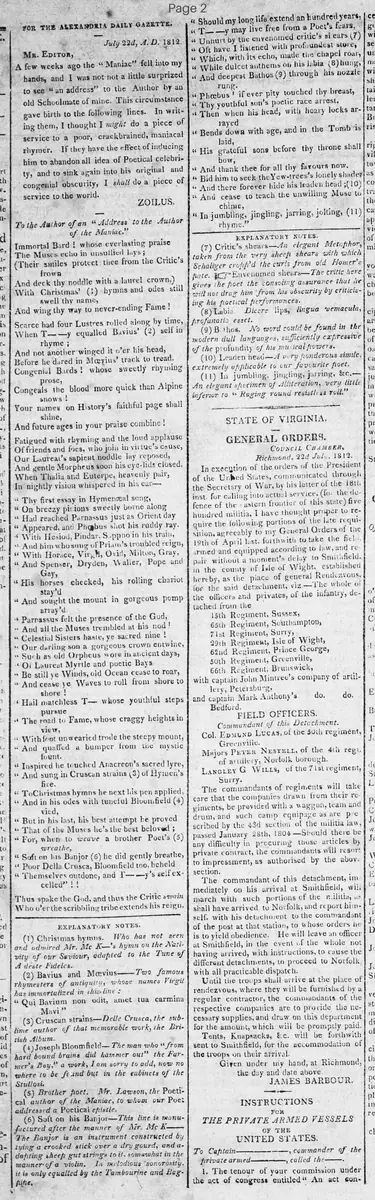
July 22d, A. D.1812
MR. EDITOR,
A few weeks ago the "Maniac" fell into my hands, and I was not a little surprized to see "an address" to the Author by an old Schoolmate of mine. This circumstance gave birth to the following lines. In writing them, I thought I might do a piece of service to a poor, crackbrained, maniacal rhymer. If they have the effect of inducing him to abandon all idea of Poetical celebrity, and to sink again into his original and congenial obscurity, I shall do a piece of service to the world.
ZOILUS.
To the Author of an "Address to the Author of the Maniac."
Immortal Bard! whose everlasting praise
The Muses echo in unsullied lays;
(Their smiles protect thee from the Critic's frown
And deck thy noddle with a laurel crown,)
With Christmas hymns and odes still swell thy name,
And wing thy way to never-ending Fame!
Scarce had four Lustres rolled along by time,
When T---y equalled Bavius' self in rhyme;
And not another winged it o'er his head,
Before he dared in Mævius' track to tread.
Congenial Bards! whose sweetly rhyming
Congeals the blood more quick than Alpine snows
Your names on History's faithful page shall shine,
And future ages in your praise combine!
Fatigued with rhyming and the loud applause
Of friends and foes, who join in virtue's cause,
Our Laureat's sapient noddle lay reposed,
And gentle Morpheus soon his eye-lids closed.
When Thalia and Euterpe, heavenly pair,
In nightly vision whispered in his ear-
"Thy first essay in Hymenæal song,
"On breezy pilions sweetly borne along
"Had reached Parnassus just as Orient day
"Appeared, and Phœbus shot his ruddy ray
"With Hesiod, Pindar, Sappho in his train,
"And him who sung of Priam's troubled reign,
"With Horace, Virgil, Ovid, Milton, Gray,
"And Spenser, Dryden, Waller, Pope and Gay,
"His horses checked, his rolling chariot stay'd
"And sought the mount in gorgeous pomp array'd.
"Parnassus felt the presence of the God,
"And all the Muses trembled at his nod!
"Celestial Sisters haste, ye sacred nine!
"Our darling son a gorgeous crown entwine,
"Such as old Orpheus wore in ancient days,
"Of Laureat Myrtle and poetic Bays.
"Be still ye Winds, old Ocean cease to roar,
"And cease ye Waves to roll from shore to shore!
Hail matchless T-- whose youthful steps pursue
"The road to Fame, whose craggy heights in view,
"With foot unwearied trode the steepy mount.
"And quaffed a bumper from the mystic fount.
"Inspired he touched Anacreon's sacred lyre,
"And sung in Cruscan strains of Hymen's fire.
"To Christmas hymns he next his pen applied,
"And in his odes with tuneful Bloomfield vied,
"But in his last, his best attempt he proved
"That of the Muses he's the best beloved;
"For, when to weave a brother Poet's wreathe,
"Soft on his Banjor he did gently breathe,
"Poor Della Crusca, Bloomfield too, beheld
"Themselves outdone, and I---y's self excelled"! !
Thus spake the God, and thus the Critic srain
Who o'er the scribbling tribe extends his reign.
EXPLANATORY NOTES.
(1) Christmas hymns. Who has not seen and admired Mr. Mc K-'s hymn on the Nativity of our Saviour, adapted to the Tune of Adeste Fideles.
(2) Bavius and Mævius-Two famous rhymesters of antiquity, whose names Virgil has immortalized in this line:
"Qui Bavium non odit, amet tua carmina Mævi"
(3) Cruscan strains--Della Crusca, the sublime author of that memorable work, the British Album.
(4) Joseph Bloomfield- The man who "from hard bound brains did hammer out" the Farmer's Boy," a work, I am sorry to add, now no where to be found but in the cabinets of the Stultosi.
(5) Brother poet. Mr. Lawson, the Poetical author of the Maniac, to whom our Poet addressed a Poetical epistle.
(6) Soft on his Banjor-This line is manufactured after the manner of Mr. Mc K-.
The Banjor is an instrument constructed by tying a crooked stick over a dry gourd, and adapting sheep gut strings to it, somewhat in the manner of a violin. In melodious sonorosity, it is only equalled by the Tambourine and Bag-pipe.
"Should my long life extend an hundred years,
"Unhurt by the envenomed critic's shears.(7)
"T---y may live free from a Poet's fears,
"Oft have I listened with profoundest store,
"Which, with its echo, made the chapel roar,
"While dulcet anthems on his labia (8) hung,
"And deepest Bathos (9) through his nozzle rung.
"Phæbus! if ever pity touched thy breast,
"Thy youthful son's poetic race arrest.
"Then when his head, with hoary locks arrayed
"Bends down with age, and in the Tomb is laid,
"His grateful sons before thy throne shall bow,
"And thank thee for all thy favours now.
"Bid him to seek the Yew-tree's lonely shade,
"And cease to teach the unwilling Muse to chime,
"And there forever hide his leaden head ;(10)
"In jumbling, jingling, jarring, jolting, (11)
rhyme."
EXPLANATORY NOTES.
(7) Critic's shears--An elegant Metaphor. taken from the very sheep shears with which Scaliger cropp'd the curls from old Homer's pate. &c. "Envenomed shears"--The critic here gives the poet the consoling assurance that he will not drag him from his obscurity by criticising his poetical performances.
(8) Labia. Dicere lips, lingua vernacula, profanatio esset.
(9) Bathos. No word could be found in the modern dull languages, sufficiently expressive of the profundity of his musical powers.
(10) Leaden head--A very ponderous simile. extremely applicable to our favourite poet.
(11) In jumbling, jingling, jarring, &c.-- An elegant specimen of Alliteration, very little inferior to "Raging round resistless roll."
July 22d, A. D.1812
MR. EDITOR,
A few weeks ago the "Maniac" fell into my hands, and I was not a little surprized to see "an address" to the Author by an old Schoolmate of mine. This circumstance gave birth to the following lines. In writing them, I thought I might do a piece of service to a poor, crackbrained, maniacal rhymer. If they have the effect of inducing him to abandon all idea of Poetical celebrity, and to sink again into his original and congenial obscurity, I shall do a piece of service to the world.
ZOILUS.
To the Author of an "Address to the Author of the Maniac."
Immortal Bard! whose everlasting praise
The Muses echo in unsullied lays;
(Their smiles protect thee from the Critic's frown
And deck thy noddle with a laurel crown,)
With Christmas hymns and odes still swell thy name,
And wing thy way to never-ending Fame!
Scarce had four Lustres rolled along by time,
When T---y equalled Bavius' self in rhyme;
And not another winged it o'er his head,
Before he dared in Mævius' track to tread.
Congenial Bards! whose sweetly rhyming
Congeals the blood more quick than Alpine snows
Your names on History's faithful page shall shine,
And future ages in your praise combine!
Fatigued with rhyming and the loud applause
Of friends and foes, who join in virtue's cause,
Our Laureat's sapient noddle lay reposed,
And gentle Morpheus soon his eye-lids closed.
When Thalia and Euterpe, heavenly pair,
In nightly vision whispered in his ear-
"Thy first essay in Hymenæal song,
"On breezy pilions sweetly borne along
"Had reached Parnassus just as Orient day
"Appeared, and Phœbus shot his ruddy ray
"With Hesiod, Pindar, Sappho in his train,
"And him who sung of Priam's troubled reign,
"With Horace, Virgil, Ovid, Milton, Gray,
"And Spenser, Dryden, Waller, Pope and Gay,
"His horses checked, his rolling chariot stay'd
"And sought the mount in gorgeous pomp array'd.
"Parnassus felt the presence of the God,
"And all the Muses trembled at his nod!
"Celestial Sisters haste, ye sacred nine!
"Our darling son a gorgeous crown entwine,
"Such as old Orpheus wore in ancient days,
"Of Laureat Myrtle and poetic Bays.
"Be still ye Winds, old Ocean cease to roar,
"And cease ye Waves to roll from shore to shore!
Hail matchless T-- whose youthful steps pursue
"The road to Fame, whose craggy heights in view,
"With foot unwearied trode the steepy mount.
"And quaffed a bumper from the mystic fount.
"Inspired he touched Anacreon's sacred lyre,
"And sung in Cruscan strains of Hymen's fire.
"To Christmas hymns he next his pen applied,
"And in his odes with tuneful Bloomfield vied,
"But in his last, his best attempt he proved
"That of the Muses he's the best beloved;
"For, when to weave a brother Poet's wreathe,
"Soft on his Banjor he did gently breathe,
"Poor Della Crusca, Bloomfield too, beheld
"Themselves outdone, and I---y's self excelled"! !
Thus spake the God, and thus the Critic srain
Who o'er the scribbling tribe extends his reign.
EXPLANATORY NOTES.
(1) Christmas hymns. Who has not seen and admired Mr. Mc K-'s hymn on the Nativity of our Saviour, adapted to the Tune of Adeste Fideles.
(2) Bavius and Mævius-Two famous rhymesters of antiquity, whose names Virgil has immortalized in this line:
"Qui Bavium non odit, amet tua carmina Mævi"
(3) Cruscan strains--Della Crusca, the sublime author of that memorable work, the British Album.
(4) Joseph Bloomfield- The man who "from hard bound brains did hammer out" the Farmer's Boy," a work, I am sorry to add, now no where to be found but in the cabinets of the Stultosi.
(5) Brother poet. Mr. Lawson, the Poetical author of the Maniac, to whom our Poet addressed a Poetical epistle.
(6) Soft on his Banjor-This line is manufactured after the manner of Mr. Mc K-.
The Banjor is an instrument constructed by tying a crooked stick over a dry gourd, and adapting sheep gut strings to it, somewhat in the manner of a violin. In melodious sonorosity, it is only equalled by the Tambourine and Bag-pipe.
"Should my long life extend an hundred years,
"Unhurt by the envenomed critic's shears.(7)
"T---y may live free from a Poet's fears,
"Oft have I listened with profoundest store,
"Which, with its echo, made the chapel roar,
"While dulcet anthems on his labia (8) hung,
"And deepest Bathos (9) through his nozzle rung.
"Phæbus! if ever pity touched thy breast,
"Thy youthful son's poetic race arrest.
"Then when his head, with hoary locks arrayed
"Bends down with age, and in the Tomb is laid,
"His grateful sons before thy throne shall bow,
"And thank thee for all thy favours now.
"Bid him to seek the Yew-tree's lonely shade,
"And cease to teach the unwilling Muse to chime,
"And there forever hide his leaden head ;(10)
"In jumbling, jingling, jarring, jolting, (11)
rhyme."
EXPLANATORY NOTES.
(7) Critic's shears--An elegant Metaphor. taken from the very sheep shears with which Scaliger cropp'd the curls from old Homer's pate. &c. "Envenomed shears"--The critic here gives the poet the consoling assurance that he will not drag him from his obscurity by criticising his poetical performances.
(8) Labia. Dicere lips, lingua vernacula, profanatio esset.
(9) Bathos. No word could be found in the modern dull languages, sufficiently expressive of the profundity of his musical powers.
(10) Leaden head--A very ponderous simile. extremely applicable to our favourite poet.
(11) In jumbling, jingling, jarring, &c.-- An elegant specimen of Alliteration, very little inferior to "Raging round resistless roll."
What sub-type of article is it?
Satirical
Comedic
Provocative
What themes does it cover?
Social Issues
Literary Critique
What keywords are associated?
Satirical Poem
Poetry Mockery
Bad Rhyming
Laurel Crown
Christmas Hymns
Della Crusca
Literary Critique
What entities or persons were involved?
Zoilus
Mr. Editor
Letter to Editor Details
Author
Zoilus
Recipient
Mr. Editor
Main Argument
the letter mocks an aspiring poet t---y for his poor rhyming and advises him to abandon poetry to return to obscurity, benefiting both himself and the world.
Notable Details
References To Bavius And Mævius As Bad Poets
Mentions Of Della Crusca, Bloomfield, And Other Poets
Explanatory Notes Ridiculing Specific Works Like Christmas Hymns And The Banjor Instrument
Satirical Invocation Of Muses And Phœbus