Thank you for visiting SNEWPapers!
Sign up free
Editorial
February 17, 1814
Daily National Intelligencer
Washington, District Of Columbia
What is this article about?
Editorial discusses recent European news favoring general peace negotiations, critiques Britain's disruptive role, predicts inclusion despite reluctance, and speculates on benefits for US maritime rights via Russia's influence in the coalition.
Clipping
OCR Quality
98%
Excellent
Full Text
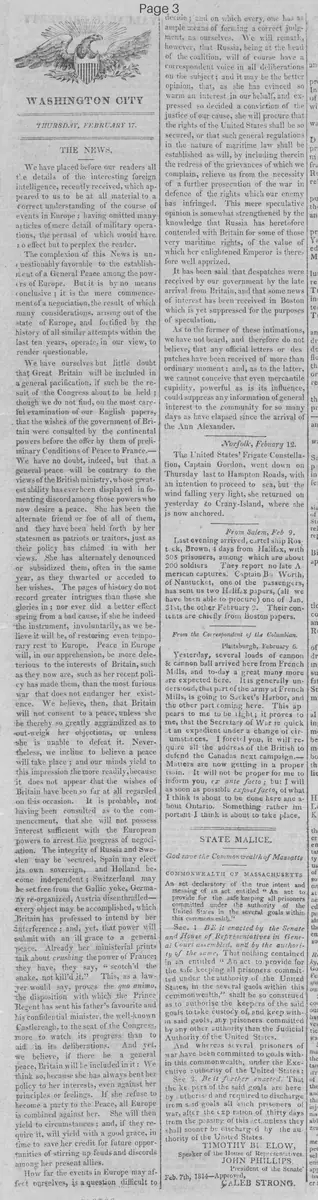
WASHINGTON CITY
THURSDAY, FEBRUARY 17.
THE NEWS.
We have placed before our readers all the details of the interesting foreign intelligence, recently received, which appeared to us to be at all material to a correct understanding of the course of events in Europe; having omitted many articles of mere detail of military operations, the perusal of which would have no effect but to perplex the reader.
The complexion of this News is unquestionably favorable to the establishment of a General Peace among the powers of Europe. But it is by no means conclusive; it is the mere commencement of a negotiation, the result of which many considerations, arising out of the state of Europe, and fortified by the history of all similar attempts within the last ten years, operate, in our view, to render questionable.
We have ourselves but little doubt that Great Britain will be included in a general pacification, if such be the result of the Congress about to be held: though we do not find, on the most careful examination of our English papers, that the wishes of the government of Britain were consulted by the continental powers before the offer by them of preliminary Conditions of Peace to France.
We have no doubt, indeed, but that a general peace will be contrary to the views of the British ministry, whose greatest ability has ever been displayed in fomenting discord among those powers who now desire a peace. She has been the alternate friend or foe of all of them, and they have been held forth by her statesmen as patriots or traitors, just as their policy has chimed in with her views. She has alternately denounced or subsidized them, often in the same year, as they thwarted or acceded to her wishes. The pages of history do not record greater intrigues than those she glories in; nor ever did a better effect spring from a bad cause, if she be indeed the instrument, involuntarily, as we believe it will be, of restoring even temporary rest to Europe. Peace in Europe will, in our apprehension, be more deleterious to the interests of Britain, such as they now are, such as her recent policy has made them, than the most furious war that does not endanger her existence. We believe, then, that Britain will not consent to a peace, unless she be thereby so greatly aggrandized as to out-weigh her objections, or unless she is unable to defeat it. Nevertheless, we incline to believe a peace will take place; and our minds yield to this impression the more readily, because it does not appear that the wishes of Britain have been so far at all regarded on this occasion. It is probable, not having been consulted as to the commencement, that she will not possess interest sufficient with the European powers to arrest the progress of negotiation. The integrity of Russia and Sweden may be secured, Spain may elect its own sovereign, and Holland become independent; Switzerland may be set free from the Gallic yoke, Germany re-organized, Austria disenthralled—every object may be accomplished, which Britain has professed to intend by her interference; and, yet, that power will submit with an ill grace to a general peace. Already her ministerial prints talk about crushing the power of France; they have, they say, "scotch'd the snake, not kill'd it." This, as a lawyer would say, proves the quo animo. the disposition with which the Prince Regent has sent his father's favourite and his confidential minister, the well-known Castlereagh, to the seat of the Congress. more to watch its progress than to aid in its deliberations. And yet. we believe, if there be a general peace, Britain will be included in it: We think so, because she has always bent her policy to her interests, even against her principles or feelings. If she refuse to become a party to the Peace, all Europe is combined against her. She will then yield to circumstances; and, if they require it, will yield with a good grace, in time to save her credit for future opportunities of stirring up feuds and discords among her present allies.
How far the events in Europe may affect ourselves, is a question difficult to decide; and on which every one has as ample means of forming a correct judgment, as ourselves. We will remark, however, that Russia, being at the head of the coalition, will of course have a correspondent voice in all deliberations on the subject; and it may be the better opinion, that, as she has evinced so warm an interest in our behalf, and expressed so decided a conviction of the justice of our cause, she will procure that the rights of the United States shall be so secured, or that such general regulations in the nature of maritime law shall be established as will, by including therein the redress of the grievances of which we complain, relieve us from the necessity of a further prosecution of the war in defence of the rights which our enemy has infringed. This mere speculative opinion is somewhat strengthened by the knowledge that Russia has heretofore contended with Britain for some of those very maritime rights, of the value of which her enlightened Emperor is therefore well apprized.
It has been said that despatches were received by our government by the late arrival from Britain, and that some news of interest has been received in Boston which is yet suppressed for the purposes of speculation. As to the former of these intimations. we have not heard, and therefore do not believe, that any official letters or despatches have been received of more than ordinary moment; and, as to the latter. we cannot conceive that even mercantile cupidity, powerful as is its influence. could suppress any information of general interest to the community for so many days as have elapsed since the arrival of the Ann Alexander.
THURSDAY, FEBRUARY 17.
THE NEWS.
We have placed before our readers all the details of the interesting foreign intelligence, recently received, which appeared to us to be at all material to a correct understanding of the course of events in Europe; having omitted many articles of mere detail of military operations, the perusal of which would have no effect but to perplex the reader.
The complexion of this News is unquestionably favorable to the establishment of a General Peace among the powers of Europe. But it is by no means conclusive; it is the mere commencement of a negotiation, the result of which many considerations, arising out of the state of Europe, and fortified by the history of all similar attempts within the last ten years, operate, in our view, to render questionable.
We have ourselves but little doubt that Great Britain will be included in a general pacification, if such be the result of the Congress about to be held: though we do not find, on the most careful examination of our English papers, that the wishes of the government of Britain were consulted by the continental powers before the offer by them of preliminary Conditions of Peace to France.
We have no doubt, indeed, but that a general peace will be contrary to the views of the British ministry, whose greatest ability has ever been displayed in fomenting discord among those powers who now desire a peace. She has been the alternate friend or foe of all of them, and they have been held forth by her statesmen as patriots or traitors, just as their policy has chimed in with her views. She has alternately denounced or subsidized them, often in the same year, as they thwarted or acceded to her wishes. The pages of history do not record greater intrigues than those she glories in; nor ever did a better effect spring from a bad cause, if she be indeed the instrument, involuntarily, as we believe it will be, of restoring even temporary rest to Europe. Peace in Europe will, in our apprehension, be more deleterious to the interests of Britain, such as they now are, such as her recent policy has made them, than the most furious war that does not endanger her existence. We believe, then, that Britain will not consent to a peace, unless she be thereby so greatly aggrandized as to out-weigh her objections, or unless she is unable to defeat it. Nevertheless, we incline to believe a peace will take place; and our minds yield to this impression the more readily, because it does not appear that the wishes of Britain have been so far at all regarded on this occasion. It is probable, not having been consulted as to the commencement, that she will not possess interest sufficient with the European powers to arrest the progress of negotiation. The integrity of Russia and Sweden may be secured, Spain may elect its own sovereign, and Holland become independent; Switzerland may be set free from the Gallic yoke, Germany re-organized, Austria disenthralled—every object may be accomplished, which Britain has professed to intend by her interference; and, yet, that power will submit with an ill grace to a general peace. Already her ministerial prints talk about crushing the power of France; they have, they say, "scotch'd the snake, not kill'd it." This, as a lawyer would say, proves the quo animo. the disposition with which the Prince Regent has sent his father's favourite and his confidential minister, the well-known Castlereagh, to the seat of the Congress. more to watch its progress than to aid in its deliberations. And yet. we believe, if there be a general peace, Britain will be included in it: We think so, because she has always bent her policy to her interests, even against her principles or feelings. If she refuse to become a party to the Peace, all Europe is combined against her. She will then yield to circumstances; and, if they require it, will yield with a good grace, in time to save her credit for future opportunities of stirring up feuds and discords among her present allies.
How far the events in Europe may affect ourselves, is a question difficult to decide; and on which every one has as ample means of forming a correct judgment, as ourselves. We will remark, however, that Russia, being at the head of the coalition, will of course have a correspondent voice in all deliberations on the subject; and it may be the better opinion, that, as she has evinced so warm an interest in our behalf, and expressed so decided a conviction of the justice of our cause, she will procure that the rights of the United States shall be so secured, or that such general regulations in the nature of maritime law shall be established as will, by including therein the redress of the grievances of which we complain, relieve us from the necessity of a further prosecution of the war in defence of the rights which our enemy has infringed. This mere speculative opinion is somewhat strengthened by the knowledge that Russia has heretofore contended with Britain for some of those very maritime rights, of the value of which her enlightened Emperor is therefore well apprized.
It has been said that despatches were received by our government by the late arrival from Britain, and that some news of interest has been received in Boston which is yet suppressed for the purposes of speculation. As to the former of these intimations. we have not heard, and therefore do not believe, that any official letters or despatches have been received of more than ordinary moment; and, as to the latter. we cannot conceive that even mercantile cupidity, powerful as is its influence. could suppress any information of general interest to the community for so many days as have elapsed since the arrival of the Ann Alexander.
What sub-type of article is it?
War Or Peace
Foreign Affairs
What keywords are associated?
European Peace
British Policy
Congress Negotiations
Maritime Rights
Russia Coalition
Us War Implications
What entities or persons were involved?
Great Britain
British Ministry
Prince Regent
Castlereagh
Russia
France
Sweden
Spain
Holland
Switzerland
Germany
Austria
United States
Editorial Details
Primary Topic
Prospects For General Peace In Europe And Its Implications For The United States
Stance / Tone
Cautiously Optimistic About Peace Despite British Opposition, Critical Of British Policy
Key Figures
Great Britain
British Ministry
Prince Regent
Castlereagh
Russia
France
Sweden
Spain
Holland
Switzerland
Germany
Austria
United States
Key Arguments
European News Favors General Peace But Negotiations Are Inconclusive
Britain Likely To Be Included In Peace Despite Opposition
British Policy Historically Fosters Discord Among European Powers
Peace Detrimental To Britain's Current Interests
Russia May Secure Us Maritime Rights In Peace Deliberations
No Significant Suppressed News From Britain