Thank you for visiting SNEWPapers!
Sign up free
Editorial
April 21, 1928
Richmond Planet
Richmond, Virginia
What is this article about?
Editorial critiques R. H. Angell's April 11, 1928, circular inviting Virginians, especially disgruntled Democrats, to join Republicans amid expectations of Al Smith's Democratic nomination. Warns of vote shift to Republicans like Hoover or Lowden, backed by prohibitionists and Protestants, unless Glass or Byrd nominated.
Clipping
OCR Quality
98%
Excellent
Full Text
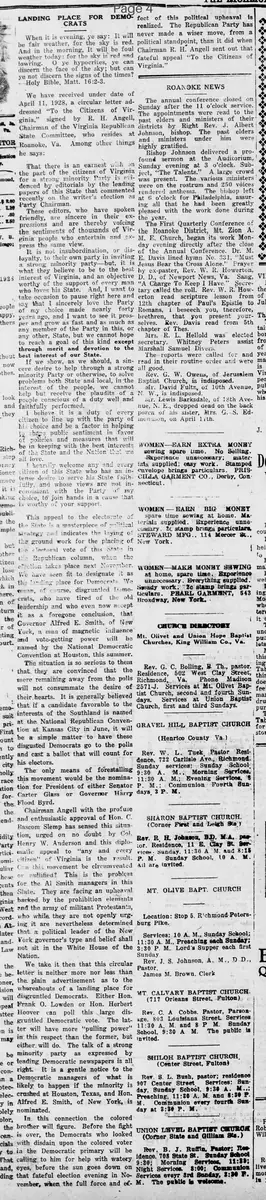
When it is evening, ye say: It will be fair weather, for the sky is red. And in the morning, It will be foul weather today: for the sky is red and lowring. O ye hypocrites, ye can discern the face of the sky; but can ye not discern the signs of the times?
Holy Bible, Matt. 16:2-3.
We have received under date of April 11, 1928, a circular letter addressed "To the Citizens of Virginia," signed by R. H. Angell, Chairman of the Virginia Republican State Committee, who resides at Roanoke, Va. Among other things he says:
That there is an earnest wish on the part of the citizens of Virginia for a strong minority Party is evidenced by editorials by the leading papers of this State that commented recently on the writer's election as Party Chairman.
These editors, who have spoken friendly, are sincere in their expressions and are thereby voicing the sentiments of thousands of Virginia people who entertain and express the same view.
It is not insubordination, or disloyalty to their own party in inviting a strong minority party—but, it is what they believe to be to the best interest of Virginia, and an objective worthy of the support of every man who loves his State. And, I want to take occasion to pause right here and say that I sincerely love the Party of my choice made nearly forty years ago, and I want to see it prosper and grow as fast and as much as any member of the Party in this, or any other, State, but we cannot hope to reach a goal of this kind except through merit and devotion to the best interest of our State.
If we show, as we should, a sincere desire to help through a strong minority Party or otherwise, to solve problems both State and local, in the interest of the people, we cannot help but receive the plaudits of a people conscious of a duty well and faithfully performed.
I believe it is a duty of every citizen to line up with the party of his choice and be a factor in helping to shape public sentiment in favor of policies and measures that will be in keeping with the best interests of the State and the Nation that we all love.
I heartily welcome any and every citizen of this State who has an intense desire to serve his State faithfully, and whose views are not inconsistent with the Party of my choice, to join hands in a cause that is worthy of your support.
This appeal to the electorate of the State is a masterpiece of political strategy and indicates the laying of the ground work for the placing of the electoral vote of this State in the Republican column, when the election takes place next November.
We have seen fit to designate it as the landing place for Democrats—We mean, of course, disgruntled Democrats, who have tired of the old leadership and who even now accept it as a foregone conclusion, that Governor Alfred E. Smith, of New York, a man of magnetic influence and vote-getting power will be named by the National Democratic Convention at Houston, this summer.
The situation is so serious to them that they are convinced that the mere remaining away from the polls will not consummate the desire of their hearts. It is generally believed that if a candidate favorable to the interests of the Southland is named at the National Republican Convention at Kansas City in June, it will be a simple matter to have these disgusted Democrats go to the polls and cast a ballot that will count for his electors.
The only means of forestalling this movement would be the nomination for President of either Senator Carter Glass or Governor Harry Flood Byrd.
Chairman Angell with the profuse and enthusiastic approval of Hon. C. Bascom Slemp has sensed this situation, urged on no doubt by Col. Henry W. Anderson and this diplomatic appeal to "any and every citizen" of Virginia is the result.
Can this movement be circumvented or nullified? This is the problem for the Al Smith managers in this State. They are facing an upheaval backed by the prohibition elements and the army of militant Protestants, who while they are not openly urging it are nevertheless determined that a political leader of the New York governor's type and belief shall not sit in the White House of the Nation.
We take it then that this circular letter is neither more nor less than the plain advertisement as to the whereabouts of a landing place for disgruntled Democrats. Either Hon. Frank O. Lowden or Hon. Herbert Hoover can poll this large disgruntled Democratic vote. The latter will have more "pulling power" in this respect than the former, but either will do. The talk of a strong minority party as expressed by leading Democratic newspapers is all right. It is a gentle notice to the Democratic managers of what is likely to happen if the minority is crushed at Houston, Texas, and Hon. Alfred E. Smith, of New York, is nominated.
In this connection the colored brother will figure. Before the fight is over, the Democrats who looked with disdain upon the colored voter in the Democratic primary will be calling to him for help with watery eyes, before the sun goes down on that fateful election evening in November, when the full force and effect of this political upheaval is realized. The Republican Party has never made a wiser move, from a political standpoint, than it did when Chairman R. H. Angell sent out that fateful appeal "To the Citizens of Virginia."
Holy Bible, Matt. 16:2-3.
We have received under date of April 11, 1928, a circular letter addressed "To the Citizens of Virginia," signed by R. H. Angell, Chairman of the Virginia Republican State Committee, who resides at Roanoke, Va. Among other things he says:
That there is an earnest wish on the part of the citizens of Virginia for a strong minority Party is evidenced by editorials by the leading papers of this State that commented recently on the writer's election as Party Chairman.
These editors, who have spoken friendly, are sincere in their expressions and are thereby voicing the sentiments of thousands of Virginia people who entertain and express the same view.
It is not insubordination, or disloyalty to their own party in inviting a strong minority party—but, it is what they believe to be to the best interest of Virginia, and an objective worthy of the support of every man who loves his State. And, I want to take occasion to pause right here and say that I sincerely love the Party of my choice made nearly forty years ago, and I want to see it prosper and grow as fast and as much as any member of the Party in this, or any other, State, but we cannot hope to reach a goal of this kind except through merit and devotion to the best interest of our State.
If we show, as we should, a sincere desire to help through a strong minority Party or otherwise, to solve problems both State and local, in the interest of the people, we cannot help but receive the plaudits of a people conscious of a duty well and faithfully performed.
I believe it is a duty of every citizen to line up with the party of his choice and be a factor in helping to shape public sentiment in favor of policies and measures that will be in keeping with the best interests of the State and the Nation that we all love.
I heartily welcome any and every citizen of this State who has an intense desire to serve his State faithfully, and whose views are not inconsistent with the Party of my choice, to join hands in a cause that is worthy of your support.
This appeal to the electorate of the State is a masterpiece of political strategy and indicates the laying of the ground work for the placing of the electoral vote of this State in the Republican column, when the election takes place next November.
We have seen fit to designate it as the landing place for Democrats—We mean, of course, disgruntled Democrats, who have tired of the old leadership and who even now accept it as a foregone conclusion, that Governor Alfred E. Smith, of New York, a man of magnetic influence and vote-getting power will be named by the National Democratic Convention at Houston, this summer.
The situation is so serious to them that they are convinced that the mere remaining away from the polls will not consummate the desire of their hearts. It is generally believed that if a candidate favorable to the interests of the Southland is named at the National Republican Convention at Kansas City in June, it will be a simple matter to have these disgusted Democrats go to the polls and cast a ballot that will count for his electors.
The only means of forestalling this movement would be the nomination for President of either Senator Carter Glass or Governor Harry Flood Byrd.
Chairman Angell with the profuse and enthusiastic approval of Hon. C. Bascom Slemp has sensed this situation, urged on no doubt by Col. Henry W. Anderson and this diplomatic appeal to "any and every citizen" of Virginia is the result.
Can this movement be circumvented or nullified? This is the problem for the Al Smith managers in this State. They are facing an upheaval backed by the prohibition elements and the army of militant Protestants, who while they are not openly urging it are nevertheless determined that a political leader of the New York governor's type and belief shall not sit in the White House of the Nation.
We take it then that this circular letter is neither more nor less than the plain advertisement as to the whereabouts of a landing place for disgruntled Democrats. Either Hon. Frank O. Lowden or Hon. Herbert Hoover can poll this large disgruntled Democratic vote. The latter will have more "pulling power" in this respect than the former, but either will do. The talk of a strong minority party as expressed by leading Democratic newspapers is all right. It is a gentle notice to the Democratic managers of what is likely to happen if the minority is crushed at Houston, Texas, and Hon. Alfred E. Smith, of New York, is nominated.
In this connection the colored brother will figure. Before the fight is over, the Democrats who looked with disdain upon the colored voter in the Democratic primary will be calling to him for help with watery eyes, before the sun goes down on that fateful election evening in November, when the full force and effect of this political upheaval is realized. The Republican Party has never made a wiser move, from a political standpoint, than it did when Chairman R. H. Angell sent out that fateful appeal "To the Citizens of Virginia."
What sub-type of article is it?
Partisan Politics
What keywords are associated?
Virginia Republicans
1928 Election
Al Smith Nomination
Disgruntled Democrats
Political Strategy
Minority Party
Prohibition Opposition
What entities or persons were involved?
R. H. Angell
Virginia Republican State Committee
Alfred E. Smith
Carter Glass
Harry Flood Byrd
C. Bascom Slemp
Henry W. Anderson
Frank O. Lowden
Herbert Hoover
Editorial Details
Primary Topic
Republican Strategy To Attract Disgruntled Democrats In Virginia For 1928 Presidential Election
Stance / Tone
Critical Warning To Democrats About Potential Republican Gains
Key Figures
R. H. Angell
Virginia Republican State Committee
Alfred E. Smith
Carter Glass
Harry Flood Byrd
C. Bascom Slemp
Henry W. Anderson
Frank O. Lowden
Herbert Hoover
Key Arguments
Circular Letter From Angell Invites Citizens To Join Republicans To Build Strong Minority Party
Appeals To Disgruntled Democrats Tired Of Old Leadership Expecting Al Smith's Nomination
Believes Nomination Of Southern Favorable Republican Could Draw Democratic Votes
Mentions Support From Slemp And Anderson
Prohibitionists And Protestants Oppose Smith
Suggests Lowden Or Hoover Could Capture Disgruntled Vote
Warns Of Political Upheaval If Smith Nominated At Houston Convention