Thank you for visiting SNEWPapers!
Sign up free
The Enquirer
Richmond, Henrico County, Virginia
What is this article about?
Commentary on the providential destruction of Napoleon's army by early Russian winter during the 1812 invasion, drawing parallels to the Spanish Armada, and discussing future war prospects including advances into Prussia, Polish independence, and continental sentiments against France.
Clipping
OCR Quality
Full Text
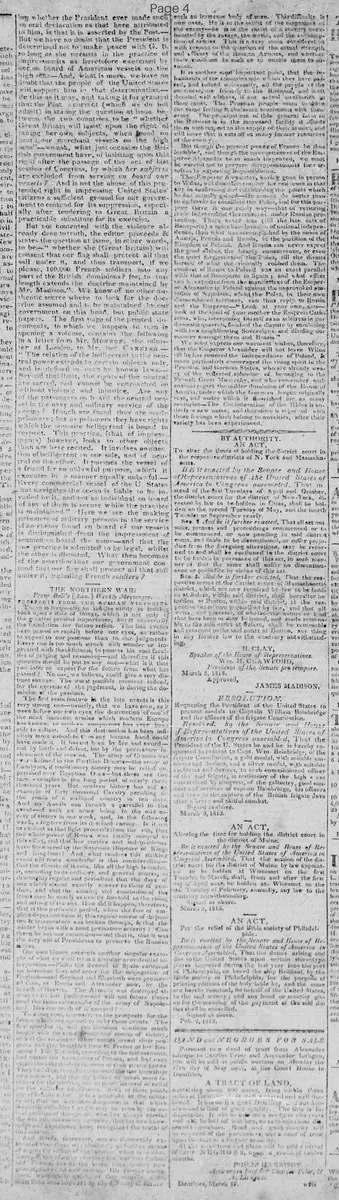
From Bell's [Lon.] Weekly Messenger.
PROPHETS FROM THE RUSSIAN VICTORIES.
There is frequently an infinite utility in looking back upon a state of things, which is not only the greatest present importance, but is necessarily the foundation for future action. The late events have passed so rapidly before our eyes, as rather to appeal to our passions than to our judgments. Every one is too much struck with wonder or impressed with thankfulness, to possess his cool faculties of judging and reasoning—and therefore if this question should be put to any one—what is it that you infer or expect for the future from what has passed? No one, we believe, could give a very distinct answer. The worst possible moment indeed, for the exercise of the judgment, is during the dominion of the passions.
The first main feature in the late events is this very strong one—namely, that we have seen, as it were before our own eyes, the destruction of one of the most immense armies which modern Europe has known. or modern conquerors have ever been able to collect. And this destruction has been infinitely more complete than on any human hand could have made it. It has not been by fire and sword— not by battle and defeat, but by the premature invasion of the seasons. The army of Crassus was overwhelmed in the Parthian Desert—the army Cambyses, if traditionary history may be relied on. perished near Egyptian sands—but these are two rare examples in the long period of nearly three thousand years. But modern history has not an example of forty thousand Cavalry perishing on the roads of a civilized country' in ten days. And no Annals can furnish a parallel to the event—of such an army being in the mid career of victory in one week, and, in the following week, a fugitive from its despised enemy. Is it not as evident as that light proceeds from the sun, that the whole power of Russia was totally unequal to this effort, and that her empire and independence have been saved by the Supreme Disposer of Kings and Kingdoms! And what renders this striking event still more wonderful is this consideration— that the climate of Russia, like all the high latitudes, is according to its ordinary, and general course, so thoroughly regular and periodical that the days of one winter almost exactly answer to those of another, and that the, coming and conclusion of the frosts may be nearly as exactly foretold as the rising and setting of the sun. How did it happen, therefore, that at this particular period, when the fate of empires depended upon it, this regular course of season & temperature was broken through, & that the winter began with a most premature severity. Can there be but one conclusion—and that is, that it was the very will of Providence to preserve the Russian nation
Our own history presents another singular example of what we still term a singular providential interposition -Philip the Second of Spain collected an immense fleet and army for the subjugation of England—and England and Elizabeth were preserved. as Russia and Alexander now, by the breath of Heaven. The Armada was destroyed almost to a last timber—and will not future times read the same catastrophe of the army of Napoleon? His one tenth of it escaped?
The only question remains, however, to the prospects for the future which stand or had to us by these events. The question is, will hostilities continue much longer with the same precipitate course of victory, or will the enemy ever chase arrest their progress and give breathing time to France or her Emperor. I-Koon, according to the last accounts, had passed the boundaries of Prussia, and had even seized on a part of that country. They had, therefore transferred the war from their own soil, and (regained) much more favorable position for the allies, while to himself interval of relief or the enemy uaa, th of these prints see ofi "mite v I . Ie is a principle in the military. r e,that yo wr jeeaargas is that which asgrietly defenire mdt may be peen by coe se- thad ptdreenf asjni wo lin alwsy erried the was ist, ihoeneiny einbn y,thist hie gan khiow. lefhonl exporieneg bave reeoguze the truthof tinemaxn
And Konda, moreover, ws on (thoroughly er. Inneted thet thep ws allutaly o forthe at ofepolyfreisheeo ohe armi whcn in nrir Katny 4, the efre in shirring thre war hto Pallans nd P.i, ha th e 1ms brke byw oril alle nre m9. Fi fger ora ont, wooperfaily qic. s they siyill waro, mun lats desaidp-del D dlod.3maity c. los
such an immense body of men. This difficulty is now over. He is in the midst of the magazines of the enemy—he is in the midst of a country unex. hausted by the ravage, the waste, and the consumption of armies. This is a very main consideration with respect to the question of the actual strength and celerity of the Russian Armies, and whether their condition be such as to enable them to advance.
It is another most important point, that the inhabitants of the countries into which they have passed, and indeed universally, all the people of the continent, are friendly to the Russians, and most decidedly well wishers, if not general auxiliaries of their cause. The Prussian people seem to have the same feeling & the same sentiments with their army. The principal use of this general favor to the Russians is in the increased facility it affords them with respect to the supply of their armies, and still more that it cuts off so many former resources of the enemy.
But though the present power of France be thus humbled, and though the circumstances of the Emperor Alexander be so much improved, we must be careful not to prepare disappointments for ourselves by expecting impossibilities.
The Emperor Alexander, having gone in person to Wilna, will doubtless employ his residence in that city in confirming and establishing the points which he has actually gained—he cannot do better than to endeavor to conciliate the Poles, and for this purpose there is one ready way—that of restoring their independent Government under Russian protection. There never was (till the late acts of Bonaparte) a more base invasion of national independence. than what was accomplished by the union of Austria. Prussia and Russia, in the partition of the Kingdom of Poland. And Russia can never expect the good wishes, the hearty concurrence, or even the quiet forgiveness of the Poles, till she divests herself of what she violently robbed them. The conduct of Russia to Poland was an exact parallel with that of Bonaparte to Spain : and what effect can be expected from the manifestoes of the Emperor Alexander in Poland against the unprovoked ambition of Napoleon, while the Poles, in their own dismembered territory, can thus reply. w Russia and the Emperor—"Look at your own acts— look at the spoil of your mother the Empress Catherine. who, interposing herself as an arbitress in our domestic quarrels, finished the dispute by combining with two neighbouring Sovereigns, and dividing our country amongst them and Russia"
We must express our warmest wishes, therefore, that the Emperor Alexander will not leave Wilna until he has restored the independence of Poland, & more particularly encouraged the rising spirit in the Prussian. and German States, who are already weary of the reflected splendor of. belonging to the French Great Monarchy, and who remember with anxious regret the milder dominion of the House of Austria, under which the German league originally rose, and under which it flourished for so many centuries—The Confederation of the Rhine is entirely a new name, and therefore is regarded with those feelings which belong to novelties, after their variety has been experienced.
What sub-type of article is it?
What keywords are associated?
What entities or persons were involved?
Where did it happen?
Foreign News Details
Primary Location
Russia
Event Date
The Late Events
Key Persons
Outcome
destruction of one of the most immense armies modern europe has known, with only one tenth escaping, due to premature winter severity rather than battle.
Event Details
The article reflects on the rapid destruction of Napoleon's invading army in Russia by an unusually early and severe winter, seen as providential intervention saving Russia, similar to the Spanish Armada's fate. It discusses future prospects, including Russian advances into Prussia, favorable continental sentiments, supply advantages, and recommendations for Alexander to restore Polish independence to gain allies against France.