Thank you for visiting SNEWPapers!
Sign up free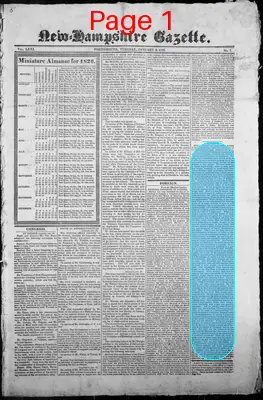
The New Hampshire Gazette
Portsmouth, Rockingham County, New Hampshire
What is this article about?
Reflective article on General Lafayette's year-long visit to the United States, explaining the extraordinary public homage as gratitude for his pivotal role in the American Revolution as a surviving hero from battles like Flat-Bush, Brandywine, and Lexington.
Clipping
OCR Quality
Full Text
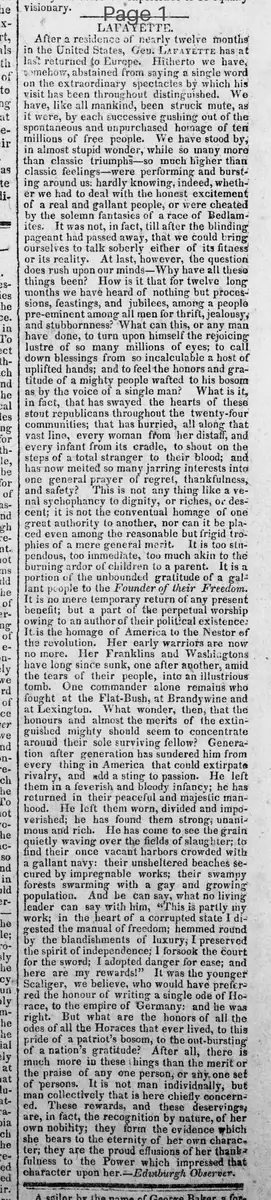
After a residence of nearly twelve months in the United States, Gen. LAFAYETTE has at last returned to Europe. Hitherto we have, somehow, abstained from saying a single word on the extraordinary spectacles by which his visit has been throughout distinguished. We have, like all mankind, been struck mute, as it were, by each successive gushing out of the spontaneous and unpurchased homage of ten millions of free people. We have stood by, in almost stupid wonder, while so many more than classic triumphs--so much higher than classic feelings--were performing and bursting around us: hardly knowing, indeed, whether we had to deal with the honest excitement of a real and gallant people, or were cheated by the solemn fantasies of a race of Bedlamites. It was not, in fact, till after the blinding pageant had passed away, that we could bring ourselves to talk soberly either of its fitness or its reality. At last, however, the question does rush upon our minds--Why have all these things been? How is it that for twelve long months we have heard of nothing but processions, feastings, and jubilees, among a people pre-eminent among all men for thrift, jealousy; and stubbornness? What can this, or any man have done, to turn upon himself the rejoicing lustre of so many millions of eyes; to call down blessings from so incalculable a host of uplifted hands; and to feel the honors and gratitude of a mighty people wafted to his bosom as by the voice of a single man? What is it, in fact, that has swayed the hearts of these stout republicans throughout the twenty-four communities; that has hurried, all along that vast line, every woman from her distaff, and every infant from its cradle, to shout on the steps of a total stranger to their blood; and has now melted so many jarring interests into one general prayer of regret, thankfulness, and safety? This is not any thing like a venal sychophancy to dignity, or riches, or descent; it is not the conventual homage of one great authority to another, nor can it be placed even among the reasonable but frigid trophies of a mere general merit. It is too stupendous, too immediate, too much akin to the burning ardor of children to a parent. It is a portion of the unbounded gratitude of a gallant people to the Founder of their Freedom. It is no mere temporary return of any present benefit; but a part of the perpetual worship owing to an author of their political existence: It is the homage of America to the Nestor of the revolution. Her early warriors are now no more. Her Franklins and Washingtons have long since sunk, one after another, amid the tears of their people, into an illustrious tomb. One commander alone remains who fought at the Flat-Bush, at Brandywine and at Lexington. What wonder, then, that the honours and almost the merits of the extinguished mighty should seem to concentrate around their sole surviving fellow? Generation after generation has sundered him from every thing in America that could extirpate rivalry, and add a sting to passion. He left them in a feverish and bloody infancy; he has returned in their peaceful and majestic manhood. He left them worn, divided and impoverished; he has found them strong; unanimous and rich. He has come to see the grain quietly waving over the fields of slaughter; to find their once vacant harbors crowded with a gallant navy: their unsheltered beaches secured by impregnable works; their swampy forests swarming with a gay and growing population. And he can say, what no living leader can say with him, "This is partly my work; in the heart of a corrupted state I digested the manual of freedom; hemmed round by the blandishments of luxury; I preserved the spirit of independence; I forsook the court for the sword; I adopted danger for ease; and here are my rewards!" It was the younger Scaliger, we believe, who would have preferred the honour of writing a single ode of Horace, to the empire of Germany: and he was right. But what are the honors of all the odes of all the Horaces that ever lived, to this pride of a patriot's bosom, to the out-bursting of a nation's gratitude? After all, there is much more in these things than the merit or the praise of any one person, or any one set of persons. It is not man individually, but man collectively that is here chiefly concerned. These rewards, and these deservings; are, in fact, the recognition by nature, of her own nobility; they form the evidence which she bears to the eternity of her own character; they are the proud effusions of her thankfulness to the Power which impressed that character upon her. Edinburgh Observer.
What sub-type of article is it?
What themes does it cover?
What keywords are associated?
What entities or persons were involved?
Where did it happen?
Story Details
Key Persons
Location
United States
Event Date
After A Residence Of Nearly Twelve Months In The United States
Story Details
The article reflects on the profound, spontaneous homage paid to General Lafayette during his year-long visit to America, attributing it to his role as the last surviving commander from key Revolutionary War battles and founder of their freedom, evoking national gratitude for his sacrifices.