Thank you for visiting SNEWPapers!
Sign up free
Story
April 20, 1852
The Daily Dispatch
Richmond, Virginia
What is this article about?
Opinion piece defending Queen Mary Stuart against her execution by Queen Elizabeth I, arguing it was unjust due to jealousy and politics, comparing to French Revolution expediency, and highlighting poetic justice under Queen Victoria as Mary's descendant.
Clipping
OCR Quality
98%
Excellent
Full Text
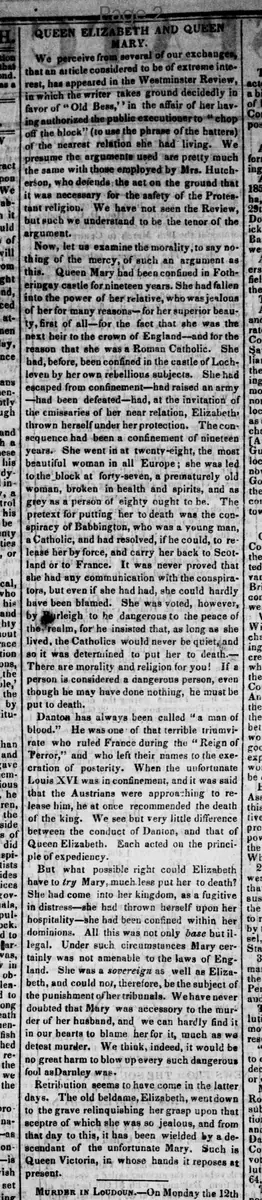
QUEEN ELIZABETH AND QUEEN MARY
We perceive from several of our exchanges, that an article considered to be of extreme interest, has appeared in the Westminster Review, in which the writer takes ground decidedly in favor of "Old Bess," in the affair of her having authorized the public executioner to "chop off the block" (to use the phrase of the batterers) of the nearest relation she had living. We presume the arguments used are pretty much the same with those employed by Mrs. Hutchinson, who defends the act on the ground that it was necessary for the safety of the Protestant religion. We have not seen the Review, but such we understand to be the tenor of the argument.
Now, let us examine the morality, to say nothing of the mercy, of such an argument as this. Queen Mary had been confined in Fotheringay castle for nineteen years. She had fallen into the power of her relative, who was jealous of her for many reasons—for her superior beauty, first of all—for the fact that she was the next heir to the crown of England—and for the reason that she was a Roman Catholic. She had, before, been confined in the castle of Lochleven by her own rebellious subjects. She had escaped from confinement—had raised an army—had been defeated—had, at the invitation of the emissaries of her near relation, Elizabeth, thrown herself under her protection. The consequence had been a confinement of nineteen years. She went in at twenty-eight, the most beautiful woman in all Europe; she was led to the block at forty-seven, a prematurely old woman, broken in health and spirits, and as grey as a person of eighty ought to be. The pretext for putting her to death was the conspiracy of Babington, who was a young man, a Catholic, and had resolved, if he could, to release her by force, and carry her back to Scotland or to France. It was never proved that she had any communication with the conspirators, but even if she had had, she could hardly have been blamed. She was voted, however, by Burleigh to be dangerous to the peace of the realm, or he insisted that, as long as she lived, the Catholics would never be quiet, and so it was determined to put her to death.
There are morality and religion for you! If a person is considered a dangerous person, even though he may have done nothing, he must be put to death.
Danton has always been called "a man of blood." He was one of that terrible triumvirate who ruled France during the "Reign of Terror," and who left their names to the execration of posterity. When the unfortunate Louis XVI was in confinement, and it was said that the Austrians were approaching to release him, he at once recommended the death of the king. We see but very little difference between the conduct of Danton, and that of Queen Elizabeth. Each acted on the principle of expediency.
But what possible right could Elizabeth have to try Mary, much less put her to death? She had come into her kingdom, as a fugitive in distress—she had thrown herself upon her hospitality—she had been confined within her dominions. All this was not only base but illegal. Under such circumstances Mary certainly was not amenable to the laws of England. She was a sovereign as well as Elizabeth, and could not, therefore, be the subject of the punishment of her tribunals. We have never doubted that Mary was accessory to the murder of her husband, and we can hardly find it in our hearts to blame her for it, much as we detest murder. We think, indeed, it would be no great harm to blow up every such dangerous fool as Darnley was.
Retribution seems to have come in the latter days. The old beldame, Elizabeth, went down to the grave relinquishing her grasp upon that sceptre of which she was so jealous, and from that day to this, it has been wielded by a descendant of the unfortunate Mary. Such is Queen Victoria, in whose hands it reposes at present.
We perceive from several of our exchanges, that an article considered to be of extreme interest, has appeared in the Westminster Review, in which the writer takes ground decidedly in favor of "Old Bess," in the affair of her having authorized the public executioner to "chop off the block" (to use the phrase of the batterers) of the nearest relation she had living. We presume the arguments used are pretty much the same with those employed by Mrs. Hutchinson, who defends the act on the ground that it was necessary for the safety of the Protestant religion. We have not seen the Review, but such we understand to be the tenor of the argument.
Now, let us examine the morality, to say nothing of the mercy, of such an argument as this. Queen Mary had been confined in Fotheringay castle for nineteen years. She had fallen into the power of her relative, who was jealous of her for many reasons—for her superior beauty, first of all—for the fact that she was the next heir to the crown of England—and for the reason that she was a Roman Catholic. She had, before, been confined in the castle of Lochleven by her own rebellious subjects. She had escaped from confinement—had raised an army—had been defeated—had, at the invitation of the emissaries of her near relation, Elizabeth, thrown herself under her protection. The consequence had been a confinement of nineteen years. She went in at twenty-eight, the most beautiful woman in all Europe; she was led to the block at forty-seven, a prematurely old woman, broken in health and spirits, and as grey as a person of eighty ought to be. The pretext for putting her to death was the conspiracy of Babington, who was a young man, a Catholic, and had resolved, if he could, to release her by force, and carry her back to Scotland or to France. It was never proved that she had any communication with the conspirators, but even if she had had, she could hardly have been blamed. She was voted, however, by Burleigh to be dangerous to the peace of the realm, or he insisted that, as long as she lived, the Catholics would never be quiet, and so it was determined to put her to death.
There are morality and religion for you! If a person is considered a dangerous person, even though he may have done nothing, he must be put to death.
Danton has always been called "a man of blood." He was one of that terrible triumvirate who ruled France during the "Reign of Terror," and who left their names to the execration of posterity. When the unfortunate Louis XVI was in confinement, and it was said that the Austrians were approaching to release him, he at once recommended the death of the king. We see but very little difference between the conduct of Danton, and that of Queen Elizabeth. Each acted on the principle of expediency.
But what possible right could Elizabeth have to try Mary, much less put her to death? She had come into her kingdom, as a fugitive in distress—she had thrown herself upon her hospitality—she had been confined within her dominions. All this was not only base but illegal. Under such circumstances Mary certainly was not amenable to the laws of England. She was a sovereign as well as Elizabeth, and could not, therefore, be the subject of the punishment of her tribunals. We have never doubted that Mary was accessory to the murder of her husband, and we can hardly find it in our hearts to blame her for it, much as we detest murder. We think, indeed, it would be no great harm to blow up every such dangerous fool as Darnley was.
Retribution seems to have come in the latter days. The old beldame, Elizabeth, went down to the grave relinquishing her grasp upon that sceptre of which she was so jealous, and from that day to this, it has been wielded by a descendant of the unfortunate Mary. Such is Queen Victoria, in whose hands it reposes at present.
What sub-type of article is it?
Historical Event
Biography
Tragedy
What themes does it cover?
Misfortune
Justice
Fate Providence
What keywords are associated?
Queen Mary Execution
Elizabeth I
Historical Defense
Mary Stuart
Retribution
Danton Comparison
What entities or persons were involved?
Queen Elizabeth
Queen Mary
Burleigh
Babington
Danton
Louis Xvi
Darnley
Queen Victoria
Where did it happen?
Fotheringay Castle, England
Story Details
Key Persons
Queen Elizabeth
Queen Mary
Burleigh
Babington
Danton
Louis Xvi
Darnley
Queen Victoria
Location
Fotheringay Castle, England
Event Date
16th Century
Story Details
The article defends Queen Mary's execution by Queen Elizabeth as immoral and illegal, citing her 19-year confinement, jealousy, and unproven conspiracy involvement. It compares Elizabeth's actions to Danton's expediency in killing Louis XVI and notes retribution in Queen Victoria, Mary's descendant, holding the throne.