Thank you for visiting SNEWPapers!
Sign up free
Phenix Gazette
Alexandria, Virginia
What is this article about?
Mutiny on brig Vineyard: Crew murdered captain William Thornby and mate William Roberts on Nov. 23, 1830, off Long Island, to steal $50,000 in silver for Stephen Girard. Led by Charles Gibbs, they scuttled the ship, divided spoils, and landed on Barren Island. Survivors examined in Flatbush jail; others presumed drowned.
Clipping
OCR Quality
Full Text
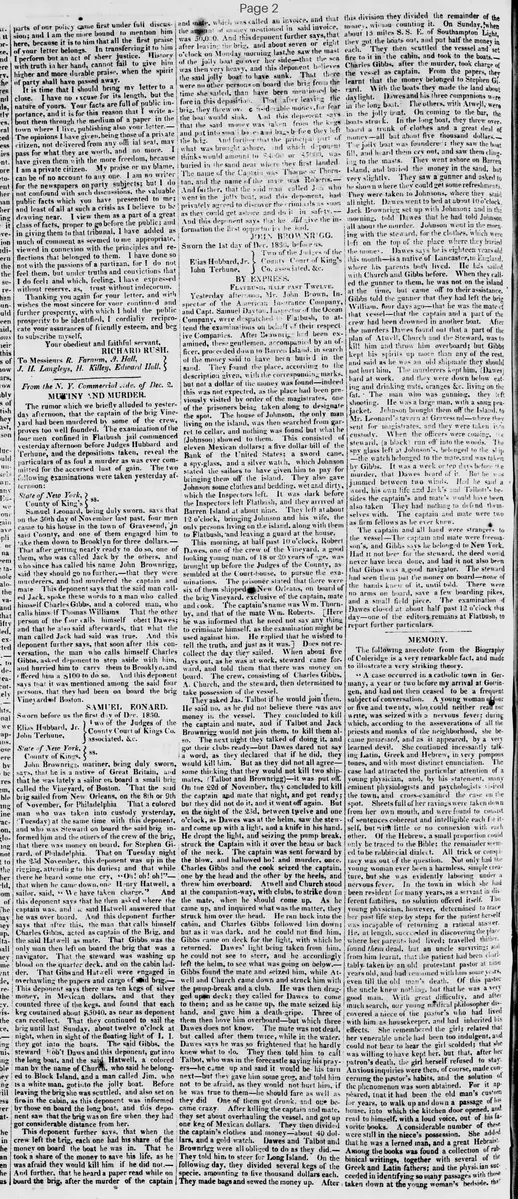
MUTINY AND MURDER.
The rumor which we briefly alluded to yesterday afternoon, that the captain of the brig Vineyard had been murdered by some of the crew, proves too well founded. The examination of the four men confined in Flatbush jail commenced yesterday afternoon before Judges Hubbard and Terhune, and the depositions taken, reveal the particulars of as foul a murder as was ever committed for the accursed lust of gain. The two following examinations were taken yesterday afternoon:
State of New York,
County of King's
ss.
Samuel Leonard, being duly sworn, says that on the 30th day of November last past, four men came to his house in the town of Gravesend, in said County, and one of them engaged him to take them down to Brooklyn for three dollars. That after getting nearly ready to do so, one of them, who was called Jack by the others, and who since has called his name John Brownrigg, said they should go no further, that they were murderers, and had murdered the captain and mate. This deponent says that the said man called Jack, spoke these words to a man who called himself Charles Gibbs, and a colored man, who calls himself Thomas Williams. That the other person of the four calls himself Robert Dawes; and that he also said afterwards, that what the man called Jack had said was true. And this deponent further says, that soon after this conversation, the man who calls himself Charles Gibbs, asked deponent to step aside with him, and hurried him to carry them to Brooklyn, and offered him $100 to do so. And this deponent says that it was mentioned among the said four persons, that they had been on board the brig Vineyard of Boston.
SAMUEL LEONARD.
Sworn before us the first day of Dec. 1830.
Two of the Judges of the
County Court of Kings Co.
Elias Hubbard, Jr.
John Terhune,
associated, &c.
State of New York,
County of Kings,
ss.
John Brownrigg, mariner, being duly sworn, says, that he is a native of Great Britain, and that he was lately a sailor on board a small brig called the Vineyard, of Boston. That the said brig sailed from New Orleans, on the 8th or 9th of November, for Philadelphia. That a colored man who was taken into custody yesterday, (Tuesday) at the same time with this deponent, and who was Steward on board the said brig, informed him and the others of the crew of the brig, that there was money on board, for Stephen Girard, of Philadelphia. That on Tuesday night the 23d November, this deponent was up in the rigging, attending to his duties; and that while there he heard some one cry, "Oh! oh! oh!" that when he came down, one Henry Atwell, a sailor, said, "We have taken charge." And this deponent says that he then asked where the captain was, and Atwell answered that he was overboard. And this deponent further says that after this, the man that calls himself Charles Gibbs, acted as captain of the Brig, and the said Atwell as mate. That Gibbs was the only man then left on board the brig that was a navigator. That the steward was washing up blood on the quarter deck, and on the cabin ladder. That Gibbs and Atwell were engaged in overhauling the papers and cargo of said brig. This deponent says there was ten kegs of silver money, in Mexican dollars, and that they counted three of the kegs, and found that each keg contained about $5040, as near as deponent can recollect. That they continued to sail the brig until last Sunday, about twelve o'clock at night, when in sight of the floating light of L. I. they got into the boats. The said Gibbs, the steward Robert Dawes and this deponent, got into the long boat, and the said Atwell, a colored man by the name of Church, who said he belonged to Block Island, and a man called Jim, who is a white man, got into the jolly boat. Before leaving the brig she was scuttled, and also set on fire in the cabin, as this deponent was informed by those on board the long boat, and this deponent saw that the brig was on fire when they had got considerable distance from her.
This deponent further says, that when the crew left the brig, each one had his share of the money on board the boat he was in. That he took a share of the money to save his life, as he was afraid they would kill him if he did not. And further, that he heard a paper read while on board the brig, after the murder of the captain and mate, which was called an invoice, and that the amount of money mentioned in said invoice, was $50,000. And this deponent further says, that after leaving the brig, and about seven or eight o'clock on Monday morning last, he saw the mast of the jolly boat go over her side--that the sea was then very heavy, and this deponent believes the said jolly boat to have sunk. That there were no other persons on board the brig from the time she sailed, than have been mentioned before in this deposition. That after leaving the brig, they threw overboard a considerable amount of money, for fear the boat would sink. And this deponent says that the said money was taken from the kegs and put into small boxes and bags before they left the brig. And further that the principal part of what was brought ashore, and which deponent thinks would amount to $34,000 or $35,000, was buried in the sand near where they first landed. The name of the Captain was Thorne or Thornton, and the name of the mate was Roberts. And further, that the said man called Jim who went in the jolly boat, and this deponent, had privately agreed to discover the criminals as soon as they could get ashore and do it in safety. And this deponent says that he did give the information the first opportunity he had.
JOHN BROWNRIGG.
Sworn the 1st day of Dec. 1830. before us.
Two of the Judges of the
County Court of King's
Elias Hubbard, Jr.
John Terhune,
Co. associated, &c.
BY EXPRESS.
Flatbush, Half past Twelve.
Yesterday afternoon, Mr. John Brown, Inspector of the American Insurance Company, and Capt. Samuel Dayton, Inspector of the Ocean Company, were despatched to Flatbush, to attend the examinations on behalf of their respective Companies. After Brownrigg had been examined, these gentlemen, accompanied by an officer, proceeded down to Barren Island, in search of the money said to have been buried in the sand. They found the place, according to the description given, with the corresponding marks, but not a dollar of the money was found--indeed this was not expected, as the place had been previously visited by order of the magistrates, one of the prisoners being taken along to designate the spot. The house of Johnson, the only man living on the island, was then searched from garret to cellar, and nothing was found but what he (Johnson) showed to them. This consisted of eleven Mexican dollars; a five dollar bill of the Bank of the United States; a sword cane, a spy-glass, and a silver watch, which Johnson stated the sailors to have given him to pay for bringing them off the island. They also gave Johnson some clothes and bedding, wet and dirty, which the Inspectors left. It was dark before the Inspectors left Flatbush, and they arrived at Barren Island at about nine. They left at about 12 o'clock, bringing Johnson and his wife, the only persons living on the island, along with them to Flatbush, and leaving a guard at the house.
This morning, at half past 10 o'clock, Robert Dawes, one of the crew of the Vineyard, a good looking young man, of 18 or 20 years of age, was brought up before the Judges of the County, assembled at the Court-house, to pursue the examinations. The prisoner stated that there were six of them shipped in New Orleans, on board of the brig Vineyard, exclusive of the captain, mate and cook. The captain's name was Wm. Thornby, and that of the mate Wm. Roberts. [Here he was informed that he need not say any thing to criminate himself, as the examination might be used against him. He replied that he wished to tell the truth, and just as it was.] Does not recollect the day they sailed. When about five days out, as he was at work, steward came forward, and told them that there was money on board. The crew, consisting of Charles Gibbs, A. Church, and the steward, then determined to take possession of the vessel. They asked Jas. Talbot if he would join them. He said no, as he did not believe there was any money in the vessel. They concluded to kill the captain and mate, and if Talbot and Jack Brownrigg would not join them, to kill them also. The next night they talked of doing it, and got their clubs ready--but Dawes dared not say a word, as they declared that if he did, they would kill him. But as they did not all agree--some thinking that they would not kill two shipmates, (Talbot and Brownrigg)--it was put off. On the 22d of November, they concluded to kill the captain and mate that night, and got ready; but they did not do it, and it went off again. But on the night of the 23d, between twelve and one o'clock, as Dawes was at the helm, saw the steward come up with a light, and a knife in his hand. He dropt the light, and seizing the pump break, struck the Captain with it over the head or back of the neck. The captain was sent forward by the blow, and hallowed ho! and murder, once. Charles Gibbs and the cook seized the captain, one by the head and the other by the heels, and threw him overboard. Atwell and Church stood at the companion-way, with clubs, to strike down the mate, when he should come up. As he came up, and inquired what was the matter, they struck him over the head. He ran back into the cabin, and Charles Gibbs followed him down; but as it was dark, and he could not find him, Gibbs came on deck for the light, with which he returned: Dawes' light being taken from him, he could not see to steer, and he accordingly left the helm, to see what was going on below. Gibbs found the mate and seized him, while Atwell and Church came down and struck him with the pump-break and a club. He was then dragged upon deck; they called for Dawes to come to them; and as he came up, the mate seized his hand, and gave him a death-gripe. Three of them then hove him overboard--but which three Dawes does not know. The mate was not dead, but called after them twice, while in the water. Dawes says he was so frightened that he hardly knew what to do. They then told him to call Talbot, who was in the forecastle saying his prayers--he came up and said it would be his turn next; but they gave him some grog, and told him not to be afraid, as they would not hurt him, if he was true to them--he should fare as well as they did. One of them got drunk, and one became crazy. After killing the captain and mate, they set about overhauling the vessel, and got up one keg of Mexican dollars. They then divided the captain's clothes and money--about 40 dollars, and a gold watch. Dawes and Talbot and Brownrigg were all obliged to do as they did. They told him to steer for Long Island. On the following day, they divided several kegs of the specie, amounting to five thousand dollars each. They made bags and sewed the money up. After this division they divided the remainder of the money, without counting it: On Sunday, when about 15 miles S. S. E. of Southampton Light, they got the boats out, and put half the money in each. They then scuttled the vessel and set fire to it in the cabin, and took to the boats. Charles Gibbs, after the murder, took charge of the vessel as captain. From the papers, they learnt that the money belonged to Stephen Girard. With the boats they made the land about daylight. Dawes and his three companions were in the long boat. The others, with Atwell, were in the jolly boat. On coming to the bar, the boats struck. In the long boat, they threw overboard a trunk of clothes and a great deal of money--all but about five thousand dollars. The jolly boat was foundered: they saw the boat fill, and heard them cry out, and saw them clinging to the masts. They went ashore on Barren Island, and buried the money in the sand, but very slightly. They saw a gunner and asked to be shown where they could get some refreshments. They were taken to Johnson's, where they staid all night. Dawes went to bed at about 10 o'clock. Jack Brownrigg set up with Johnson; and in the morning, told Dawes that he had told Johnson all about the murder. Johnson went in the morning with the steward, for the clothes, which were left on the top of the place where they buried the money. Dawes says he is eighteen years old this month--is a native of Lancaster, in England, where his parents both lived. He has sailed with Church and Gibbs before. When they called the gunner to them, he was not on the island at the time, but came off to their assistance. Gibbs told the gunner that they had left the brig William, four days ago--that he was the mate of that vessel--that the captain and a part of the crew had been drowned in another boat. After the murders Dawes found out that a part of the plan of Atwell, Church and the Steward, was to kill him and throw him overboard; but Gibbs kept his spirits up more than any of the rest, and said as he was an old shipmate they should not hurt him. The murderers kept him, (Dawes) hard at work, and they were down below eating and drinking nuts, oranges &c. living on the fat. The man who was gunning, they left shooting. He was a large man, with a snug pea-jacket. Johnson brought them off the Island, to Mr. Leonard's tavern at Gravesend--where they sent for magistrates, and they were taken into custody. When the officers were coming, the steward, (a black) run off into the woods. The spy glass left at Johnson's, belonged to the ship--the watch belonged to the mate, and was taken by Gibbs. It was a week or ten days before the murder, that Dawes heard of it. But he was jammed between two winds. Had he said a word, his own life and Jack's and Talbot's besides the captain's and mate's would have been also taken. They had nothing to defend themselves with. The captain and mate were two as firm fellows as he ever knew. The captain and all hands were strangers to the vessel--The captain and mate were freeman's, and Gibbs says he belonged to New York. Had it not been for the steward, the deed would never have been done, and had it not also been that Gibbs was a good navigator. The steward had seen them put the money on board--none of the hands knew of it, until told. There were no arms on board, save a few boarding pikes, and a small field piece. The examination of Dawes closed at about half past 12 o'clock this day--one of the editors remains at Flatbush, to report further particulars.
What sub-type of article is it?
What keywords are associated?
What entities or persons were involved?
Where did it happen?
Domestic News Details
Primary Location
King's County, New York
Event Date
November 23, 1830
Key Persons
Outcome
captain and mate murdered and thrown overboard; jolly boat sank with atwell, church, and jim, presumed drowned; brig scuttled and burned; money divided and partially buried, some thrown overboard; four men examined and confined.
Event Details
Crew of brig Vineyard mutinied on November 23, 1830, murdering captain and mate for $50,000 in Mexican dollars destined for Stephen Girard. Led by Charles Gibbs, they took control, sailed to Long Island, abandoned and burned the ship, landed on Barren Island, buried money. Examinations of John Brownrigg and Robert Dawes on December 1 revealed details; search for money unsuccessful.